
Home › Guides › Learn to Read
My Child Knows Sounds but Cannot Blend: What to Do
 Detective HootSee every case →
My child knows the letter sounds but cannot blend them into words.What we found: the short answer
Here is what to do when your child knows the letter sounds but cannot blend. Knowing sounds and blending them are two different skills. Start with two-sound words like at and up. Hold the first sound until the next one, with no gap. Slide your voice through the whole word.
By Sound It Out. Updated 2026-10-15.
1Why knowing the sounds but not blending them happens
Knowing that the letter s makes the sound “sss” is one skill. Holding that sound in mind while moving to the next sound, and the next, without losing the first one, is a different skill called blending. Many children learn several letter sounds well before they can join them into a word, and that gap is common and expected. It does not mean your child is behind, only that blending needs its own turn of practice.
Your child does not need to know every letter sound before starting to blend. Blending can start as soon as a child knows the first few sounds taught, such as s, a, t and p. With just those four sounds, a child can already blend at, sat, and tap. Waiting for all twenty-six letters only delays reading practice that your child is ready for right now.
2What your child needs to know first, and a quick check
Before blending practice will work well, your child needs a small group of letter sounds said cleanly, with no extra sound added. The sound for t should be a tiny, clipped “t”, with no extra sound after it. The sound for s should be a clean “sss”, held as long as you like. Pick four or five sounds your child already knows well, such as s, a, t, p, and m, and use only those to start.
To check, say each sound alone and ask your child to say it back. Try “sss,” “aaa,” “t,” “p,” and “mmm.” If any sound comes out with an extra sound added after it, work on that sound first. A quick check like this takes a few minutes and tells you exactly where to start blending practice.
3Step 1: Hold the first sound until the next one
Say the first sound and hold it, without a gap, until the next sound starts: “aaat” for at, then “sssaaat” for sat. Then say the whole word the normal way: “sat.” Show this out loud first, two or three times, before asking your child to try it. Use words such as am, sun, mop, tan, and sip. Hold the stretchy sound at the start of each one for a full second or two before sliding into the rest of the word.
Start with sounds that can stretch, like s, m, f, and a, since they are easiest to hold. Quick sounds, like b, d, t, p, k, and g, cannot be held. Keep them short and clipped and move into the next sound right away. Never add an extra sound after a quick letter, since that makes a word like “tap” hard to hear.
4Step 2: Start with two-sound words before three
Begin with words made of only two sounds, since these are the easiest to blend. Try at, in, up, am, and on. Say each sound, hold the first one, and slide into the second: “aaat,” then “at.” These short words let your child feel what blending is. There is no third sound to keep track of yet. Keep practicing two-sound words until this feels easy before adding a third sound.
Once two-sound words feel easy, move to real three-letter words, such as sat, sun, map, hop, and mom. Say it the same way: hold the first sound, slide into the middle sound, then the last sound, then say the whole word smoothly. Skip long words or made-up words at this stage. The goal is to build the feel of blending, not to test memory.
 Practice this in the free reading appReading games your child can play on a phone, tablet or computer. Every word can be sounded out.Open the app
5Step 3: Point under each letter, then slide your finger
Point under each letter as you say its sound, then slide your finger smoothly under the whole word as you blend it together. Some children blend better when they move a finger, a small counter, or their own hand along the word. Sitting still and only looking at the letters is harder for them. Try this with words like tap, dig, run, hot, and bus, sliding your finger from left to right as you go.
If your child guesses instead of sounding out, cover the word and show one letter at a time. Say, “Look again. Touch every letter.” This stops a guess from being rewarded and brings your child's eyes back to each sound in order. Never finish a guess for your child or confirm a wrong guess, even to be encouraging.
6Step 4: Bring back known sounds and words every day
Each session, mix in a few words your child already blended well before, along with one or two new ones. For example, review sat and tap, then try a new word like pin or dot. Bringing back known words first builds confidence and warms up the blending muscle before asking for something new.
This daily review also tells you where blending is solid and where it is still shaky. Your child may blend sat easily on Monday but have trouble with the same word on Friday. That is normal too, and it just means a few more days of the same practice.
7What to do when blending still is not working
The most common problem is a child saying each sound on its own with a gap, like “s... a... t,” instead of sliding them together. What helps is to go back to holding the first sound out loud yourself, longer than feels natural. Your child hears there is no pause: “sssss-a-t.” Practice this with just one word for a few minutes until the gap goes away. Then try another word.
A second common problem is a child who can blend with you there but freezes alone. For this, say the first sound together, then let your child finish the word alone, slowly handing over more of the word each day. A third problem is guessing based on the first letter only, such as saying “big” for bug. Cover the word and show it one letter at a time to stop this.
8How much practice, how often, and what a normal week looks like
Blending takes repeated, short practice, not long sessions. Five to ten minutes a day, with five to eight words, works far better than one long session once a week. Keep the mood light. If your child gets frustrated or tired, stop, do something else, and come back to it later the same day or the next day.
A normal week might look like this: Monday and Tuesday, practice two-sound words like at and up. Wednesday and Thursday, move to three-sound words like sat and hop, mixing in Monday's words too. Friday, review everything from the week with no new words, just to build confidence. Children differ, so some may need an extra week at each stage.
9How to tell your child is ready to move on, and what comes next
Your child is ready to move on when they blend three-letter words like sat, hop, and run smoothly. You no longer hold the first sound for them, and there are no long pauses between sounds. Another sign is blending a brand new three-letter word on the first try, without any practice on it beforehand. That shows your child can blend without thinking, not just from memory.
Once that feels solid, move to four-letter words such as stop, fast, and swim, which add one more sound to track. After that, your child is ready for simple word families, and later short sentences made entirely of words they can sound out. Keep using the same hold-and-slide method, since it works at every stage.
Quick tips
 Start with two-sound words, like at and up, before moving to three sounds.
 Choose stretchy sounds, such as s, m, and f, to practice holding first.
 Show blending out loud two or three times before asking your child to try.
 Keep practice sessions to five or ten minutes, once or twice a day.
 If your child guesses, cover the word and show one letter at a time.
 Review words your child already blended well before adding new ones each day.
 Stay calm if your child gets stuck, and come back to it later the same day.
Make these worksheets, free
Not sure where to start? Get a free plan for your child
Want the whole reading path, in order?The Reading Program gives you fifteen 10-day plans in the order reading is built, with a short video for you every day.See the Reading ProgramFree games that help
 Listen and Say the WordYou say the sounds slowly, your child says the whole word. No letters to look at, so it trains the ear first.Play freeBuild the WordYour child hears a word and taps the letter tiles in the right order to build it.Play free
 Read the WordOne short word at a time, such as sat, pin or dog. Every word uses only the sounds of the level you choose.Play free
Printables that help
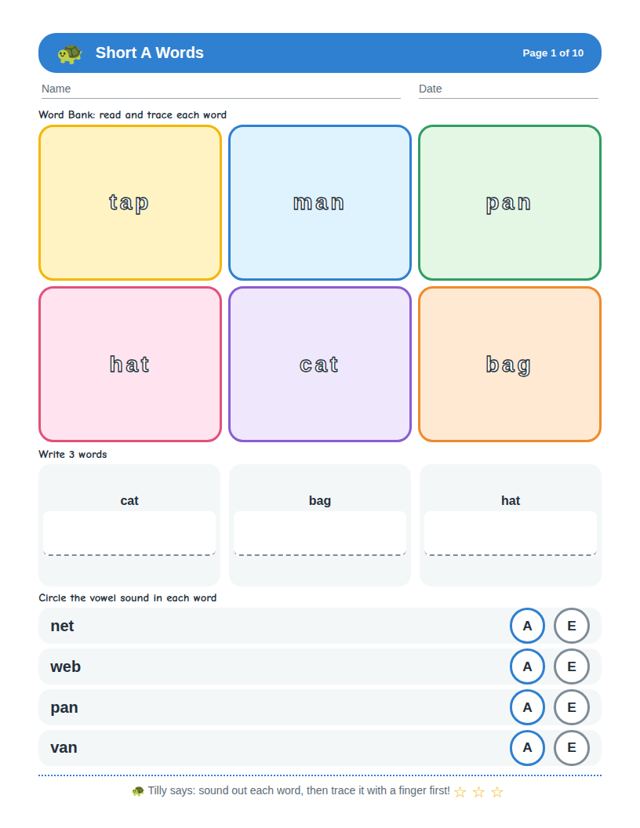
Free Short A Words Worksheets
3 free pages · Ages 5 to 7Short a words worksheets, CVC word family practice.
Get the free pages FREE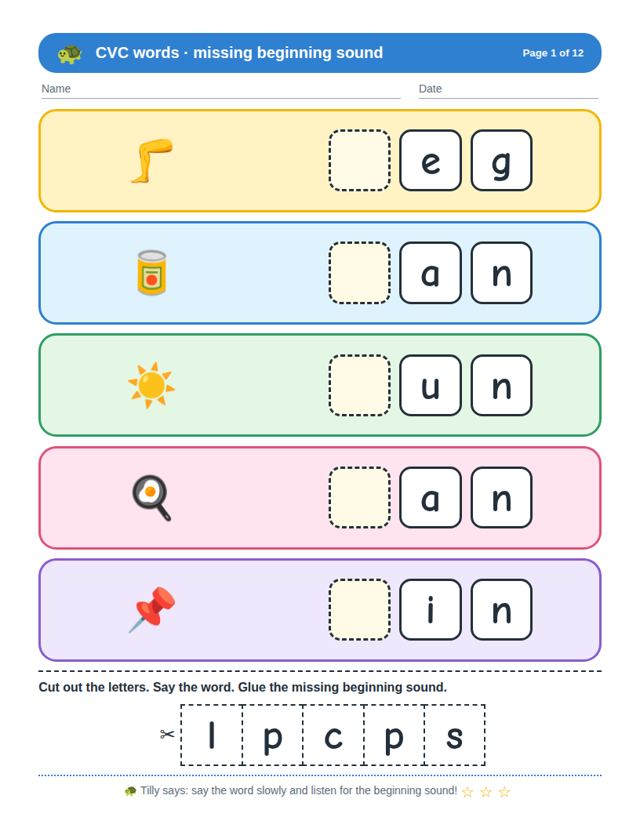
Free CVC Cut and Paste Worksheets
3 free pages · Ages 4 to 7CVC cut and paste worksheets for beginning, middle and ending sounds.
Get the free pages FREE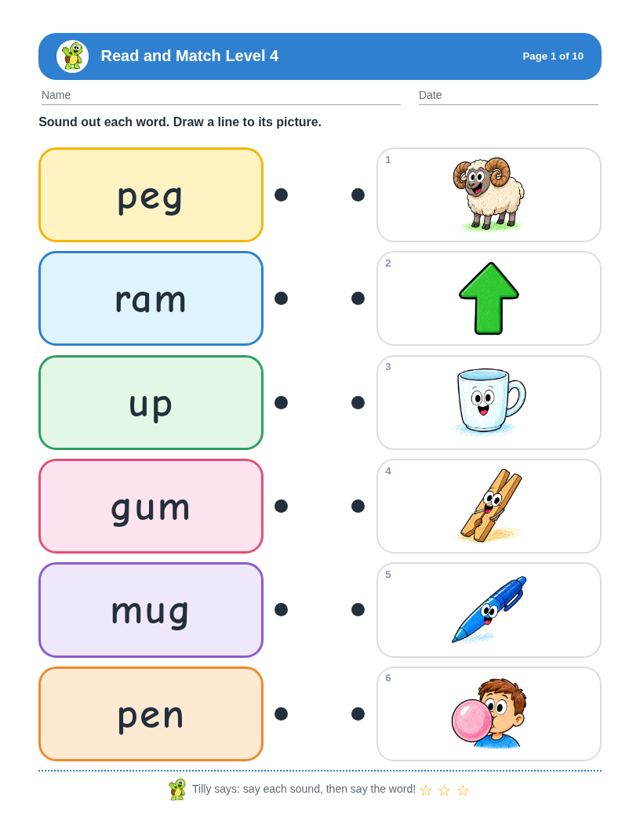
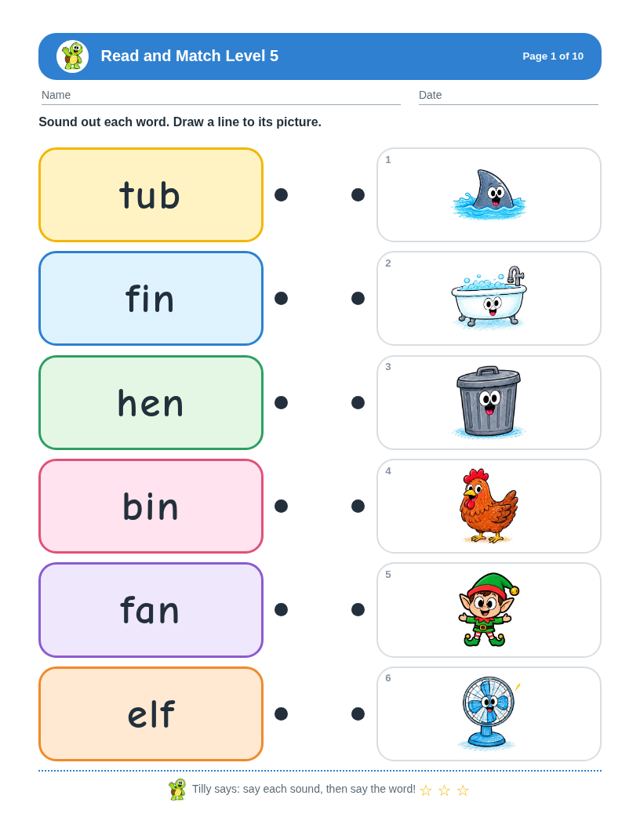
Read and Match Level Bundle
65 pages · Ages 4 to 6All 5 read and match level worksheet packs in one download.
See inside FREE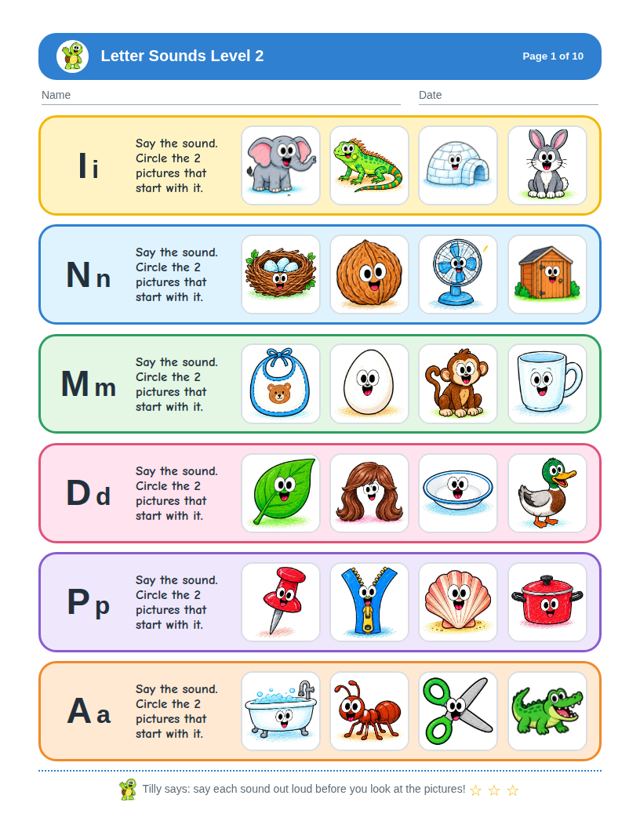
Letter Sounds Level Bundle
91 pages · Ages 3 to 5All 7 letter sounds level worksheet packs in one download.
See insideGood questions
Why can my child say every letter sound but not blend them into a word?
Knowing sounds and blending are two different skills. Many children learn a lot of letter sounds before they learn to hold and slide them together. Blending needs its own practice with short, simple words, not more sound drills.
Does my child need to know all 26 letter sounds before learning to blend?
No. Blending can start as soon as a child knows a small group of sounds, such as s, a, t, and p. Waiting for all twenty-six letters only delays reading practice your child is ready for right now.
What if my child can blend out loud but not when looking at the letters?
This is common, and it usually means the finger-sliding step needs more practice. Point under each letter as your child says its sound, then slide your finger under the whole word. This way the eyes and the voice move together at the same pace.
How long does it usually take to learn to blend?
This differs a lot from child to child, and there is no set number of weeks to expect. Staying calm and keeping up short daily practice matters more than speed. If you see no change after steady practice, tell your child's teacher.
Should I use letter sound apps or flash cards to help with blending?
Either can help with sound review, but blending practice with real words, said out loud together, matters more than any single tool. Choose whatever keeps your child calm and willing to keep trying, and skip anything that adds pressure or a timer.
More guides
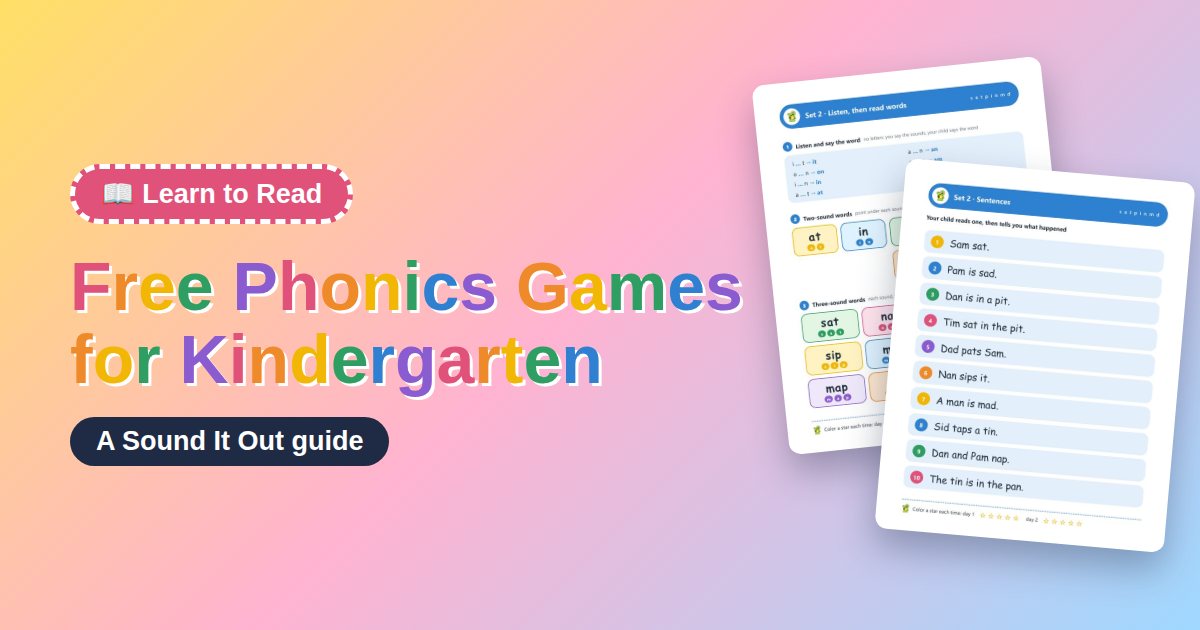 Learn to ReadFree Phonics Games for KindergartenFree phonics games for kindergarten that build real reading: listening, blending, word building and sentence games, with tips to make each one count.Read the guide
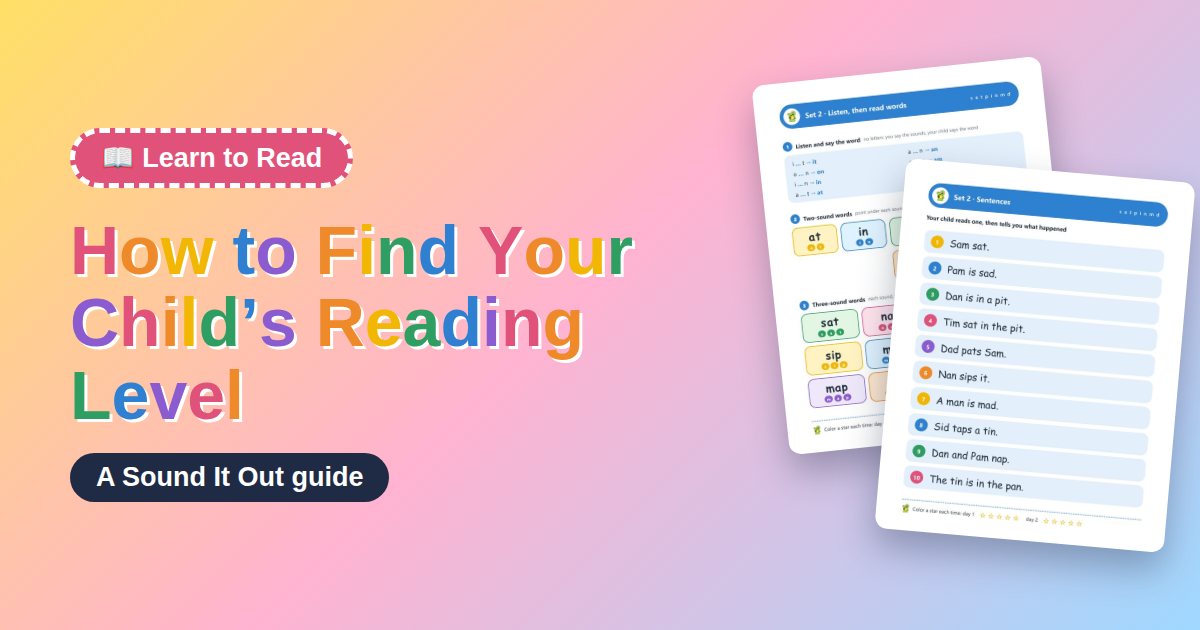 Learn to ReadHow to Find Your Child’s Reading LevelHow to find your child’s reading level at home: check each reading step in order, listen to your child read a short page, and choose books that fit.Read the guide
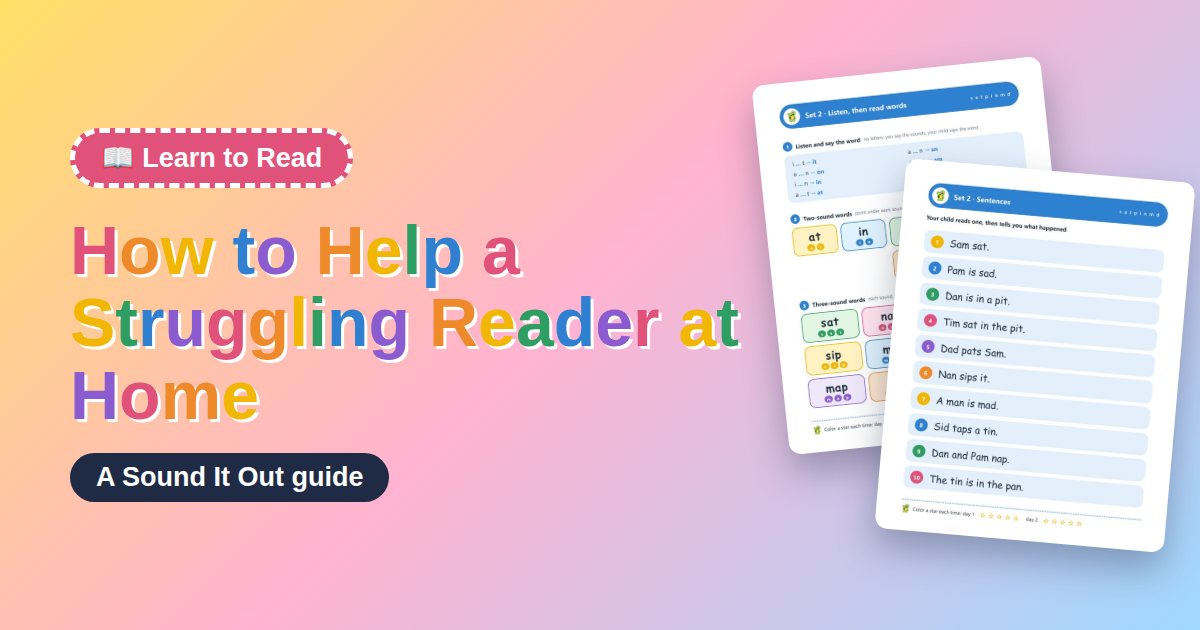 Learn to ReadHow to Help a Struggling Reader at HomeHow to help a struggling reader at home: find the step that is hard, teach it in a few minutes a day, read together, and work with the school on support.Read the guide
- Free 3-minute checkPutting sounds together
- The 10-day planFrom Sounds to Words
- What the research saysBlending Sounds Into Words: What the Research Says
- What the research saysDecodable Books for Beginners: What the Research Says
- GuideFree Phonics Games for Kindergarten
- GuideHow to Help a Child With Vowel Sounds
- GuideHow to Teach Phonics at Home: A Step-by-Step Guide
Want the next sheet made for your child?
The packs on this site are free. The One Sheet goes further: one sheet a day, made for your child from what you tell us happened.
- No planning. Today’s sheet is ready every day.
- Made for your child. The next sheet is built from what you tell us.
- A few minutes of your time. Paper, not a screen.
See The One Sheet · $9.99 a month
Or try the 10-day plan: From Sounds to Words, $19 one timeOr do the free 3-minute check first