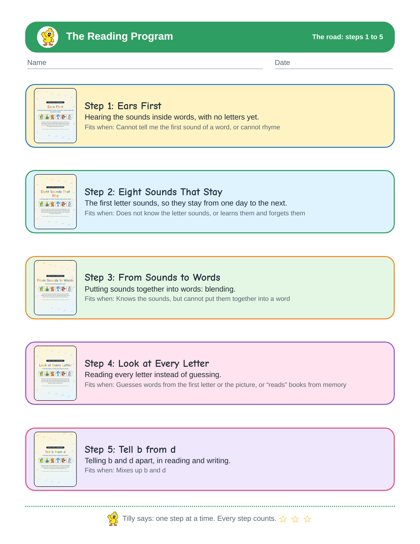
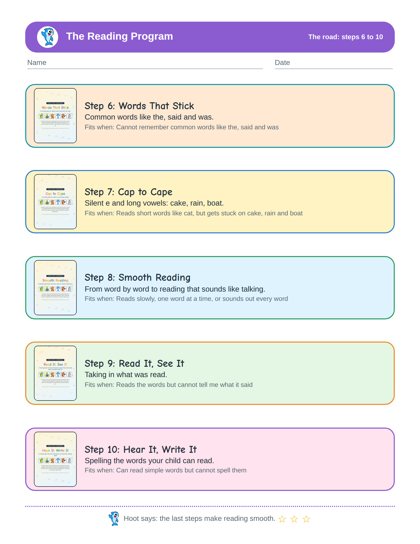
Is this your child?
“Cannot tell me the first sound of a word, or cannot rhyme”“Does not know the letter sounds, or learns them and forgets them”“Knows the sounds, but cannot put them together into a word”“Guesses words from the first letter or the picture, or “reads” books from memory”“Mixes up b and d”“Cannot remember common words like the, said and was”
Each of these is one step that is not firm yet. Everything after it wobbles. The program finds that step, teaches it, and moves on.
The kind of teaching it uses
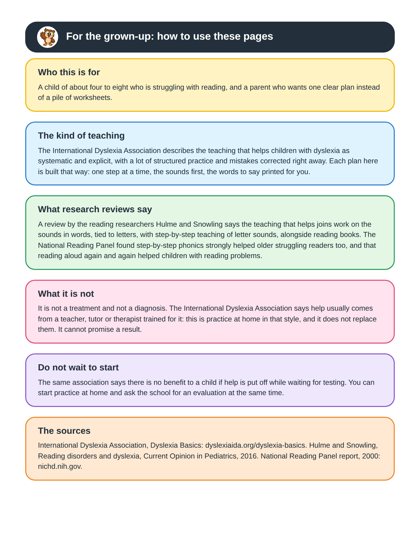
The International Dyslexia Association describes the teaching that helps children with dyslexia as systematic and explicit, with a lot of structured practice and mistakes corrected right away.1 A research review by Hulme and Snowling says the teaching that helps joins work on the sounds in words, tied to letters, with step-by-step teaching of letter sounds, alongside reading books.2
The National Reading Panel found that step-by-step phonics teaching strongly helped word reading for older struggling readers as well as for the youngest children, and that reading aloud again and again helped students with reading problems.3
Every plan in this program is built that way: the sounds first, one step at a time, the words to say printed for you, and a check before you move on.
What it is notIt is not a treatment and not a diagnosis, and it cannot promise a result. The International Dyslexia Association says help usually comes from a teacher, tutor or therapist trained for it: this is practice at home in that style, and it does not replace them.1 If you are worried about dyslexia, read Signs of dyslexia in kids, and ask the school about an evaluation. You do not have to wait for one to start practice at home.
Good questions
Is this a program for dyslexia?
It is practice at home in the style the International Dyslexia Association describes for children with dyslexia: systematic and explicit, one step at a time, with mistakes corrected right away. It is not a treatment and not a diagnosis, and it does not replace a teacher, tutor or therapist trained for it.
Does my child have to do all ten plans?
No. Most children start partway along. Find the first step that is not firm, do that plan’s day 1 check, and go on from there. A plan whose day 1 check shows the step is firm can be skipped.
How long does the program take?
Each plan is ten days, about five minutes a day from you. How many plans your child needs depends on where they start. Some steps need a second round.
My child is 7 or 8. Is it too late?
No. The National Reading Panel found that step-by-step phonics teaching strongly helped word reading for older struggling readers too. Tell the teacher what you see as well, and ask what the school’s reading checks have shown.
What do I get?
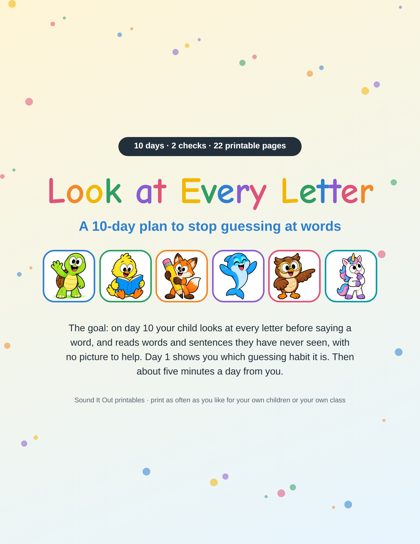
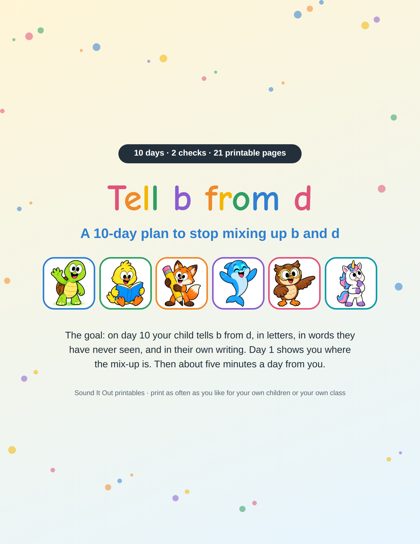
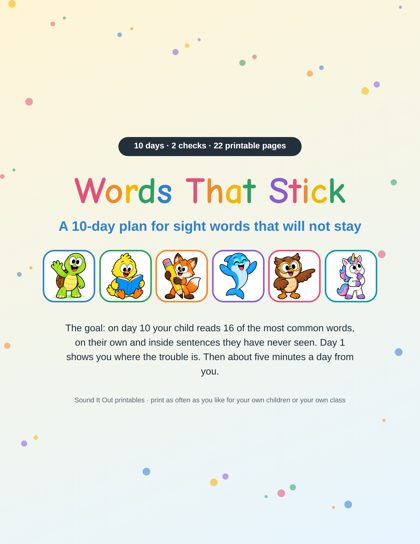
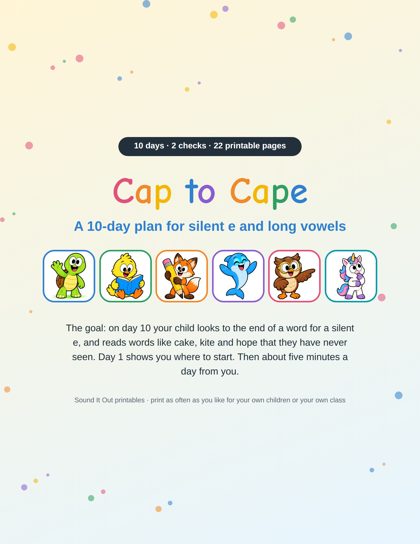
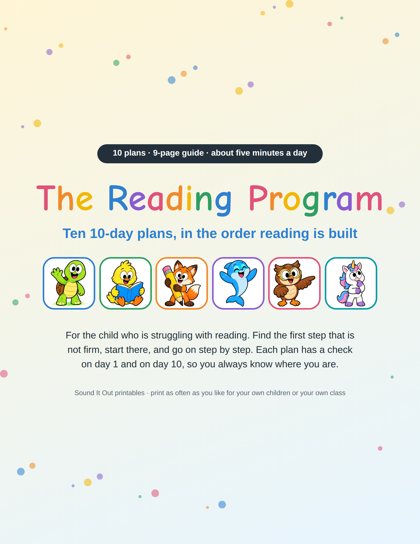
All ten plans: each one a printable book in color and ink-saving black and white, US Letter and A4, with a short video for you every day and sound tracks for your child on some days. And the program guide: the road, where to start, and a chart for the whole program.
Do I need a printer?
Yes. The pages are made to be printed, on plain paper. The black-and-white copy uses very little ink.
What if it does not suit my child?
Email us within 30 days and we will refund you.





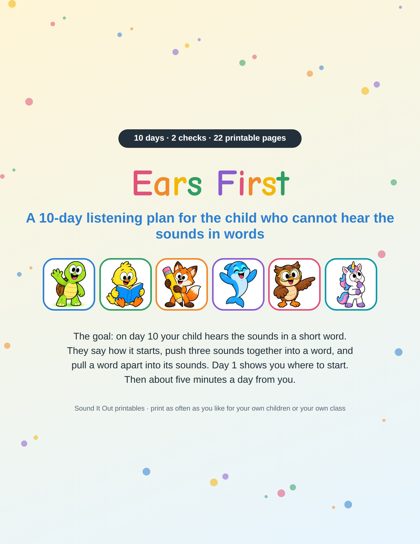
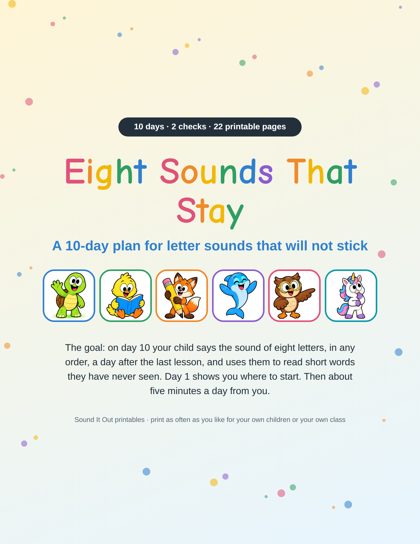
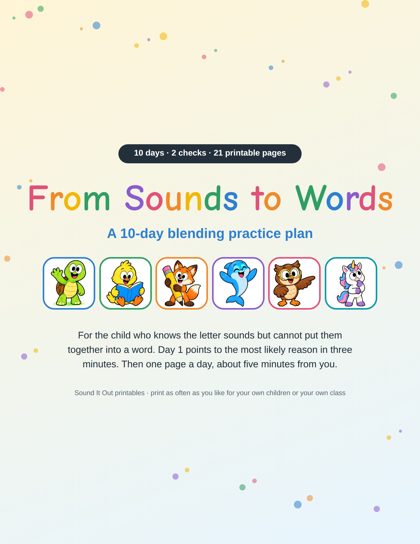
 10 plans
 A video every day