
Home › Guides › Learn to Read
Home › Guides › Learn to Read
 Detective SplashSee every case →
How do I know what reading level my child is at?What we found: the short answer
Here is how to find your child’s reading level at home: check the reading steps in order. Can your child say letter sounds, blend short words, read common words, read letter teams and read a page smoothly? The first step that is not firm shows your child’s level and what to practice.
By Julz, founder of Sound It Out. Updated 2026-10-15.
A reading level describes what your child can read now and what comes next.
Schools use different systems, such as letters, numbers or grade levels. They are not all the same.
For a beginning reader, the most useful level is the phonics step your child is on.
Knowing the step tells you exactly what to practice and which books fit.
A level is a starting point, not a label. It changes as your child grows.
For parents, the most useful question is not what letter level your child is at. It is what your child can read now, and what to practice next.
Every child moves through the same steps, but at their own speed.
Step 1: hearing sounds. Can your child tell you the first sound in sun?
Step 2: letter sounds. Does your child know the sound of each letter?
Step 3: blending. Can your child read short words like map and pin?
Step 4: common words and letter teams. Does your child read the, was, ship and chin?
Step 5: longer patterns and smooth reading. Does your child read cake, rain and a short page without stopping on every word?
Do these checks on a calm day, one step at a time, in a few minutes each. Stop if your child gets tired.
A step is firm when your child does it correctly on several different days.
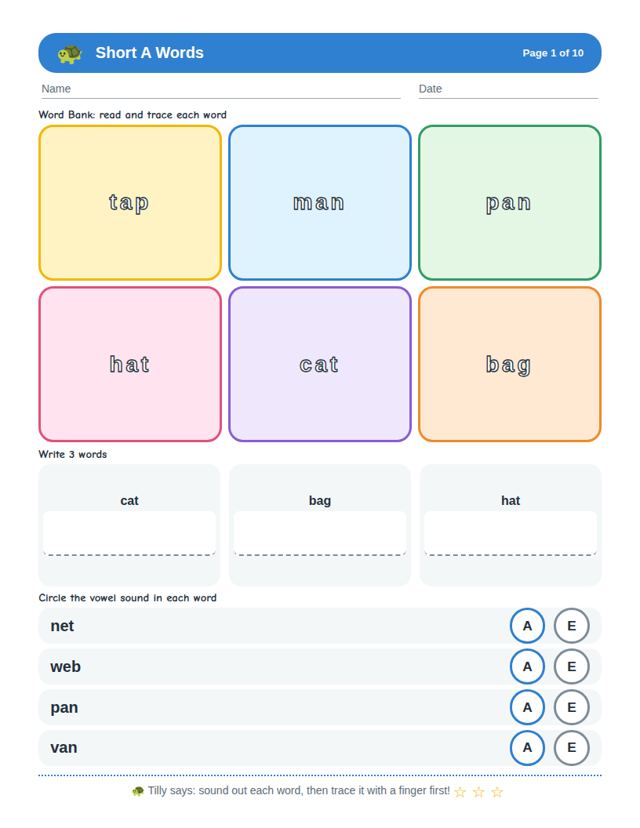
Choose a short page your child has not seen before. Ask your child to read it aloud.
Listen for guesses, long pauses and skipped words. Do not correct during the reading.
Count the words read correctly. Most words right means the page fits.
Ask one or two questions about the page to check understanding.
Try a page from the next step up if this one was easy.
Use a page with words your child has not memorized. A favorite book can hide what your child really reads.
Avoid correcting during the check. You want to see what your child does alone.
Your child reads almost every word correctly, with a few slow spots.
Your child sounds out new words instead of guessing.
Your child can tell you what happened.
Your child is not frustrated, and may even want to read it again.
If many words are missed, the book is too hard for reading alone. It may still be great to read aloud together.
This is often called reading at the right level: easy enough to read alone, but with a little challenge.
Books slightly too hard for your child are perfect for reading aloud together.
 Practice this in the free reading appReading games your child can play on a phone, tablet or computer. Every word can be sounded out. No sign-up.Open the app
Many schools use letter levels for books, such as A, B and C. Others use numbers or grade levels.
These systems look at things like sentence length and pictures, not only phonics.
Ask the teacher which system the class uses and what your child’s level is.
Ask what skills your child is working on. Skills are more useful than a letter alone.
Use the phonics step at home to choose practice, and the school level to choose library books.
If your child’s school level seems higher than what you see at home, share your notes with the teacher. Both views help.
Library books often show a level on the back cover.
A short free check can walk you through each step with plain questions and simple tasks.
A reading level finder asks a few questions about what your child can do and suggests where to start.
Printable reading assessment sheets let you listen to your child read a list of letters or words.
Use the same sheet again after a few weeks to see progress.
None of these are tests or diagnoses. They help you choose what to practice.
Use the results from these tools to pick one step to work on. Trying to fix everything at once is overwhelming.
If you are unsure, start at an earlier step. Easy success is a good warm-up.
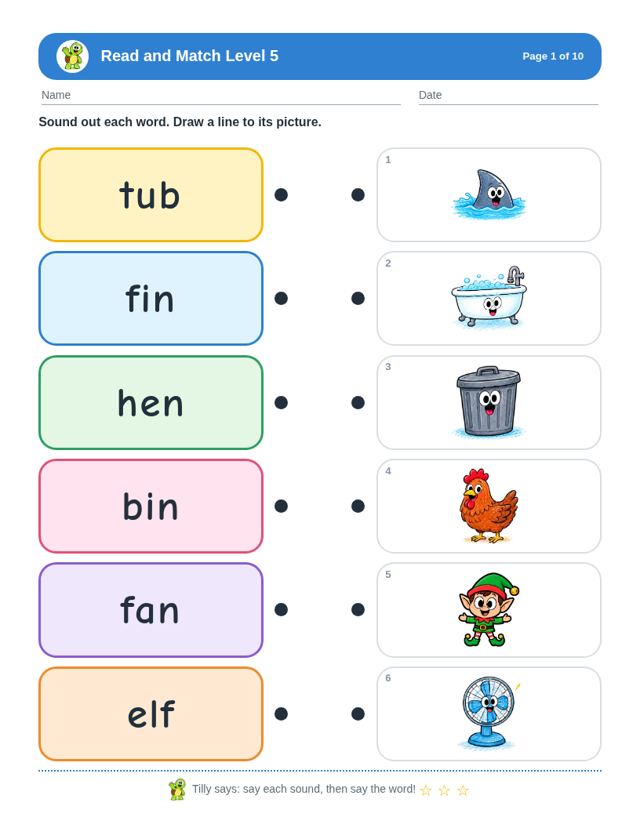
Once you know the step, practice that step a few minutes a day.
Choose decodable books that use only the sounds your child knows.
Review the earlier steps quickly to keep them strong.
Check again every few weeks. Move up when the current step is easy.
Keep reading aloud harder books for fun and new words.
Write down the step and the date. In a few weeks, check again and see what has changed.
Use decodable books that match the step your child is on.
Minute one and two: ask for the first sound in five spoken words, such as sun, map and fish. Minutes three and four: point to ten letters and ask for each sound.
Minutes five and six: read five short words like map, pin and hot. Minutes seven and eight: read five words with patterns, such as the, ship, chin, cake and rain.
Minutes nine and ten: read a short new page aloud, then answer one question about it.
Stop at the first part that is hard. That is the step to practice, and the place to start next time.
Write down the step your child is on and what you saw, such as knows 20 sounds, blends slowly.
Choose one small goal for the next two weeks, such as blending three-sound words without help.
Pick books and pages that match the step. Decodable books are ideal for early steps.
Practice the step for ten minutes a day, and read aloud for fun as well.
Share your notes with the teacher, and ask if school sees the same thing.
Check again in a few weeks. If the step is easy, move up. If not, keep going, and try a slightly different game.
Keep the check friendly. Say we are going to see what you already know, not you are taking a test. Children read better when they feel relaxed.
Remember that a level is about skills, not about how clever your child is. Every reader moves through the same steps, at their own pace.
Start from the first step that is not firm, even if it seems young for your child’s age.
Short daily practice on that step helps most children move forward.
Talk to the teacher about what you found and ask about extra support.
If you see signs of a reading difficulty, ask about an evaluation.
A structured plan can guide you through each step in order.
Starting from an earlier step is not going backward. It is building the base your child needs.
If your child struggles at every step, talk to the school soon.
Your child reads the current step’s words quickly and correctly.
Your child reads a new page at this level with few mistakes.
Your child starts to read words from the next step without help.
Your child enjoys reading more and asks for new books.
Then check the next step and choose new books to match.
Small signs of progress matter. Notice them, write them down, and share them with your child.
Moving up a level is a great moment to celebrate together.
 Check the reading steps in order.
 Listen to a short, new page.
 Do not correct during the check.
 Ask a question about the page.
 Choose books that fit the step.
 Check again every few weeks.
Not sure where to start? Get a free plan for your child
Want the whole reading path, in order?The Reading Program gives you ten 10-day plans in the order reading is built, with a short video for you every day.See the Reading Program Listen and Say the WordYou say the sounds slowly, your child says the whole word. No letters to look at, so it trains the ear first.Play free
 Build the WordYour child hears a word and taps the letter tiles in the right order to build it.Play free
 Read the WordOne short word at a time, such as sat, pin or dog. Every word uses only the sounds of the level you choose.Play free
Short a words worksheets, CVC word family practice.
Get the free pages FREE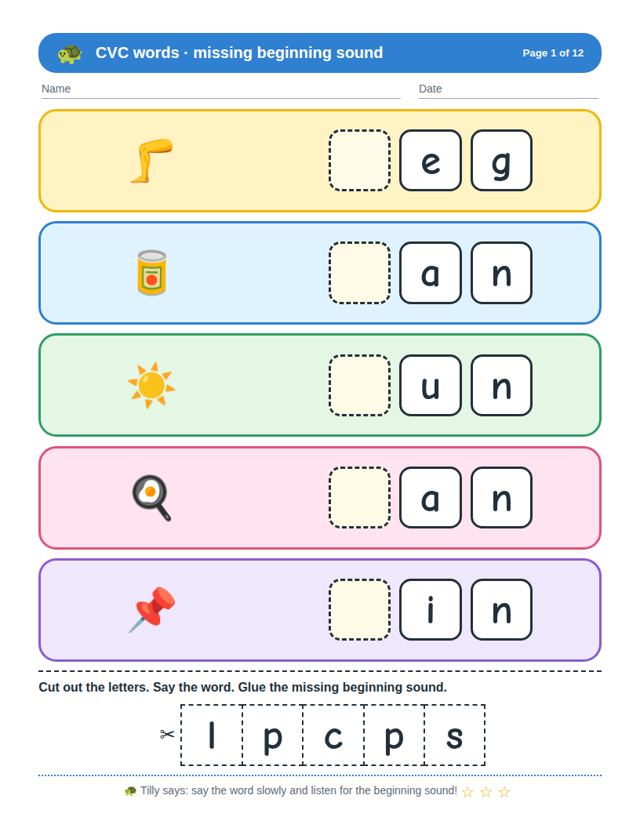
CVC cut and paste worksheets for beginning, middle and ending sounds.
Get the free pages $3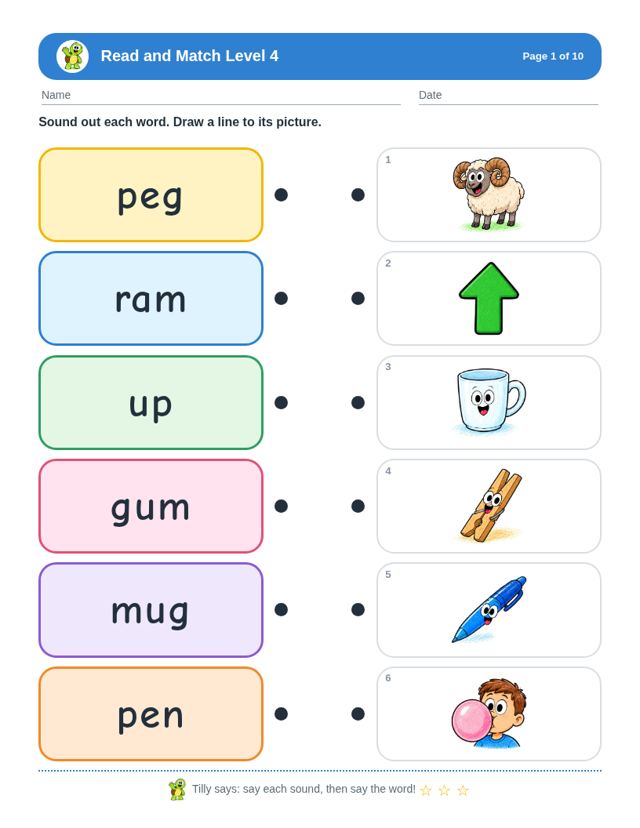
All 5 read and match level worksheet packs in one download.
See inside $3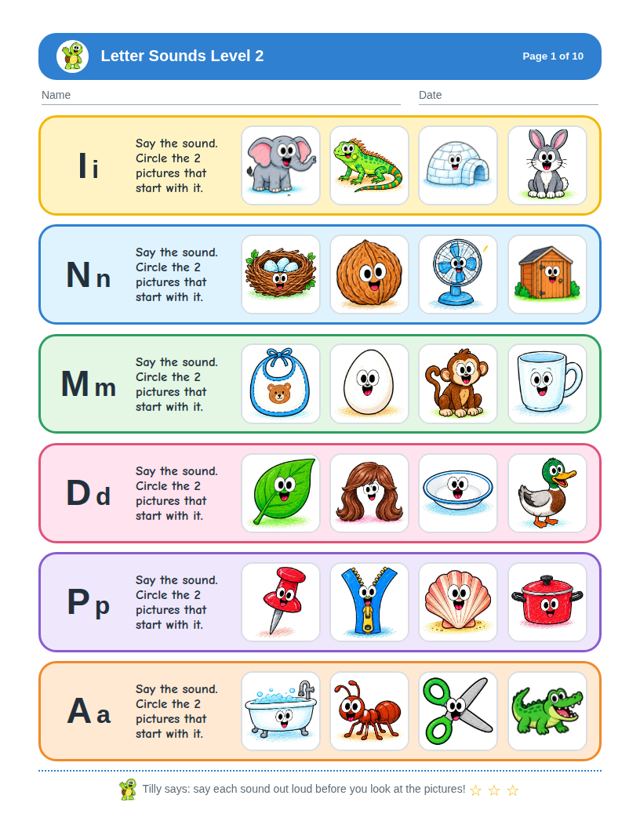
All 7 letter sounds level worksheet packs in one download.
See insideCheck each reading step in order, from hearing sounds to smooth reading. Listen to your child read a short new page, and ask the teacher which level the class uses.
By the end of kindergarten, many children read simple words, common words and short sentences. Children vary a lot, so watch for steady progress month by month.
Simple checks at home give a useful starting point for practice. They are not a diagnosis. For a full picture, talk to your child’s teacher.
Every few weeks is enough to see progress and adjust what you practice. Checking too often can make reading feel like a test.
Start from the first step that is not firm and practice it a few minutes a day. Talk to the school about extra support, and keep reading aloud together.
No. Schools use different systems, such as letters, numbers or grade levels. Ask the teacher which one your child’s class uses and what it means.
 Learn to ReadFree Phonics Games for KindergartenFree phonics games for kindergarten that build real reading: listening, blending, word building and sentence games, with tips to make each one count.Read the guide
 Learn to ReadHow to Help a Struggling Reader at HomeHow to help a struggling reader at home: find the step that is hard, teach it in a few minutes a day, read together, and work with the school on support.Read the guide
 Learn to ReadHow to Teach Digraphs: sh, ch and thHow to teach digraphs like sh, ch and th: show two letters making one sound, practice with pictures and word lists, and read and spell digraph words.Read the guide
“Behind in reading” can mean fourteen different things, and each one needs different help. Check off what is true for your child. You will see what to work on first, and what can wait.