
Home › Guides › Learn to Read
Home › Guides › Learn to Read
 Detective PipSee every case →
Are there free phonics games that really help my kindergartener?What we found: the short answer
The best free phonics games for kindergarten practice one skill at a time: hearing sounds, blending sounds into words, building words, and reading short sentences. Every word should be one your child can sound out. Play a few minutes a day, with a grown-up nearby, and pick games that match your child’s level.
By Julz, founder of Sound It Out. Updated 2026-10-15.
A good phonics game practices one clear skill, such as hearing the first sound or blending three sounds into a word.
Every word in the game should follow the sounds your child knows. Otherwise the game turns into guessing.
The game should be short. Five to ten minutes keeps attention high and leaves your child wanting more.
It should also be calm. Loud rewards and flashing animations can pull attention away from the letters.
Most important, a grown-up stays close. A game cannot hear your child read, so you decide what counts as right.
Games work because children practice more when they are having fun. The trick is to make sure the fun is wrapped around real reading.
Games also give you a quick view of what your child can do. Watch closely, and you will often see the next step to practice.
Before letters, children need to hear the sounds inside words. Listening games build this skill.
Play I spy with sounds: I spy something that starts with mmm. Your child finds the moon picture or the milk.
Play rhyme or not: say two words, and your child says yes if they rhyme.
Play the blending game by ear: you say s, u, n, and your child says sun.
These games need no screen and no paper. They work in the car, at dinner or on a walk.
Listening games are especially useful for children who struggle to hear sounds. Many reading problems start with this early skill.
If your child cannot yet hear sounds, stay with listening games for a week or two before moving on.
Blending is joining sounds into a word. It is the moment a child starts to read.
In a blending game, your child sees or hears the sounds one at a time and says the whole word.
Start with words that have stretchy sounds, like mmm and sss. Man and sun are easier than words starting with b or t.
Point to each letter as your child says its sound, then slide your finger under the word.
Play the same game several days in a row. Repetition builds speed.
A good blending game shows letters your child knows and asks for the whole word. It should not reveal the answer before your child tries.
If blending is slow, stretch the sounds a little longer and slide them together.
Word building games ask your child to make words with letters, instead of only reading them.
Use letter tiles or magnet letters. Build cat, then change one letter to make hat, then hot.
Word chains like this keep your child looking at every letter in order.
Spelling with tiles is often easier than writing for young children, because moving letters is less tiring.
Ask your child to read each new word aloud after building it.
Word building also builds spelling. Children who build words with tiles often spell better when they write.
Word chains with only one letter changed are the best way to keep attention on each letter.
 Practice this in the free reading appReading games your child can play on a phone, tablet or computer. Every word can be sounded out. No sign-up.Open the app
Once your child reads short words, sentence games bring reading to life.
Read a short sentence and act it out: The cat can hop. Your child hops like a cat.
Use sentence strips: cut a sentence into words, mix them up, and put them back in order.
Short decodable stories turn practice into real reading, with a beginning, middle and end.
Ask one question after each story to check understanding.
Sentence games are a nice way to end a session. A short success with a real sentence leaves your child proud.
Acting out sentences is great for active children who find sitting still hard.
Online games can be handy on a busy day. Choose ones without ads, sign-ups or endless rewards.
Check that every word can be sounded out at your child’s level. Many games mix in hard words too early.
Printable games, like bingo or roll and read, keep your child looking at real letters on paper.
Mixing both works well: a short online game one day, a printable game the next.
Whatever you choose, keep screens short and sit with your child.
Free games without sign-up are easy to try. If a game asks for personal details or shows ads, skip it.
Turn off sound effects if they distract your child from the letters.
Pick the game that matches what your child needs right now. A listening game for a child who cannot hear sounds yet, a blending game for a child who knows sounds.
Keep the words the same for a few days. The game can change, but repeated words build real reading.
Celebrate effort and careful looking, not speed.
Stop while your child is still having fun. A happy ending makes tomorrow’s game easier.
Write down the words your child finds hard, and use them in tomorrow’s game.
Keep a small list of the games your child likes. On busy days, pick one and play for five minutes.
Short games at the same time each day become a habit your child expects.
Sound I spy: find something in the room that starts with a sound you say.
Blend and jump: you say the sounds of a word, and your child jumps and says the whole word.
Word chains with tiles: cat, hat, hot, hop. Change one letter at a time.
Sentence act-out: read a short sentence and act it out together. Each game takes about five minutes.
Sound sort: sort picture cards into two piles by first sound, such as s and m. Roll and read: roll a die and read a word from that row.
Pick one game a day and keep the same words all week. The game keeps it fresh, and the repeated words build real reading.
If your child guesses during games, choose easier words and point to each letter.
If your child gets frustrated, go back one step, for example from reading words to blending by ear.
If your child loves the game but does not improve, check that the game practices the skill your child needs.
A free check can show which reading step is in the way.
A plan with a short lesson each day can give structure that games alone do not.
Some children need more teaching before games make sense. In that case, a short daily plan can help more than more games.
If your child loses interest, try a new game with the same words.
Your child hears and says sounds in words more easily.
Your child blends short words without your help.
Your child reads new words in the game correctly on the first try.
Your child asks to play, and stays focused for the whole game.
Then move up a level, with new sounds and longer words.
Notice your child’s mood too. Children who enjoy phonics games usually start to enjoy reading itself.
Keep a few printed games in a folder so they are ready to use.
 Pick games that practice one skill.
 Use only words your child can sound out.
 Play five to ten minutes a day.
 Sit with your child while playing.
 Keep the same words for a few days.
 Mix screen games with paper games.
Not sure where to start? Get a free plan for your child
Want the whole reading path, in order?The Reading Program gives you ten 10-day plans in the order reading is built, with a short video for you every day.See the Reading Program Listen and Say the WordYou say the sounds slowly, your child says the whole word. No letters to look at, so it trains the ear first.Play free
 Build the WordYour child hears a word and taps the letter tiles in the right order to build it.Play free
 Read the WordOne short word at a time, such as sat, pin or dog. Every word uses only the sounds of the level you choose.Play free
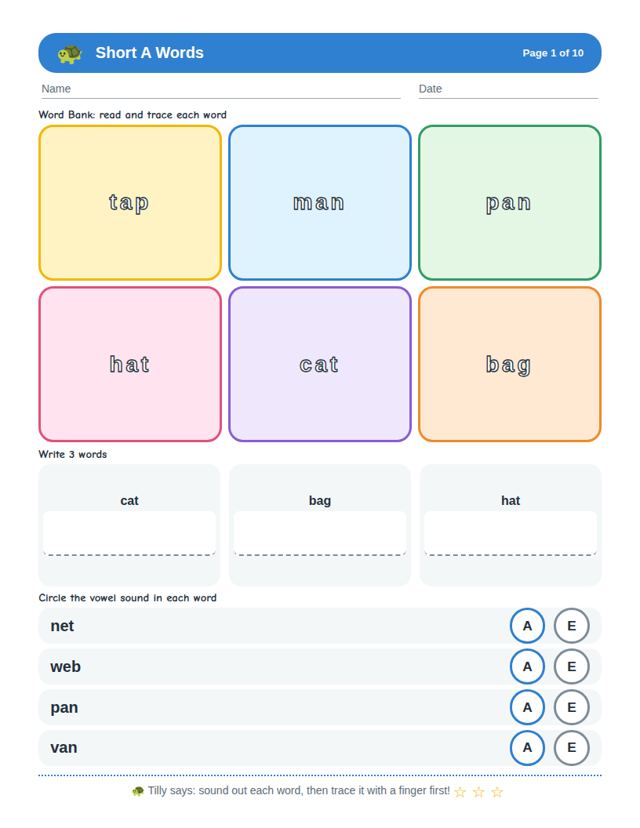
Short a words worksheets, CVC word family practice.
Get the free pages FREE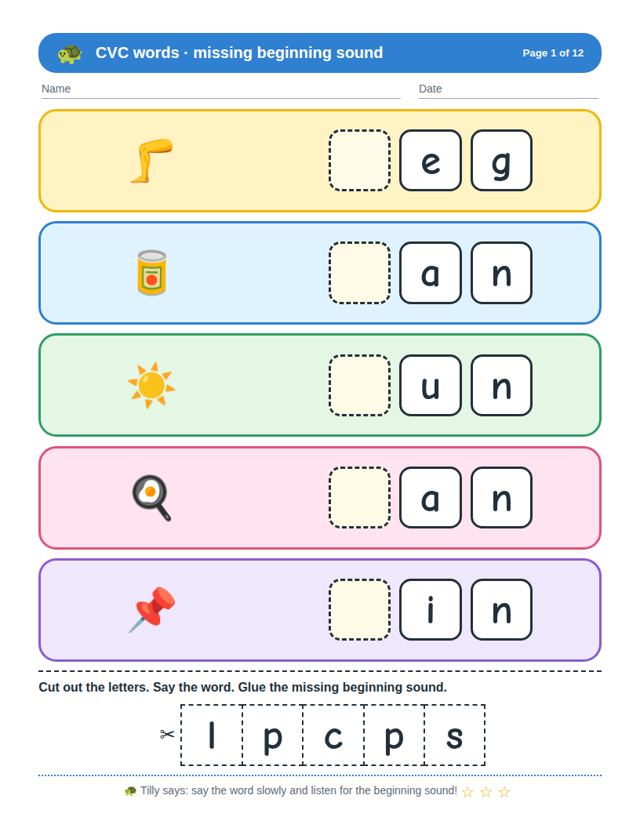
CVC cut and paste worksheets for beginning, middle and ending sounds.
Get the free pages $3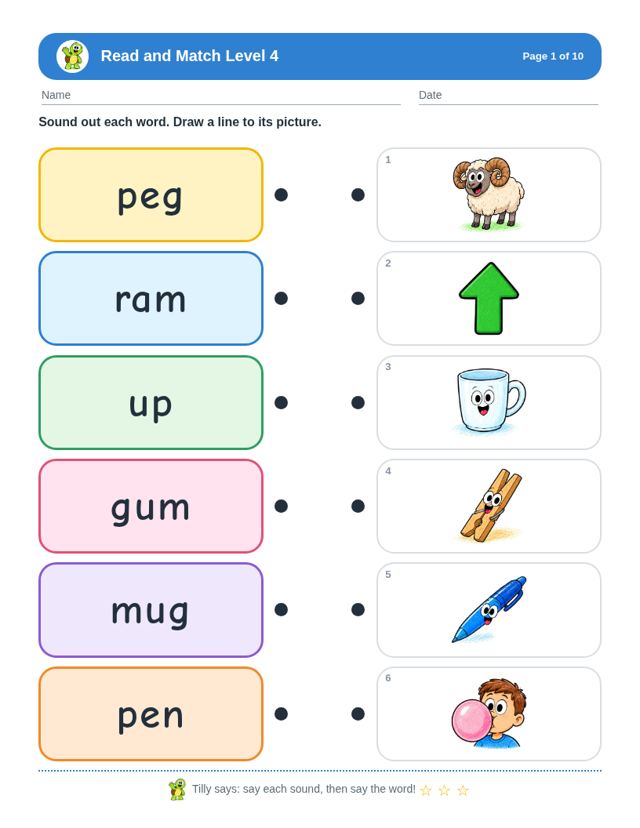
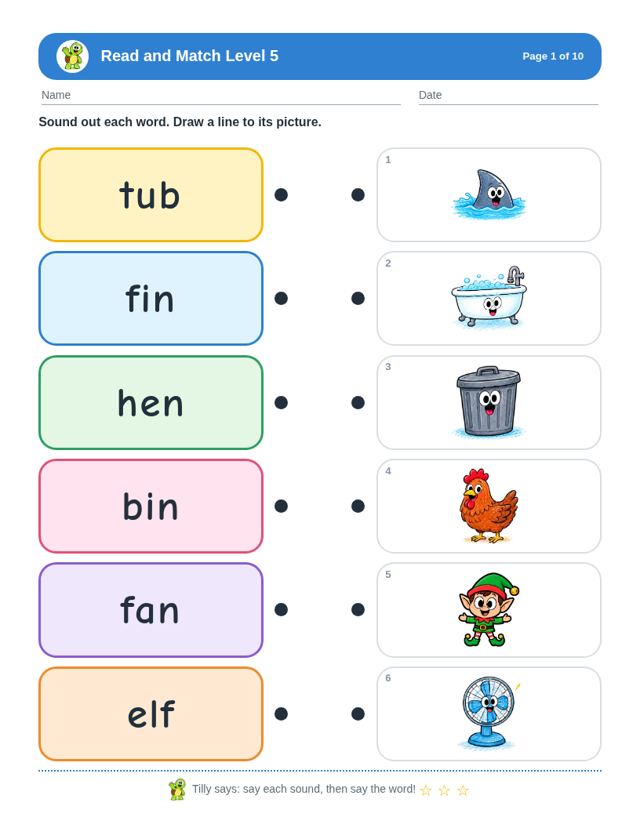
All 5 read and match level worksheet packs in one download.
See inside $3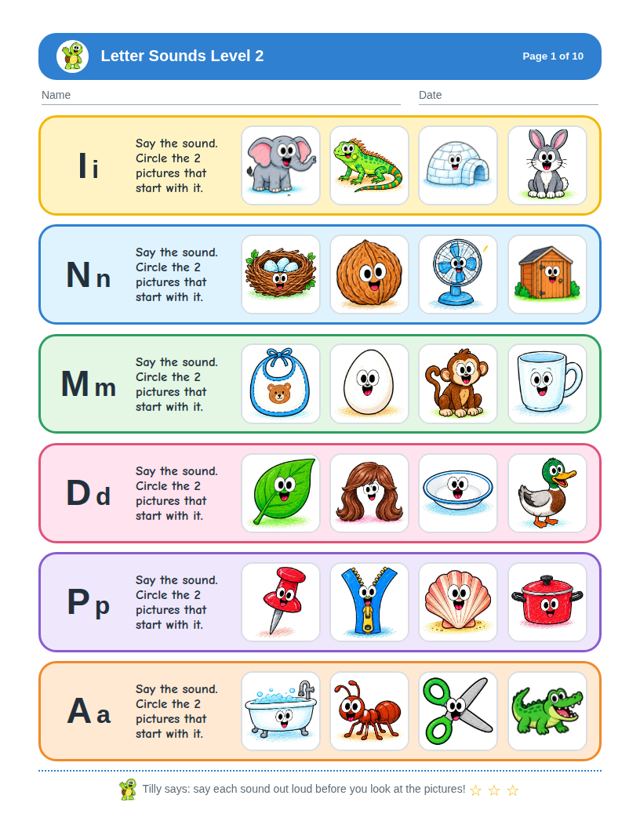
All 7 letter sounds level worksheet packs in one download.
See insideGames that practice one skill at a time: hearing sounds, blending, building words and reading short sentences. Every word should be one your child can sound out with the letters learned so far.
They can help as extra practice when they are calm, free of ads and matched to your child’s level. Sit nearby, because an app cannot hear your child read and decide what counts.
Five to ten minutes a day is enough for most kindergarteners. Short, regular games build more skill than one long session, and your child stays eager to play again.
Games are great practice, but children still need clear teaching of the sounds in order. Use a game after a short lesson, so your child practices what was just taught.
A listening game, such as I spy with sounds, or blending by ear, where you say the sounds and your child says the word. Neither needs letters, paper or a screen.
Yes. Bingo, roll and read, and word building with letter tiles keep your child looking at real letters on paper. They are also easy to play with brothers, sisters or friends.
 Learn to ReadHow to Find Your Child’s Reading LevelHow to find your child’s reading level at home: check each reading step in order, listen to your child read a short page, and choose books that fit.Read the guide
 Learn to ReadHow to Help a Struggling Reader at HomeHow to help a struggling reader at home: find the step that is hard, teach it in a few minutes a day, read together, and work with the school on support.Read the guide
 Learn to ReadHow to Teach Digraphs: sh, ch and thHow to teach digraphs like sh, ch and th: show two letters making one sound, practice with pictures and word lists, and read and spell digraph words.Read the guide
The packs on this site are free. The One Sheet goes further: one sheet a day, made for your child from what you tell us happened.
See The One Sheet · $9.99 a month
Or try the 10-day plan: From Sounds to Words, $19 one timeOr do the free 3-minute check first