Home › The Reading Lab

Decodable books for beginners

A good case at the start, with limits later

The short answer

Should my beginner read decodable books or ordinary story books?

The authors of a major research review believe there is a good case for decodable books at the very start, because phonics works better when a child can use it right away in reading. In their view the limits of these books are likely to outweigh the benefits once a child is past the very early stages.

What the research found

  • 1 × Strong evidence
  • 1 × Moderate evidence
  • 5 × Expert advice, not a trial
  • 1 × Reported by a research review
  1. The review defines decodable books as books made mostly of words a child can read with the letter-sound links already taught.

    In the source’s own words“Decodable books are texts written for children that consist primarily of words that they can read correctly using the grapheme-phoneme correspondences that they have learned”
  2. The authors believe there is a good case for decodable books at the very start, because phonics teaching works better when children can use what they learned right away in reading.

    In the source’s own words“There is evidence that phonics teaching is more effective when children are given immediate opportunities to apply what they have learned to their reading”
  3. In the authors' view, once children are past the very early stages, the limits of decodable books are likely to outweigh the benefits.

    In the source’s own words“once children move beyond the very early stages of reading, the benefits of decodable readers are likely to be outweighed by the limitations of this medium.”
  4. The review says decodable books use a narrow set of words, so they may be weaker than real books at holding interest and building vocabulary and knowledge.

    In the source’s own words“may tend to be inferior to real books in maintaining children’s interest and motivation to read, and in achieving the broader goals of building children’s vocabularies and knowledge.”
  5. The foundational reading guide includes reading decodable words, alone and in text, as a step in its strongly rated recommendation on decoding.

    In the source’s own words“Have students read decodable words in isolation and in text.”
  6. For beginners who know only a few letter sounds and lean on the pictures, the panel advises decodable text.

    In the source’s own words“This problem can be preempted by having students read decodable text—text that is written so that students can read it using the letter sounds and high-frequency sight words they have learned.”
  7. The guide also says children should read a variety of connected texts of different levels, kinds and topics.

    In the source’s own words“Students should interact with a variety of connected texts, including texts of varied levels, diverse genres, and wide-ranging content.”
  8. The Rose Review said decodable books should not keep children from favorite books and stories at any stage.

    In the source’s own words“the use of decodable books should certainly not deny children access to favourite books and stories at any stage”

What this means at home

  • At the start, give your child books made of the sounds they have been taught.
  • Widen the range of books as your child's reading grows.
  • Keep sharing favorite stories all the way through, by reading them aloud.
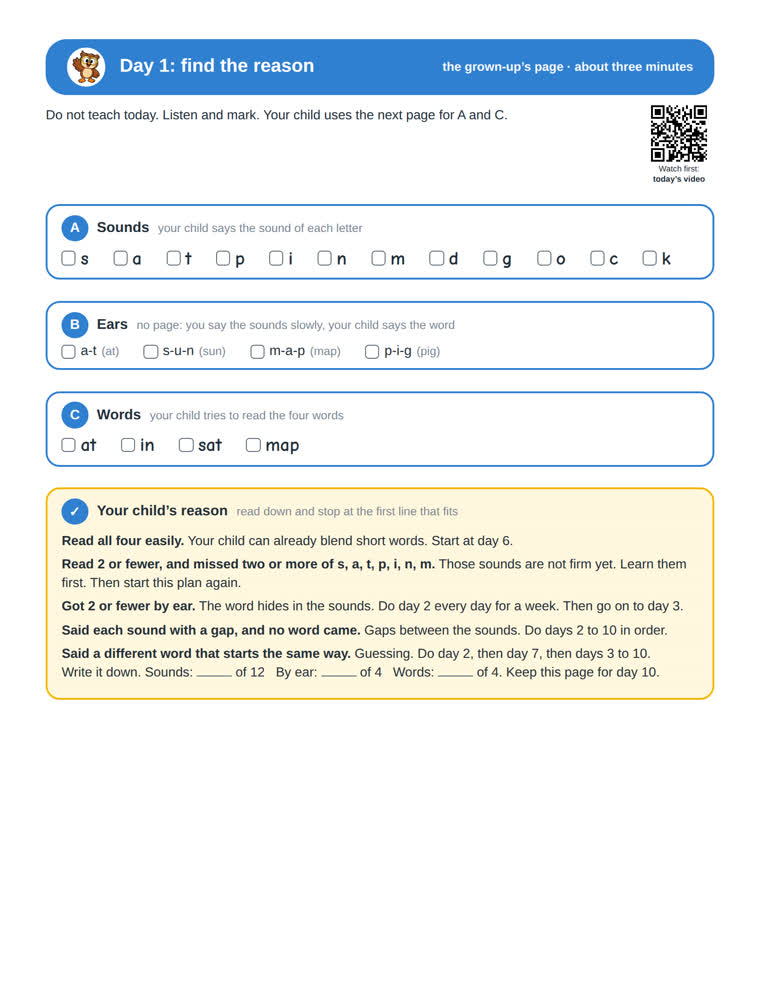
  • The free blending check shows whether your child is ready to read short words.

What the research does not tell us

  • The review says it is not yet known at what point decodable books stop being the better choice.
  • The Rose Review says a lot depends on how good the decodable books are.
  • The passages read compare decodable books with ordinary story books; none of the three sources reports a direct test of decodable books against leveled or predictable books.

Sources

We read each of these ourselves on October 9, 2026. Follow the links to read them too.

  1. Ending the Reading Wars: Reading Acquisition From Novice to Expert. Anne Castles, Kathleen Rastle, and Kate Nation; Psychological Science in the Public Interest, 19(1), 5-51 (text read: the authors' accepted manuscript held in the Oxford University Research Archive). 2018.A peer-reviewed narrative review by three reading researchers of the research on how children learn to read, from first letters to skilled reading.ora.ox.ac.uk/objects/uuid:0828c38f-5fbc-4096-a23f-66be36775f99
  2. Foundational Skills to Support Reading for Understanding in Kindergarten Through 3rd Grade. Foorman, B., Beyler, N., Borradaile, K., Coyne, M., Denton, C. A., Dimino, J., Furgeson, J., Hayes, L., Henke, J., Justice, L., Keating, B., Lewis, W., Sattar, S., Streke, A., Wagner, R., & Wissel, S.; Institute of Education Sciences, What Works Clearinghouse (NCEE 2016-4008). 2016.A U.S. government practice guide in which an expert panel made four recommendations and What Works Clearinghouse staff rated the evidence behind each from studies published from 2000 to 2014. (Text read: the guide's PDF converted to text in reading order; texts/ies_foundational.txt is the earlier column-layout copy of the same guide.)ies.ed.gov/ncee/wwc/PracticeGuide/21
  3. Independent Review of the Teaching of Early Reading: Final Report. Jim Rose; Department for Education and Skills (England). 2006.A review commissioned by the government of England, based on research evidence, visits to schools by inspectors, and consultation, on how early reading should be taught.dera.ioe.ac.uk/5551/2/report.pdf

How we write these pages

  1. We read the source itself, not a news story about it.
  2. Every finding on a page names its source and where in the source it is found, so you can check it.
  3. We say how strong the evidence is, in the words of the people who reviewed it.
  4. We say what the research does not tell us. Most studies are done in schools, and no study can say what one child needs.
  5. If we get something wrong, tell us at hello@sounditoutreading.com and we will correct the page.

More from The Reading Lab

See all the research pages

More than worksheets

Does this sound like your child?

“Knows the sounds, but cannot put them together into a word”

From Sounds to Words is a full 10-day plan, with a short video that shows you every step. The goal: on day 10 your child reads words they have never seen before. It is the goal, not a promise.
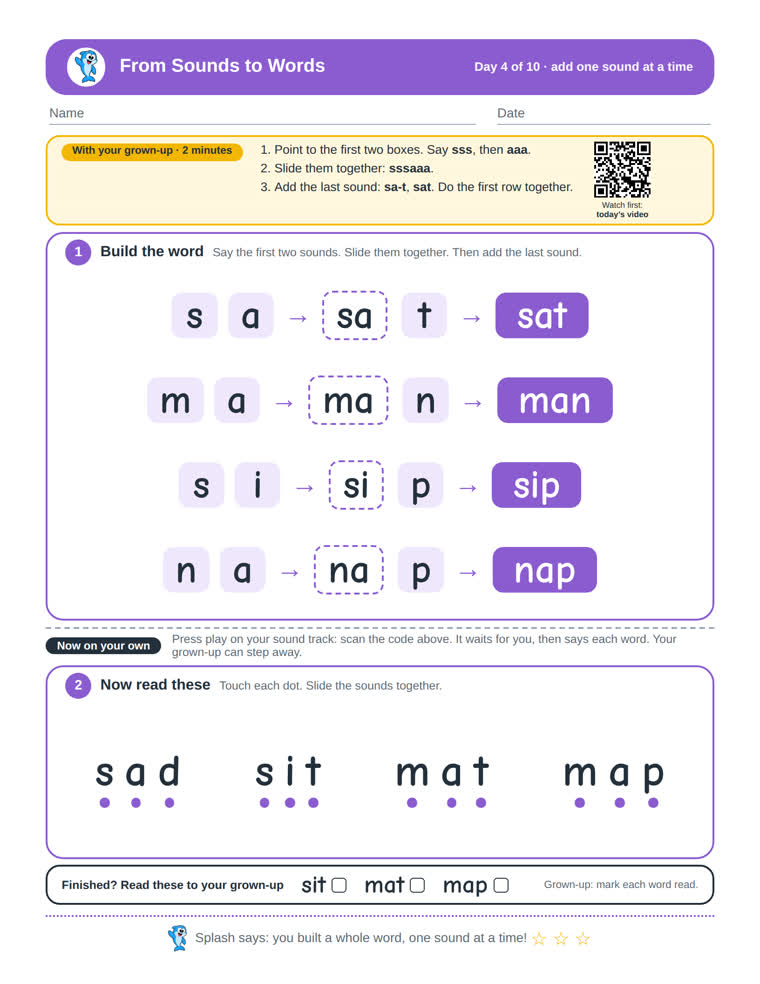
  • 21 printable pages, one short day at a time
  • 11 short videos that show you each day before you do it
  • 6 sound tracks your child works with alone, while you step away
  • A check on day 1 and day 10, and a report
  • About five minutes a day from you
  • $19, one payment. 30-day money back.

See the 10-day plan →Or do the free 3-minute check first