



Home › The Reading Lab

Do children learn to read naturally?

Talking comes naturally. Reading is taught.

The short answer

Can children pick up reading naturally, the way they learn to talk?

A major research review says no, for most children. A child surrounded by spoken language will almost certainly learn to speak it, but reading is a learned skill that usually takes years of teaching and practice. The review concludes that the idea that letters stand for sounds has to be taught directly to most children.

What the research found

  • 1 × Expert advice, not a trial
  • 6 × Reported by a research review
  1. The review says a child surrounded by rich spoken language will almost certainly learn to understand and speak it.

    In the source’s own words“If a child is exposed to a rich spoken language environment, that child will almost certainly learn to understand and produce spoken language.”
  2. The review says reading is different: it is a learned skill that usually takes years of teaching and practice.

    In the source’s own words“it is nevertheless a learned skill that typically requires years of instruction and practice.”
  3. The review calls writing a recent human invention and a code for spoken language.

    In the source’s own words“Writing is a recent cultural invention, and writing systems vary substantially in how their visual symbols represent spoken language.”
  4. The review describes experiments in which preschoolers were taught to read a few whole words and then, left to work it out alone, did not figure out that letters stand for sounds.

    In the source’s own words“When left to their own devices, the children showed no evidence of inducing the alphabetic principle.”
  5. The review concludes that the idea that letters stand for sounds does not usually come naturally and has to be taught directly to most children.

    In the source’s own words“It is something that most children must be taught explicitly, and doing so is important for making further progress in reading.”
  6. The Rose Review said phonics is a body of knowledge and skill that has to be taught and learned.

    In the source’s own words“phonic work is a body of knowledge, skills and understanding that quite simply has to be taught and learned.”
  7. The National Reading Panel found that planned, step-by-step phonics teaching added more to children's reading growth than programs with unplanned phonics or none.

    In the source’s own words“systematic phonics instruction makes a bigger contribution to children’s growth in reading than alternative programs providing unsystematic or no phonics instruction.”

What this means at home

  • Do not wait for reading to arrive by itself. Teach the letter sounds.
  • Show your child directly that letters stand for sounds.
  • Follow a plan, step by step, instead of teaching sounds as they happen to come up.
  • The free two-minute check points to where to begin.

What the research does not tell us

  • The experiments described were done with preschool children aged three to five.
  • The review says "typically" and "most children", not "all"; and it adds that the knowledge needed to trigger this insight is not large.
  • The review also says reading ability is partly inherited, so its point is about needing teaching, not that all children find it equally hard.

Sources

We read each of these ourselves on October 9, 2026. Follow the links to read them too.

  1. Ending the Reading Wars: Reading Acquisition From Novice to Expert. Anne Castles, Kathleen Rastle, and Kate Nation; Psychological Science in the Public Interest, 19(1), 5-51 (text read: the authors' accepted manuscript held in the Oxford University Research Archive). 2018.A peer-reviewed narrative review by three reading researchers of the research on how children learn to read, from first letters to skilled reading.ora.ox.ac.uk/objects/uuid:0828c38f-5fbc-4096-a23f-66be36775f99
  2. Independent Review of the Teaching of Early Reading: Final Report. Jim Rose; Department for Education and Skills (England). 2006.A review commissioned by the government of England, based on research evidence, visits to schools by inspectors, and consultation, on how early reading should be taught.dera.ioe.ac.uk/5551/2/report.pdf
  3. Report of the National Reading Panel: Teaching Children to Read: An Evidence-Based Assessment of the Scientific Research Literature on Reading and Its Implications for Reading Instruction: Reports of the Subgroups. National Reading Panel; National Institute of Child Health and Human Development, U.S. National Institutes of Health. 2000.The full report of a panel convened at the request of the U.S. Congress, which reviewed experimental studies of reading instruction and combined their results in meta-analyses.www.nichd.nih.gov/sites/default/files/publications/pubs/nrp/Documents/report.pdf

How we write these pages

  1. We read the source itself, not a news story about it.
  2. Every finding on a page names its source and where in the source it is found, so you can check it.
  3. We say how strong the evidence is, in the words of the people who reviewed it.
  4. We say what the research does not tell us. Most studies are done in schools, and no study can say what one child needs.
  5. If we get something wrong, tell us at hello@sounditoutreading.com and we will correct the page.

More from The Reading Lab

See all the research pages

More than worksheets

Does this sound like your child?

“Knows the sounds, but cannot put them together into a word”

From Sounds to Words is a full 10-day plan, with a short video that shows you every step. The goal: on day 10 your child reads words they have never seen before. It is the goal, not a promise.
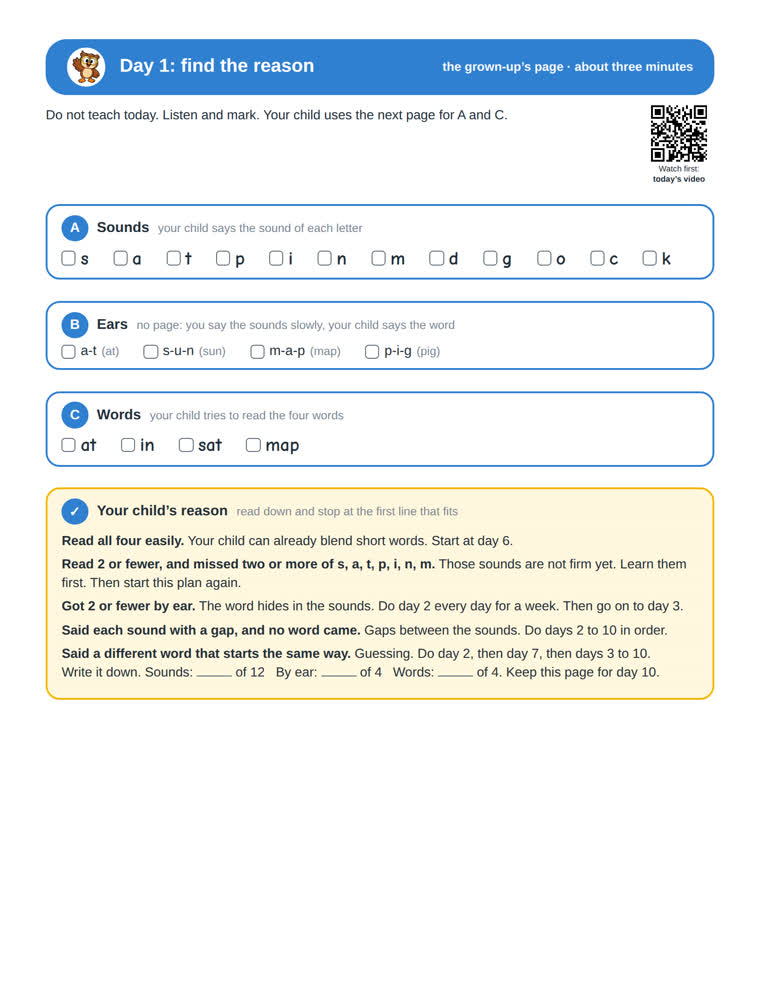
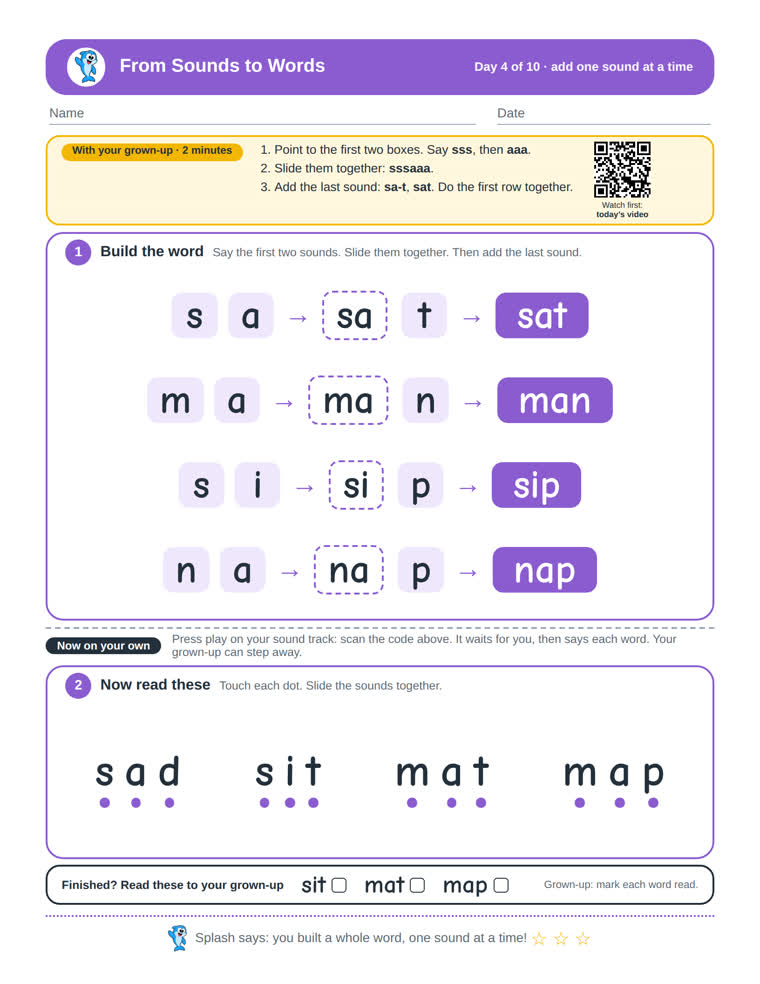
  • 21 printable pages, one short day at a time
  • 11 short videos that show you each day before you do it
  • 6 sound tracks your child works with alone, while you step away
  • A check on day 1 and day 10, and a report
  • About five minutes a day from you
  • $19, one payment. 30-day money back.

See the 10-day plan →Or do the free 3-minute check first