Home › The Reading Lab

Blending sounds into words

Knowing the sounds but not getting to the word

The short answer

Why can my child say the letter sounds but not blend them into a word?

An expert panel names this exact problem: a child can say each sound but has trouble getting to the word. Its advice is to teach blending directly, from left to right, starting with short familiar words, and to help the child join the sounds smoothly with no stop between them.

What the research found

  • 3 × Strong evidence
  • 4 × Expert advice, not a trial
  • 1 × Reported by a research review
  1. The guide describes blending as reading a word from left to right by joining each letter or letter group into one sound.

    In the source’s own words“Blending is the process of reading a word systematically from left to right by combining each successive letter or combination of letters into one sound.”
  2. The guide says to begin with simple, familiar three-sound words, show the child how to blend, and give feedback as the child tries it alone.

    In the source’s own words“Start with simple consonant-vowel-consonant (CVC) words that are familiar to students. Demonstrate how to blend, and provide feedback as students begin to apply it independently.”
  3. The guide names this exact problem: a child can say the sound of each letter but has trouble getting to the word.

    In the source’s own words“Students are able to identify the sounds of the letters in a word, but they have trouble arriving at the correct pronunciation for the word.”
  4. For that problem, the panel's advice is to teach the child to blend the sounds smoothly, with no stop between them.

    In the source’s own words“Students should be taught to sound out or blend sounds smoothly, without stopping between sounds”
  5. The panel advises listening for an extra "uh" added after quick sounds, and helping the child drop it.

    In the source’s own words“Teachers should listen for students who add a schwa sound after stop sounds (e.g., /b/ becomes buh) and should work with those students to reduce or eliminate the schwa sound.”
  6. The guide's glossary says words that begin with a quick stop sound may be harder to sound out than words that begin with a sound that can be held.

    In the source’s own words“Words beginning with stop sounds may be more difficult for students to sound out than words beginning with continuous sounds.”
    Expert advice, not a trialSource 1, Glossary, p. 42
  7. The guide describes one way to blend, called chunking: add each new sound to the sounds already joined before moving to the next one.

    In the source’s own words“Chunking is a type of blending in which students read the sounds from left to right but add each sound to the previous sound before going on to the next sound in the word.”
  8. The National Reading Panel concluded that teaching children to blend sounds and to break words into sounds helped their reading more than training in several sound skills at once.

    In the source’s own words“From these findings, the Panel concludes that blend-and-segment training benefited children’s reading more than multiple skills training did.”

What this means at home

  • Start with short words of three sounds that your child already knows when spoken.
  • Show how to slide the sounds together without stopping, then let your child try.
  • Listen for an extra "uh" after quick sounds and help your child drop it.
  • The free blending check points to the likely reason your child is stuck.

What the research does not tell us

  • The guide's review covered studies published from 2000 on, so its ratings rest on that set of studies.
  • In the studies reviewed for the guide, fewer than half of the children were English learners or children with an identified disability.
  • The 'strong' rating belongs to Recommendation 3 as a whole; the tips under Obstacle 3.2 (smooth blending, dropping the extra "uh") are the panel's advice and carry no separate rating.

Sources

We read each of these ourselves on October 9, 2026. Follow the links to read them too.

  1. Foundational Skills to Support Reading for Understanding in Kindergarten Through 3rd Grade. Foorman, B., Beyler, N., Borradaile, K., Coyne, M., Denton, C. A., Dimino, J., Furgeson, J., Hayes, L., Henke, J., Justice, L., Keating, B., Lewis, W., Sattar, S., Streke, A., Wagner, R., & Wissel, S.; Institute of Education Sciences, What Works Clearinghouse (NCEE 2016-4008). 2016.A U.S. government practice guide in which an expert panel made four recommendations and What Works Clearinghouse staff rated the evidence behind each from studies published from 2000 to 2014. (Text read: the guide's PDF converted to text in reading order; texts/ies_foundational.txt is the earlier column-layout copy of the same guide.)ies.ed.gov/ncee/wwc/PracticeGuide/21
  2. Report of the National Reading Panel: Teaching Children to Read: An Evidence-Based Assessment of the Scientific Research Literature on Reading and Its Implications for Reading Instruction: Reports of the Subgroups. National Reading Panel; National Institute of Child Health and Human Development, U.S. National Institutes of Health. 2000.The full report of a panel convened at the request of the U.S. Congress, which reviewed experimental studies of reading instruction and combined their results in meta-analyses.www.nichd.nih.gov/sites/default/files/publications/pubs/nrp/Documents/report.pdf

How we write these pages

  1. We read the source itself, not a news story about it.
  2. Every finding on a page names its source and where in the source it is found, so you can check it.
  3. We say how strong the evidence is, in the words of the people who reviewed it.
  4. We say what the research does not tell us. Most studies are done in schools, and no study can say what one child needs.
  5. If we get something wrong, tell us at hello@sounditoutreading.com and we will correct the page.

More from The Reading Lab

See all the research pages

More than worksheets

Does this sound like your child?

“Knows the sounds, but cannot put them together into a word”

From Sounds to Words is a full 10-day plan, with a short video that shows you every step. The goal: on day 10 your child reads words they have never seen before. It is the goal, not a promise.
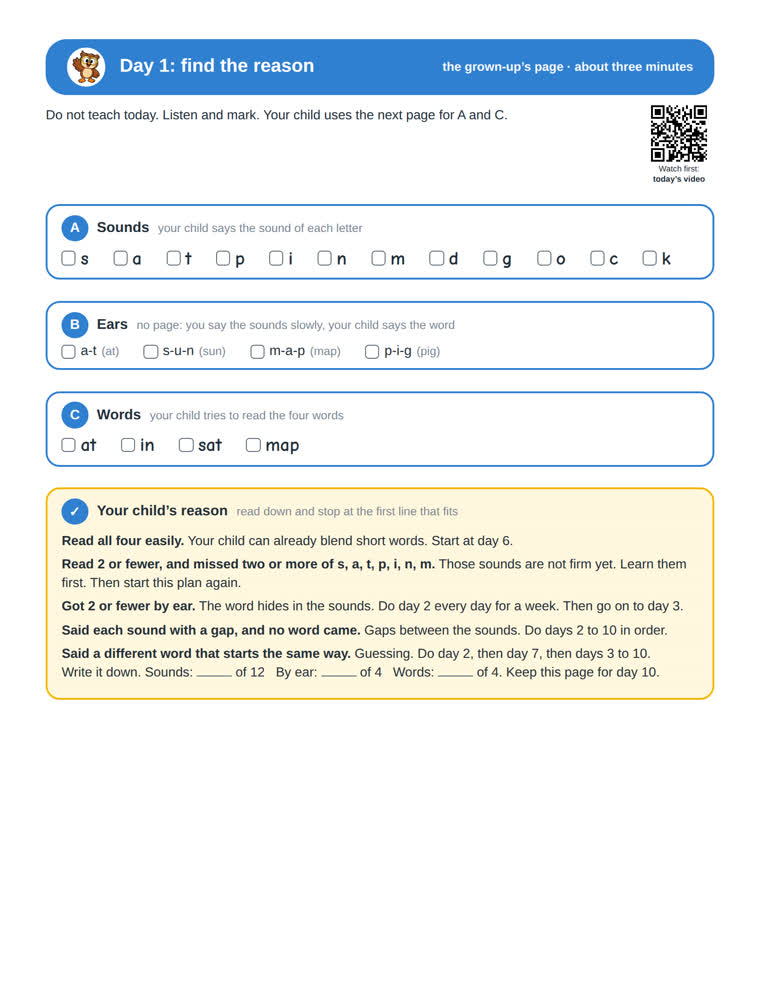
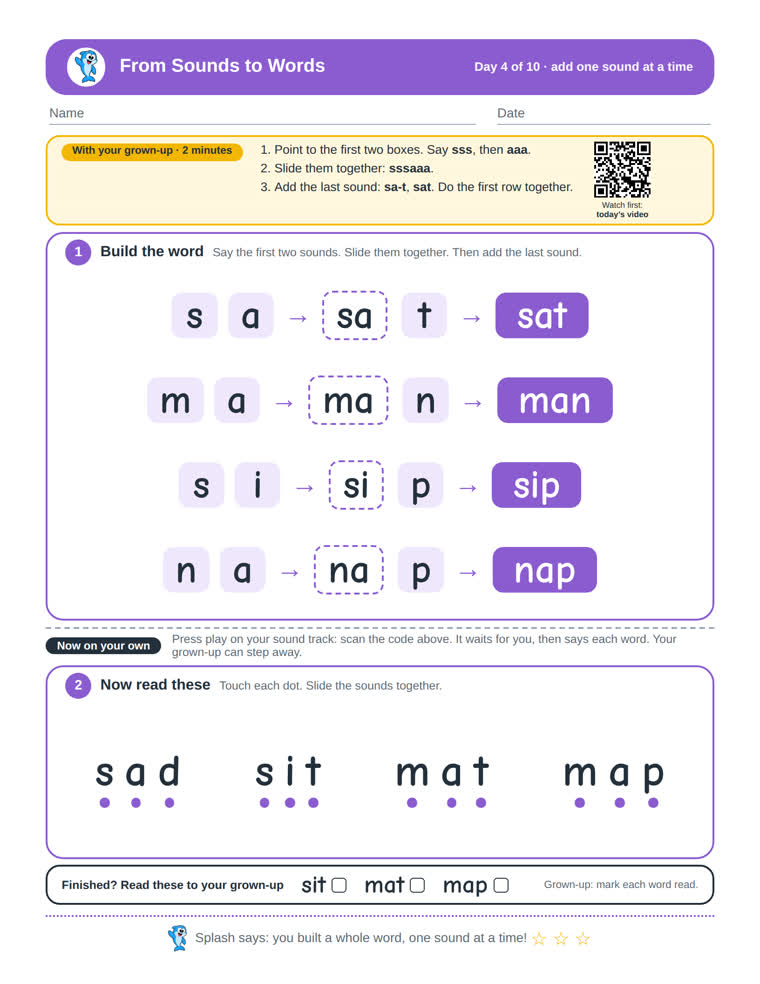
  • 21 printable pages, one short day at a time
  • 11 short videos that show you each day before you do it
  • 6 sound tracks your child works with alone, while you step away
  • A check on day 1 and day 10, and a report
  • About five minutes a day from you
  • $19, one payment. 30-day money back.

See the 10-day plan →Or do the free 3-minute check first