Home › The Reading Lab

Slow, word-by-word reading

What builds fluency, and what has not been shown to

The short answer

My child reads slowly, one word at a time. What builds fluency?

The National Reading Panel concluded that reading aloud again and again, with feedback and guidance, leads to real gains for good readers and for those having difficulty. For programs that only encourage children to read more alone, most studies did not find a gain.

What the research found

  • 3 × Moderate evidence
  • 2 × Expert advice, not a trial
  • 3 × Reported by a research review
  1. The National Reading Panel concluded that having children read aloud again and again, with feedback and guidance, leads to real gains in reading for good readers and for those having difficulty.

    In the source’s own words“classroom practices that encourage repeated oral reading with feedback and guidance leads to meaningful improvements in reading expertise for students—for good readers as well as those who are experiencing difficulties.”
  2. In the panel's analysis, guided oral reading helped accuracy most, then fluency, then understanding.

    In the source’s own words“The highest impact was on reading accuracy, with a mean effect size of 0.55; the next was on reading fluency, with a mean effect size of 0.44, and the least, but still impressive impact was on reading comprehension, where the effect size was 0.35.”
  3. The panel looked at programs that only encourage children to read more on their own, and most of those studies did not find a gain.

    In the source’s own words“Most of these studies failed to find a positive relationship between encouraging reading and either the amount of reading or reading achievement.”
  4. The panel wrote that children who do not become fluent keep reading slowly and with great effort, however bright they are.

    In the source’s own words“Children who do not develop reading fluency, no matter how bright they are, will continue to read slowly and with great effort.”
  5. The guide says children should read connected text every day, with and without feedback, starting as soon as they can read a few words.

    In the source’s own words“Having students read connected text daily, both with and without constructive feedback, facilitates the development of reading accuracy, fluency, and comprehension and should begin as soon as students can identify a few words.”
  6. The guide says rereading the same text shows a child the same words many times, which should help the child know them faster.

    In the source’s own words“They are repeatedly exposed to the same words, which should help students recognize them more efficiently.”
  7. The guide says reading many different texts does a different job: it brings more varied words and knowledge of the world.

    In the source’s own words“Wide reading, on the other hand, exposes students to more diverse vocabulary and world knowledge.”
  8. The guide warns against having a child read text that is too hard without feedback.

    In the source’s own words“It is important not to ask students to read frustration-level text without feedback, as it can lead them to practice ineffective word-reading strategies that reduce comprehension.”

What this means at home

  • Have your child read a short text aloud to you, more than once, and help with the hard words.
  • Read connected text every day, as soon as your child can read a few words.
  • Do not leave your child alone with text that is too hard.
  • The free check for slow reading points to what is slowing your child down.

What the research does not tell us

  • The panel could not compare one kind of guided oral reading with another, because the studies were too small.
  • On reading alone, the panel did not say it fails; it said a benefit has not been clearly shown.
  • In the studies reviewed for the guide, fewer than half of the children were English learners or children with an identified disability.

Sources

We read each of these ourselves on October 9, 2026. Follow the links to read them too.

  1. Report of the National Reading Panel: Teaching Children to Read: An Evidence-Based Assessment of the Scientific Research Literature on Reading and Its Implications for Reading Instruction: Reports of the Subgroups. National Reading Panel; National Institute of Child Health and Human Development, U.S. National Institutes of Health. 2000.The full report of a panel convened at the request of the U.S. Congress, which reviewed experimental studies of reading instruction and combined their results in meta-analyses.www.nichd.nih.gov/sites/default/files/publications/pubs/nrp/Documents/report.pdf
  2. Foundational Skills to Support Reading for Understanding in Kindergarten Through 3rd Grade. Foorman, B., Beyler, N., Borradaile, K., Coyne, M., Denton, C. A., Dimino, J., Furgeson, J., Hayes, L., Henke, J., Justice, L., Keating, B., Lewis, W., Sattar, S., Streke, A., Wagner, R., & Wissel, S.; Institute of Education Sciences, What Works Clearinghouse (NCEE 2016-4008). 2016.A U.S. government practice guide in which an expert panel made four recommendations and What Works Clearinghouse staff rated the evidence behind each from studies published from 2000 to 2014. (Text read: the guide's PDF converted to text in reading order; texts/ies_foundational.txt is the earlier column-layout copy of the same guide.)ies.ed.gov/ncee/wwc/PracticeGuide/21

How we write these pages

  1. We read the source itself, not a news story about it.
  2. Every finding on a page names its source and where in the source it is found, so you can check it.
  3. We say how strong the evidence is, in the words of the people who reviewed it.
  4. We say what the research does not tell us. Most studies are done in schools, and no study can say what one child needs.
  5. If we get something wrong, tell us at hello@sounditoutreading.com and we will correct the page.

More from The Reading Lab

See all the research pages

More than worksheets

Does this sound like your child?

“Reads slowly, one word at a time, or sounds out every word”

Smooth Reading is a full 10-day plan, with a short video that shows you every step. The goal: on day 10 your child reads a short sentence they have never seen, smoothly, the way they would say it. It is the goal, not a promise.
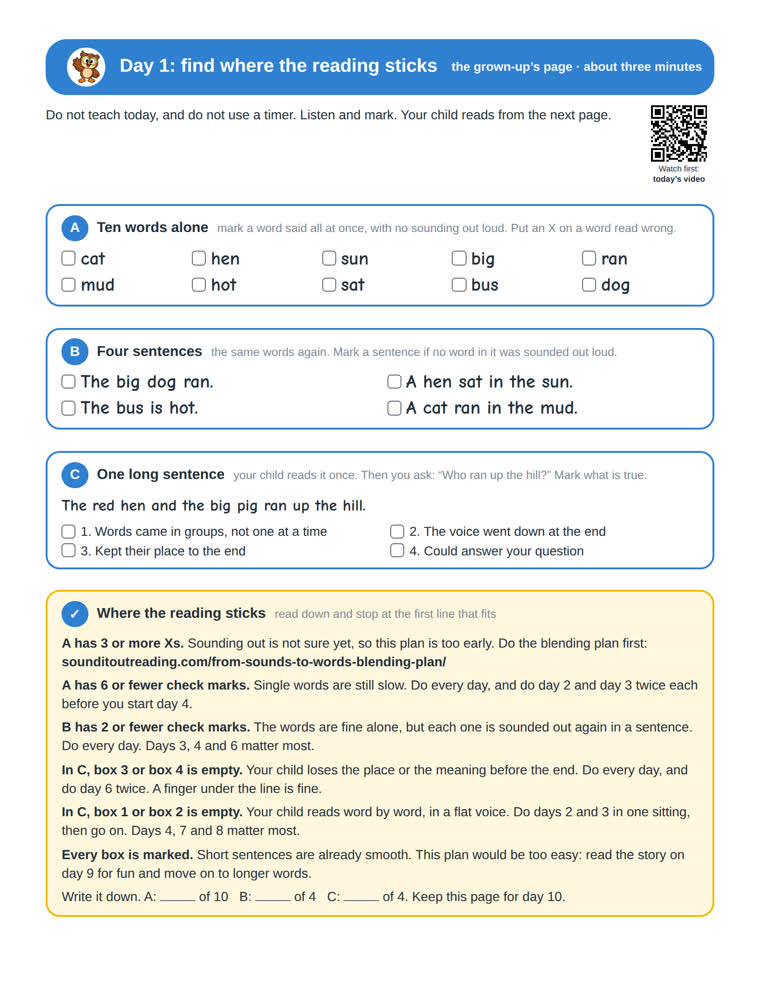
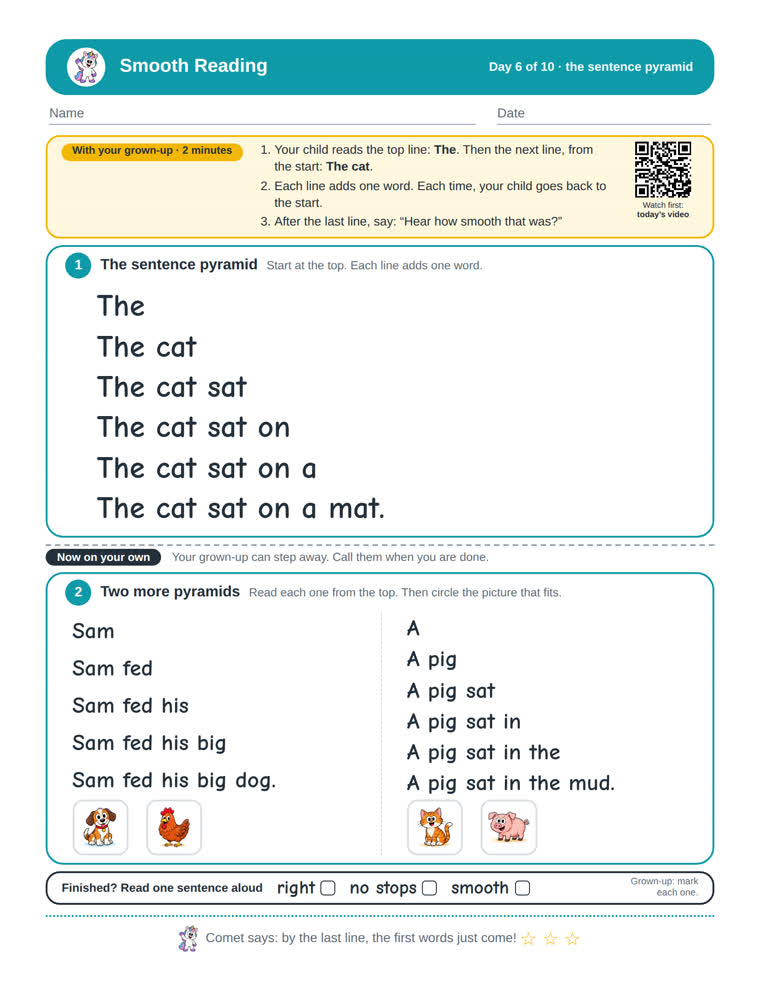
  • 21 printable pages, one short day at a time
  • 11 short videos that show you each day before you do it
  • 3 sound tracks your child works with alone, while you step away
  • A check on day 1 and day 10, and a report
  • About five minutes a day from you
  • $19, one payment. 30-day money back.

See the 10-day plan →Or do the free 3-minute check first