Home › The Reading Lab

Sight words: memorize or sound out?

What to do with the very common words

The short answer

Should my child memorize sight words or sound them out?

Both, depending on the word. The U.S. practice guide says a common word with a regular spelling should first be worked out with letter sounds, while an irregular word that a beginner cannot yet sound out is taught as a whole word. A major review adds that memorized words can only ever be a small share of what a child must learn.

What the research found

  • 4 × Strong evidence
  • 2 × Expert advice, not a trial
  • 1 × Reported by a research review
  1. The guide says to teach very common words, both those with regular spellings and those with irregular spellings, so children know them fast.

    In the source’s own words“Teach regular and irregular high-frequency words so that students can recognize them efficiently.”
  2. For irregular words, which are hard for beginners to sound out, the guide says to teach the word as a whole.

    In the source’s own words“the typical sound–spelling patterns and are not easy for early readers to decode. Teach these words holistically—that is, as whole words, rather than as combinations of sound units.”
  3. For common words with regular spellings, the guide says the child should first work the word out with letter sounds.

    In the source’s own words“For regular words, have students apply their letter–sound skills—for example, using Elkonin sound boxes—to identify the word initially.”
  4. The guide gives the reason: knowing very common words quickly speeds up reading and frees attention for meaning.

    In the source’s own words“Because these words occur so often in text, learning to recognize them quickly will speed up the reading process so that students can focus more on the meaning of the text.”
  5. The authors of this review hold that carefully choosing a small number of sight words to study in detail has a place next to phonics.

    In the source’s own words“the judicious selection of a small number of sight words for children to study in detail has its place in the classroom alongside phonics.”
  6. The review reports one large study in which struggling readers taught phonics plus sight words gained as much in sounding out as those taught phonics alone.

    In the source’s own words“struggling readers who received mixed phonics and sight word instruction made just as strong gains in their alphabetic decoding ability as those receiving phonics instruction alone.”
  7. The review says memorizing single words can only cover a tiny share of the words a child must learn, since children learn about 3000 new words a year from mid-childhood.

    In the source’s own words“learning individual sight words could only ever be a drop in the ocean in terms of children’s orthographic learning: it is estimated that from mid-childhood onwards children learn approximately 3000 …”

What this means at home

  • If a common word can be sounded out, have your child sound it out first.
  • Teach only the irregular words as whole words, a few at a time.
  • Keep phonics going: memorized words alone cannot carry a reader far.
  • The free sight words check shows which common words your child knows and which need work.

What the research does not tell us

  • The review says the best way to teach sight words has not been tested systematically.
  • The review says it is not known how many sight words to teach at each stage or how intensively.
  • The 'strong' rating is for Recommendation 3 as a whole (decoding, word parts and word recognition); the guide gives no separate rating to the step on high-frequency words.

Sources

We read each of these ourselves on October 9, 2026. Follow the links to read them too.

  1. Foundational Skills to Support Reading for Understanding in Kindergarten Through 3rd Grade. Foorman, B., Beyler, N., Borradaile, K., Coyne, M., Denton, C. A., Dimino, J., Furgeson, J., Hayes, L., Henke, J., Justice, L., Keating, B., Lewis, W., Sattar, S., Streke, A., Wagner, R., & Wissel, S.; Institute of Education Sciences, What Works Clearinghouse (NCEE 2016-4008). 2016.A U.S. government practice guide in which an expert panel made four recommendations and What Works Clearinghouse staff rated the evidence behind each from studies published from 2000 to 2014. (Text read: the guide's PDF converted to text in reading order; texts/ies_foundational.txt is the earlier column-layout copy of the same guide.)ies.ed.gov/ncee/wwc/PracticeGuide/21
  2. Ending the Reading Wars: Reading Acquisition From Novice to Expert. Anne Castles, Kathleen Rastle, and Kate Nation; Psychological Science in the Public Interest, 19(1), 5-51 (text read: the authors' accepted manuscript held in the Oxford University Research Archive). 2018.A peer-reviewed narrative review by three reading researchers of the research on how children learn to read, from first letters to skilled reading.ora.ox.ac.uk/objects/uuid:0828c38f-5fbc-4096-a23f-66be36775f99

How we write these pages

  1. We read the source itself, not a news story about it.
  2. Every finding on a page names its source and where in the source it is found, so you can check it.
  3. We say how strong the evidence is, in the words of the people who reviewed it.
  4. We say what the research does not tell us. Most studies are done in schools, and no study can say what one child needs.
  5. If we get something wrong, tell us at hello@sounditoutreading.com and we will correct the page.

More from The Reading Lab

See all the research pages

More than worksheets

Does this sound like your child?

“Cannot remember common words like the, said and was”

Words That Stick is a full 10-day plan, with a short video that shows you every step. The goal: on day 10 your child reads 16 of the most common words, on their own and inside sentences never seen before. It is the goal, not a promise.
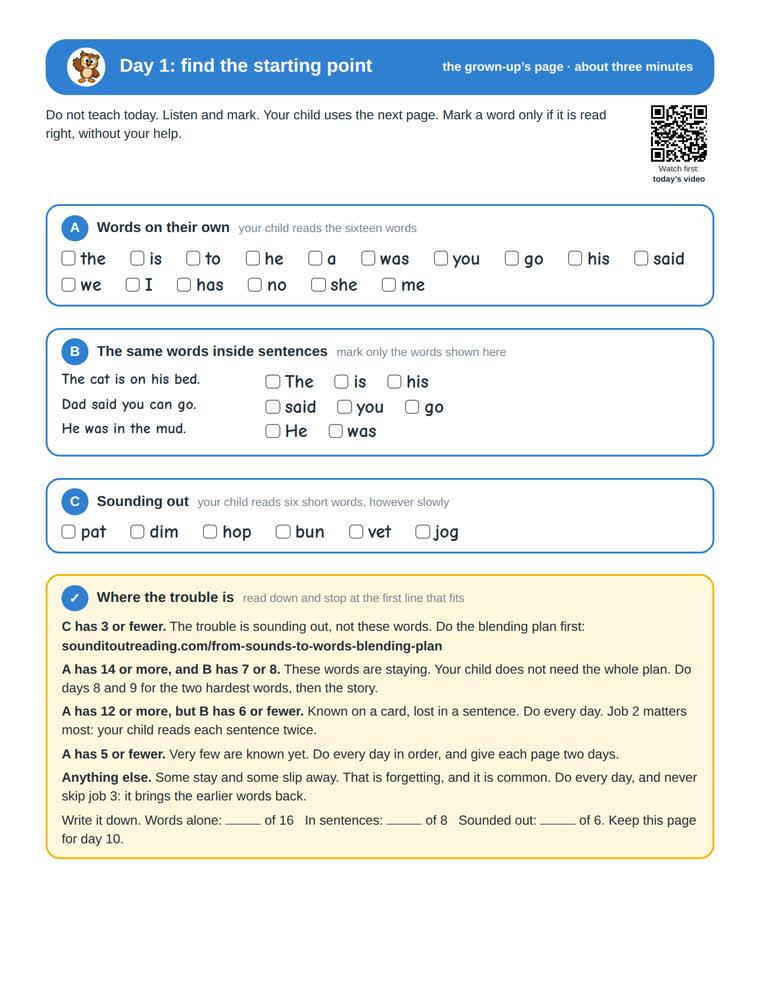
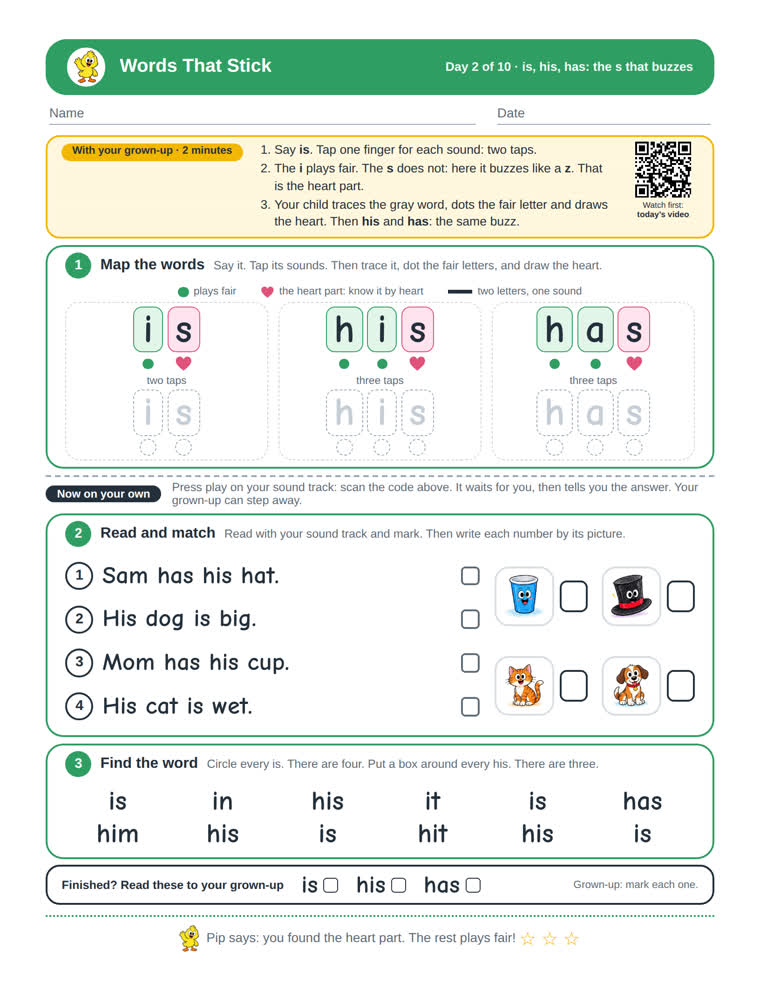
  • 22 printable pages, one short day at a time
  • 11 short videos that show you each day before you do it
  • 4 sound tracks your child works with alone, while you step away
  • A check on day 1 and day 10, and a report
  • About five minutes a day from you
  • $19, one payment. 30-day money back.

See the 10-day plan →Or do the free 3-minute check first