Home › The Reading Lab

Guessing words from pictures

Why panels advise against guessing

The short answer

Is it a problem when my child guesses words from the picture or the first letter?

A U.S. expert panel discourages letting children guess unfamiliar words from the first letters or the pictures, because guessing will not work with harder texts. A national review in England said beginners taught to lean on pictures are far less likely to use their phonics on the print.

What the research found

  • 5 × Expert advice, not a trial
  • 2 × Reported by a research review
  1. The review describes the "three-cueing" approach as one where beginners use meaning, grammar and letter-sound cues together to form a guess about a word.

    In the source’s own words“beginning readers use semantic, syntactic, and “graphophonic” (letter-sound) cues simultaneously to formulate an intelligent hypothesis about a word’s identity”
  2. The panel discourages letting children guess unfamiliar words, because guessing will not work with harder texts.

    In the source’s own words“The panel discourages teachers from allowing students to use guessing strategies to identify unfamiliar words, because these will not be effective with more-advanced texts.”
  3. The panel names guessing from the first letters or from the pictures as habits to discourage.

    In the source’s own words“For example, discourage students from guessing unknown words using beginning letters or pictures.”
  4. The panel also cautions adults against giving riddle-like hints that lead a child to guess the word.

    In the source’s own words“The panel also cautions against giving hints that encourage students to guess a word as if answering a riddle”
  5. The Rose Review said beginners who are taught as a habit to work out the word from the picture are far less likely to use their phonics on the print.

    In the source’s own words“where beginner readers are taught habitually to infer the word they need from pictures they are far less likely to apply their developing phonic knowledge and skills to print.”
  6. The Rose Review said skilled readers do not depend on such strategies to read words, because they can already recognize words.

    In the source’s own words“skilled readers do not rely upon strategies to read words, as they have already developed the skill of word recognition.”
  7. The appendix to the Rose Review reports that children with weaker word reading lean on context more than children with good word reading.

    In the source’s own words“Children with poorer word recognition skills show larger facilitatory effects of context on word recognition than children with good word recognition skills”
    Reported by a research reviewSource 3, Appendix 1, paragraph 42, p. 83

What this means at home

  • When your child guesses, point back to the letters and ask for the sounds.
  • Avoid riddle-like hints that invite a guess.
  • Keep enjoying books and stories together. The concern is guessing words, not sharing books.
  • The free check for guessing words points to why your child is guessing.

What the research does not tell us

  • The Rose Review does not say to keep books and stories away from beginners; it says the opposite.
  • The Rose Review appendix says context still matters for understanding a text; the concern is about using it to identify words.
  • The 'moderate' rating is for Recommendation 4 as a whole (daily reading of connected text); the warning about guessing is the panel's advice inside that recommendation and has no separate rating.

Sources

We read each of these ourselves on October 9, 2026. Follow the links to read them too.

  1. Ending the Reading Wars: Reading Acquisition From Novice to Expert. Anne Castles, Kathleen Rastle, and Kate Nation; Psychological Science in the Public Interest, 19(1), 5-51 (text read: the authors' accepted manuscript held in the Oxford University Research Archive). 2018.A peer-reviewed narrative review by three reading researchers of the research on how children learn to read, from first letters to skilled reading.ora.ox.ac.uk/objects/uuid:0828c38f-5fbc-4096-a23f-66be36775f99
  2. Foundational Skills to Support Reading for Understanding in Kindergarten Through 3rd Grade. Foorman, B., Beyler, N., Borradaile, K., Coyne, M., Denton, C. A., Dimino, J., Furgeson, J., Hayes, L., Henke, J., Justice, L., Keating, B., Lewis, W., Sattar, S., Streke, A., Wagner, R., & Wissel, S.; Institute of Education Sciences, What Works Clearinghouse (NCEE 2016-4008). 2016.A U.S. government practice guide in which an expert panel made four recommendations and What Works Clearinghouse staff rated the evidence behind each from studies published from 2000 to 2014. (Text read: the guide's PDF converted to text in reading order; texts/ies_foundational.txt is the earlier column-layout copy of the same guide.)ies.ed.gov/ncee/wwc/PracticeGuide/21
  3. Independent Review of the Teaching of Early Reading: Final Report. Jim Rose; Department for Education and Skills (England). 2006.A review commissioned by the government of England, based on research evidence, visits to schools by inspectors, and consultation, on how early reading should be taught.dera.ioe.ac.uk/5551/2/report.pdf

How we write these pages

  1. We read the source itself, not a news story about it.
  2. Every finding on a page names its source and where in the source it is found, so you can check it.
  3. We say how strong the evidence is, in the words of the people who reviewed it.
  4. We say what the research does not tell us. Most studies are done in schools, and no study can say what one child needs.
  5. If we get something wrong, tell us at hello@sounditoutreading.com and we will correct the page.

More from The Reading Lab

See all the research pages

More than worksheets

Does this sound like your child?

“Guesses words from the first letter or the picture, or “reads” books from memory”

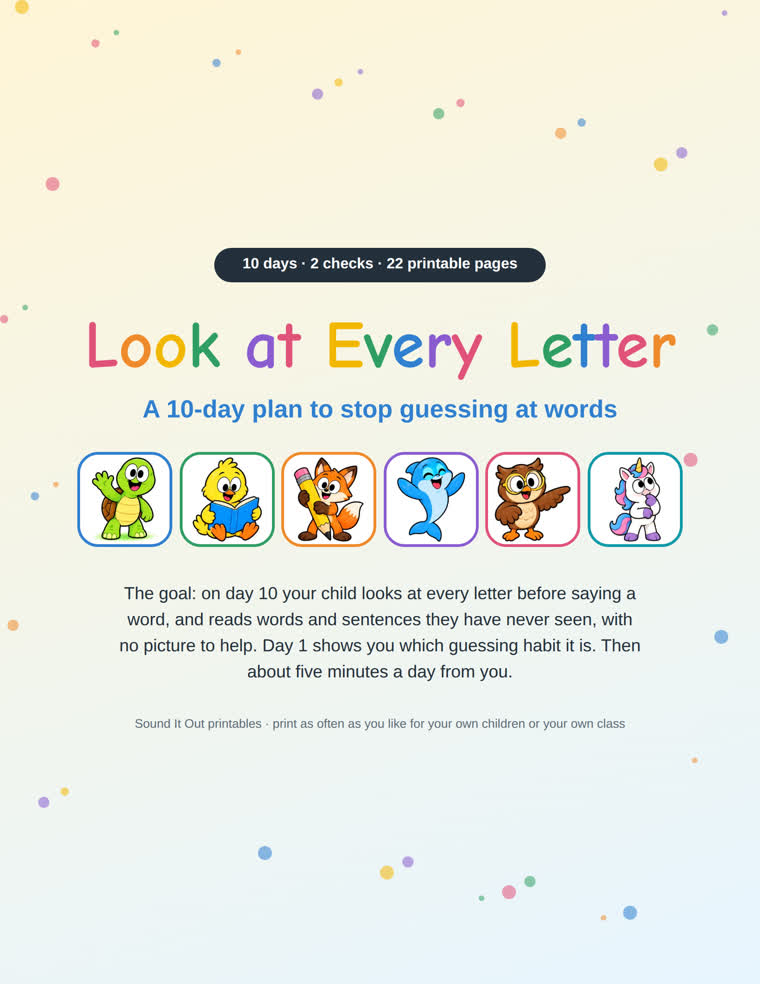
Look at Every Letter is a full 10-day plan, with a short video that shows you every step. The goal: on day 10 your child looks at every letter before saying a word, and reads words and sentences never seen before, with no picture to help. It is the goal, not a promise.
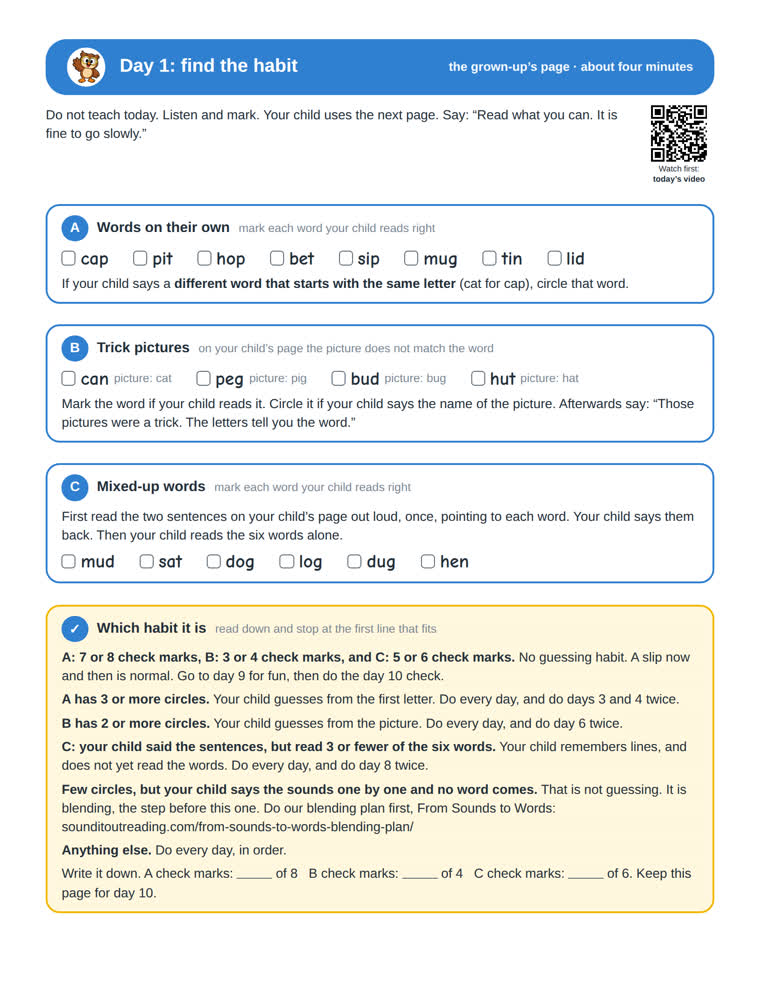
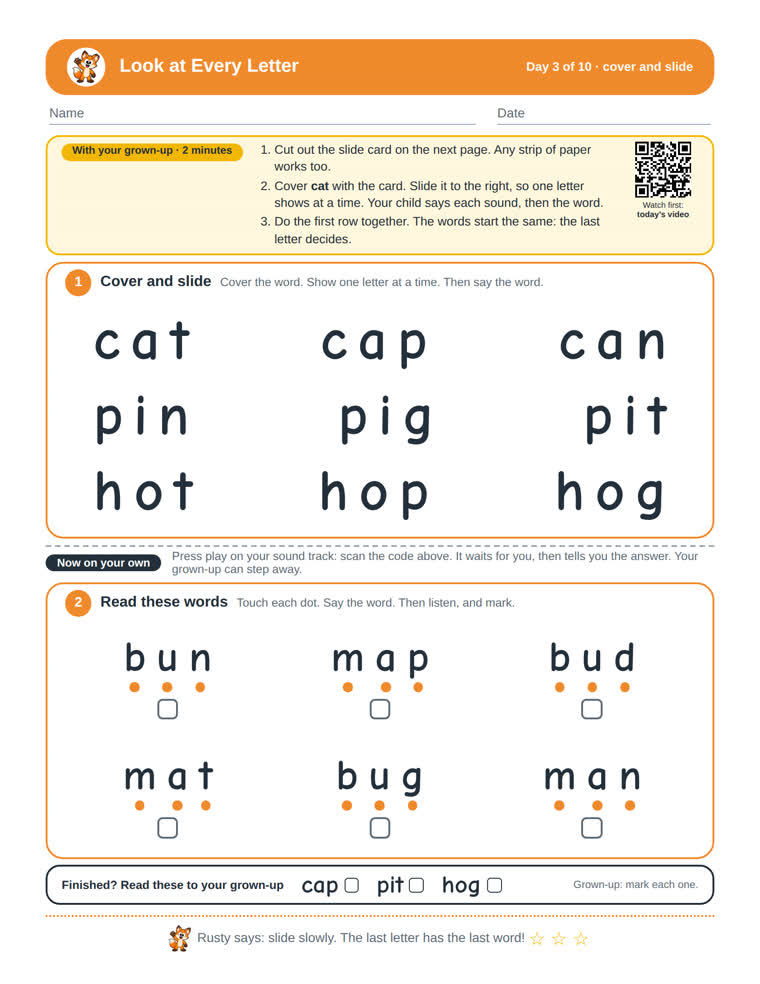
  • 22 printable pages, one short day at a time
  • 11 short videos that show you each day before you do it
  • 4 sound tracks your child works with alone, while you step away
  • A check on day 1 and day 10, and a report
  • About five minutes a day from you
  • $19, one payment. 30-day money back.

See the 10-day plan →Or do the free 3-minute check first