Home › The Reading Lab

Letter names or letter sounds?

Which comes first, and how many at a time

The short answer

Should I teach letter names or letter sounds first, and how many at a time?

The U.S. practice guide teaches each letter together with its most common sound, a few sounds at a time, once a child can pick out single sounds in spoken words. A national review in England advised teaching letter names as part of early phonics, since children meet the names everywhere.

What the research found

  • 4 × Strong evidence
  • 2 × Expert advice, not a trial
  • 1 × Reported by a research review
  1. The guide says to teach each letter together with its sound, a few sounds at a time, once a child can pick out single sounds in spoken words.

    In the source’s own words“Once students have learned to isolate phonemes in speech, teach students each letter of the alphabet and their corresponding sounds, working with a few phonemes at a time”
  2. The guide says to start with the most common sound for each letter and to bring in letter sounds one at a time.

    In the source’s own words“start with the most common sound each letter represents, and introduce each letter sound one at a time.”
  3. The guide gives five sounds as an example of a first group to teach.

    In the source’s own words“For example, the first group of phonemes taught could be /s/, /m/, /d/, /p/, /a/.”
  4. In the guide's routine the adult starts by naming the letter and shows it in both capital and small form.

    In the source’s own words“For each phoneme, begin by naming the letter or letters that represent the phoneme (e.g., p for /p/ or s and h for /sh/). Introduce the letters in both uppercase and lowercase.”
  5. The panel recommends building on the letters a child already knows, such as those in the child's name, and adding new ones.

    In the source’s own words“The panel recommends building upon this foundation by reinforcing familiar letters and introducing new ones.”
  6. The Rose Review reported that children often learn letter names before letter sounds, and that five-year-olds who know more names also know more sounds.

    In the source’s own words“research indicates that children often learn letter names earlier than they learn letter sounds and that five year olds who know more letter names also know more letter sounds.”
  7. The Rose Review advised teaching letter names as part of early phonics work, because children meet letter names in and out of school.

    In the source’s own words“Given that children will meet many instances outside, as well as within, their settings and schools where letter names are used, it makes sense to teach them within the programme …”

What this means at home

  • Teach a letter and its most common sound together.
  • Work on a few sounds at a time, and bring in new ones one at a time.
  • Build on letters your child already knows, such as the ones in their name.
  • The free letter sounds check shows which sounds your child knows firmly and which are still shaky.

What the research does not tell us

  • The Rose Review says researchers do not fully understand why knowing letter names goes together with knowing letter sounds.
  • The guide's ratings rest on studies published from 2000 on.
  • The 'strong' rating is for Recommendation 2 as a whole (sound awareness plus letter-sound teaching); the guide does not give a separate rating to the order of names and sounds or to the number of letters taught at once.

Sources

We read each of these ourselves on October 9, 2026. Follow the links to read them too.

  1. Foundational Skills to Support Reading for Understanding in Kindergarten Through 3rd Grade. Foorman, B., Beyler, N., Borradaile, K., Coyne, M., Denton, C. A., Dimino, J., Furgeson, J., Hayes, L., Henke, J., Justice, L., Keating, B., Lewis, W., Sattar, S., Streke, A., Wagner, R., & Wissel, S.; Institute of Education Sciences, What Works Clearinghouse (NCEE 2016-4008). 2016.A U.S. government practice guide in which an expert panel made four recommendations and What Works Clearinghouse staff rated the evidence behind each from studies published from 2000 to 2014. (Text read: the guide's PDF converted to text in reading order; texts/ies_foundational.txt is the earlier column-layout copy of the same guide.)ies.ed.gov/ncee/wwc/PracticeGuide/21
  2. Independent Review of the Teaching of Early Reading: Final Report. Jim Rose; Department for Education and Skills (England). 2006.A review commissioned by the government of England, based on research evidence, visits to schools by inspectors, and consultation, on how early reading should be taught.dera.ioe.ac.uk/5551/2/report.pdf

How we write these pages

  1. We read the source itself, not a news story about it.
  2. Every finding on a page names its source and where in the source it is found, so you can check it.
  3. We say how strong the evidence is, in the words of the people who reviewed it.
  4. We say what the research does not tell us. Most studies are done in schools, and no study can say what one child needs.
  5. If we get something wrong, tell us at hello@sounditoutreading.com and we will correct the page.

More from The Reading Lab

See all the research pages

More than worksheets

Does this sound like your child?

“Does not know the letter sounds, or learns them and forgets them”

Eight Sounds That Stay is a full 10-day plan, with a short video that shows you every step. The goal: on day 10 your child says the sound of eight letters, in any order, a day after the last lesson, and uses them to read short words never seen before. It is the goal, not a promise.
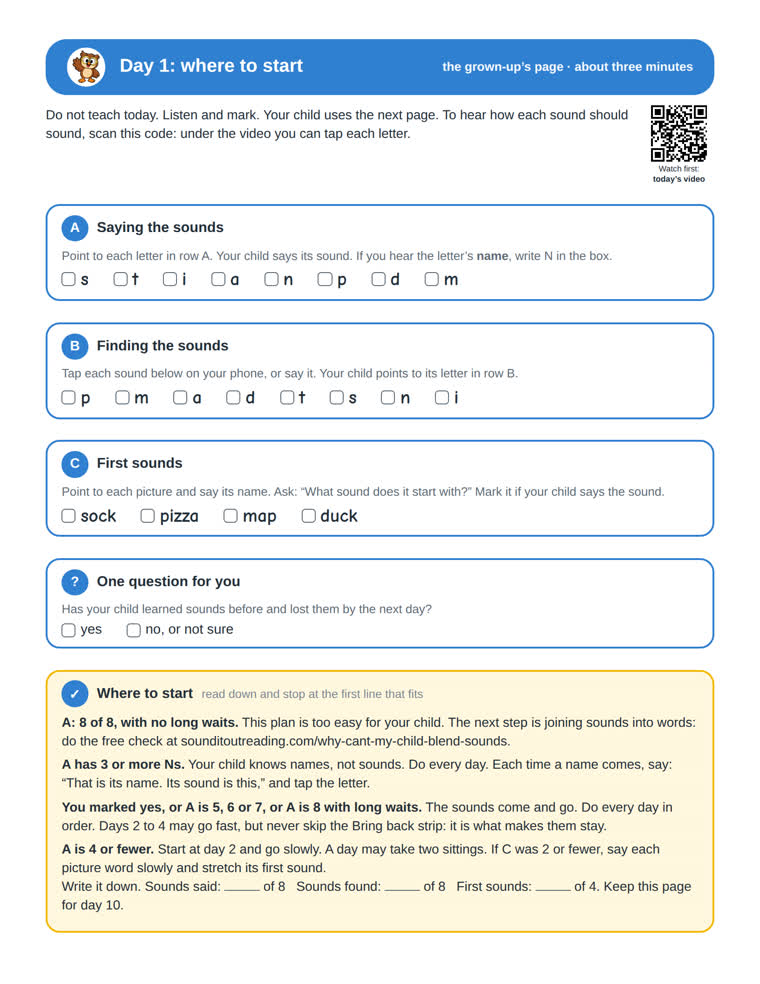
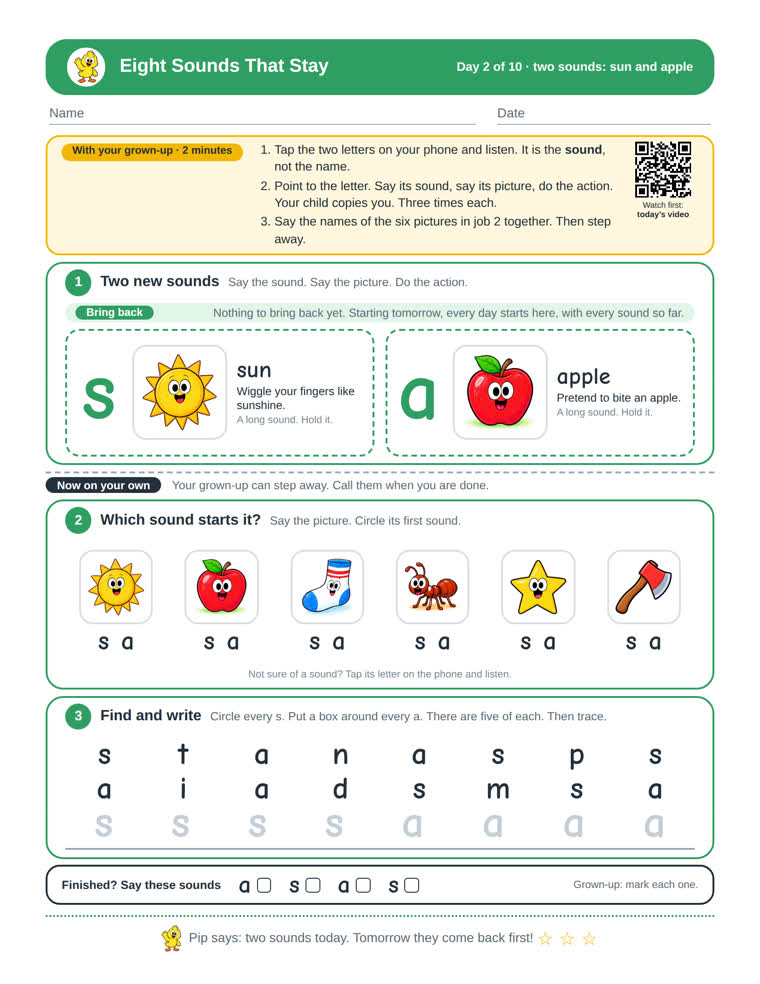
  • 22 printable pages, one short day at a time
  • 11 short videos that show you each day before you do it
  • 3 sound tracks your child works with alone, while you step away
  • A check on day 1 and day 10, and a report
  • About five minutes a day from you
  • $19, one payment. 30-day money back.

See the 10-day plan →Or do the free 3-minute check first