
Home › Guides › Learn to Read
Home › Guides › Learn to Read
 Detective CometSee every case →
My child is struggling with reading. How can I help at home?What we found: the short answer
Here is how to help a struggling reader at home: find the reading step that is hard, then practice that step a few minutes every day. Check letter sounds, blending, common words and smooth reading in that order. Read aloud together for fun, and share what you see with the school.
By Julz, founder of Sound It Out. Updated 2026-10-15.
Reading is built in steps: hearing sounds, knowing letter sounds, blending, reading common words, reading smoothly and understanding.
When one early step is shaky, everything after it feels hard. A child may seem to struggle with books when the real gap is blending.
Some children need more practice than their classmates to master each step. That is common and not a sign of low intelligence.
Some have a reading difficulty such as dyslexia. Only a qualified professional can diagnose it.
Whatever the reason, finding the hard step is the start of helping.
It helps to remember that struggling is not the same as failing. A struggling reader is a child who needs a different path or more practice, not a child who cannot learn.
Many struggling readers also find spelling hard. Spelling words with the same pattern as reading practice helps both.
Start with letter sounds. Can your child say the sound of each letter quickly?
Then blending. Can your child read a short word like map by joining the sounds?
Then common words and patterns. Does your child read the, was, ship and cake?
Then smooth reading. Does your child read a short page without stopping on every word?
The first step that is not firm is where to start. A free check can help you find it.
Write down what you find for each step, such as knows 20 letter sounds, blends slowly, guesses long words. That list is your plan.
A free check takes only a few minutes and gives you a clear starting point.
Spend ten to fifteen minutes a day on the hard step. Short, daily practice beats long sessions.
Start each session with a quick review of what is already known. Easy wins build confidence.
Then practice the hard step with a few examples. Keep it small enough that your child succeeds most of the time.
End with a short book or sentence your child can read. Reading real text matters every day.
Move to the next step only when the current one is easy on most days.
Here is an example. If blending is the hard step, practice five short words a day, saying each sound and joining them. End with one sentence using those words.
Use the same order every day: review, practice, read. A steady routine reduces arguments.
Reading aloud to your child keeps the love of stories alive while skills catch up.
Choose books your child enjoys, even if they are too hard to read alone.
Talk about the story, the pictures and new words. This builds vocabulary and understanding.
Take turns if your child wants: you read one page, your child reads a short line.
This shared time also reminds your child that reading is about stories, not only practice.
Audiobooks can also help older struggling readers enjoy stories at their level of understanding while reading practice continues.
Children who hear many stories have more words and ideas, which helps reading later.
 Practice this in the free reading appReading games your child can play on a phone, tablet or computer. Every word can be sounded out. No sign-up.Open the app
Struggling readers often feel embarrassed. Avoid comparing your child to siblings or classmates.
Praise effort and careful reading, such as you looked at every letter.
Keep a chart of skills learned. Seeing progress helps your child keep going.
Use easy books for independent reading, so your child can feel success.
Never use reading as a punishment. It should feel like a shared project.
Avoid long homework battles. If homework reading turns into tears, ask the teacher if a shorter or easier book can be used for now.
Let your child pick the reward for a week of practice, such as a trip to the library.
Older children often have gaps from earlier steps. Check letter sounds and blending, even in second or third grade.
Use materials that are not babyish, such as short chapter books with simple words or nonfiction about their interests.
Practice reading longer words by splitting them into parts, like sun-set or rab-bit.
Rereading short passages several times builds smooth reading.
Ask the school about extra reading support and how progress is measured.
Older readers also benefit from reading the same short text several times. Each reading gets smoother, and confidence grows.
Graphic novels and comics can draw older struggling readers into books.
Talk to the teacher about what you see at home. Ask which reading skills are strong and which need work.
Ask what support is available, such as small-group reading or a reading specialist.
In the US, you can ask in writing for an evaluation if you think your child may have a learning disability.
Ask how you can match home practice to what happens in class.
Keep notes and examples of your child’s reading to share at meetings.
Bring a short list of what you have tried and what helped. Specific notes make meetings with the school more useful.
Ask the school how often they will update you on progress.
Monday: a short review of known sounds, then the hard step with five examples, then one short book. Tuesday and Wednesday: the same hard step with new examples, and the same book again.
Thursday: a game with the week’s words, such as bingo or word building with tiles. Friday: read the week’s book to a family member and celebrate.
Every day, also read aloud to your child for ten minutes, just for fun. Keep this time free of questions and corrections.
Repeat the week with the same step until it is easy, then move to the next one. A steady routine like this is easier to keep than a new plan every week.
On busy days, do three minutes instead of fifteen. A short session keeps the habit alive.
Read a sign, a label or a menu together instead of a book.
Play a quick sound game in the car. Small moments still count.
Reading aloud at bedtime counts too. Even ten minutes of a favorite story keeps your child connected to books.
Go back one step. Strong basics make later steps much easier.
Make sessions shorter but keep them daily.
Check vision and hearing with your doctor if they have not been checked recently.
If you see signs of dyslexia, such as trouble learning letter sounds after lots of practice, ask about an evaluation.
A structured plan that teaches each step in order can give you a clear path.
Remember to look after yourself too. Helping a struggling reader takes patience, and short breaks help everyone.
Do not wait for a diagnosis to start helping. Practice at home helps whatever the cause.
Your child knows all letter sounds and blends new words.
Your child reads common words quickly and sounds out new ones instead of guessing.
Your child reads short books with few mistakes.
Your child is less upset at reading time and sometimes reads alone.
Keep going. Catching up takes time, and steady practice works.
Share the progress with your child. Hearing that you can read this now and you could not last month is powerful.
Celebrate every step, not only the finish line.
 Find the first step that is not firm.
 Practice ten to fifteen minutes a day.
 Start each session with easy wins.
 Read aloud for fun every day.
 Praise effort, not speed.
 Talk to the school early.
Not sure where to start? Get a free plan for your child
Want the whole reading path, in order?The Reading Program gives you ten 10-day plans in the order reading is built, with a short video for you every day.See the Reading Program Listen and Say the WordYou say the sounds slowly, your child says the whole word. No letters to look at, so it trains the ear first.Play free
 Build the WordYour child hears a word and taps the letter tiles in the right order to build it.Play free
 Read the WordOne short word at a time, such as sat, pin or dog. Every word uses only the sounds of the level you choose.Play free
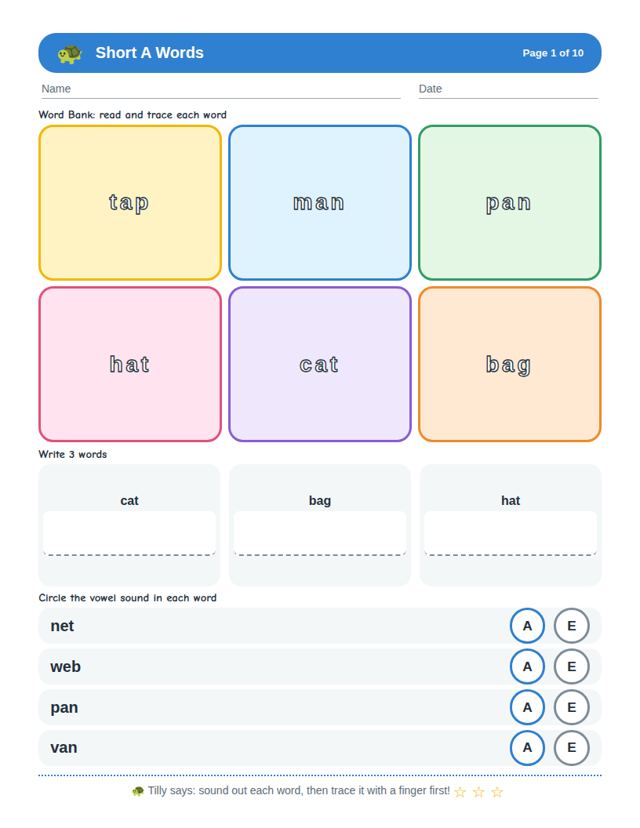
Short a words worksheets, CVC word family practice.
Get the free pages FREE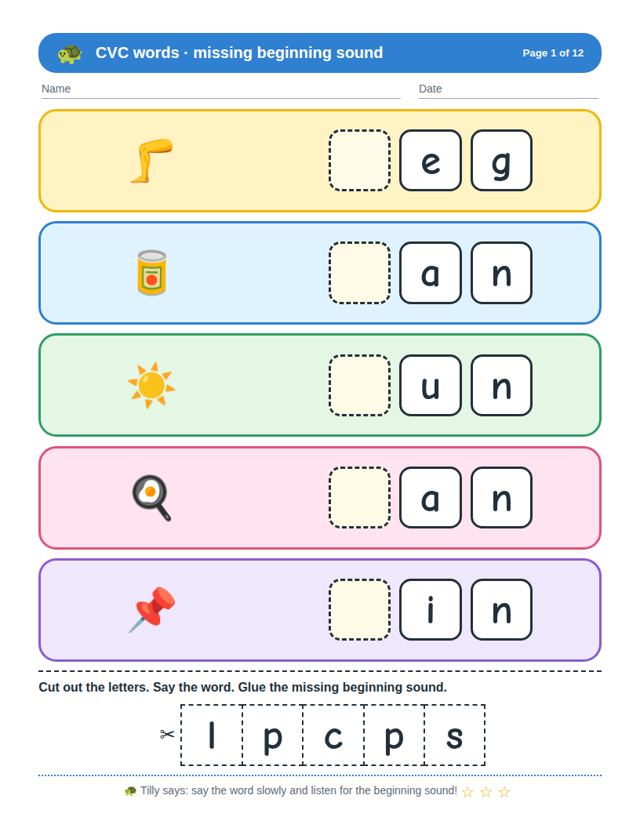
CVC cut and paste worksheets for beginning, middle and ending sounds.
Get the free pages $3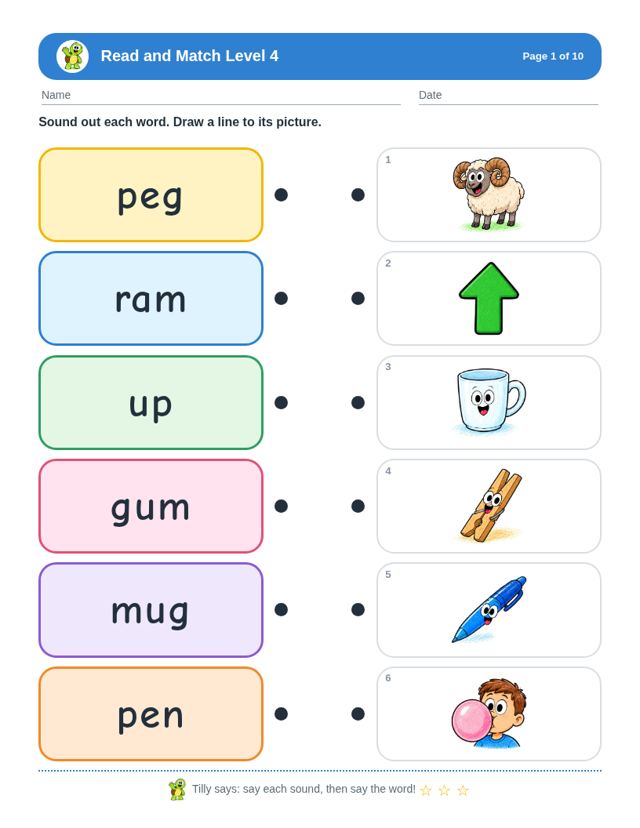
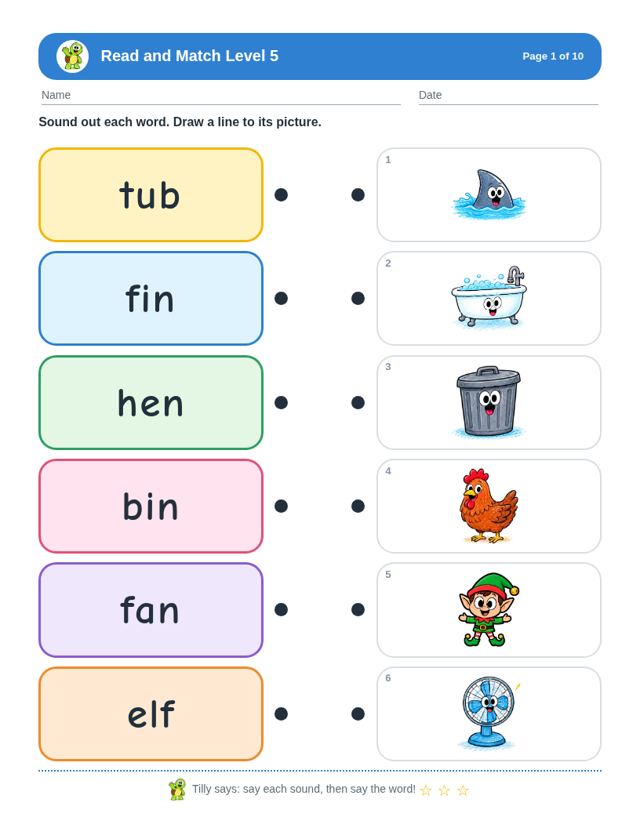
All 5 read and match level worksheet packs in one download.
See inside $3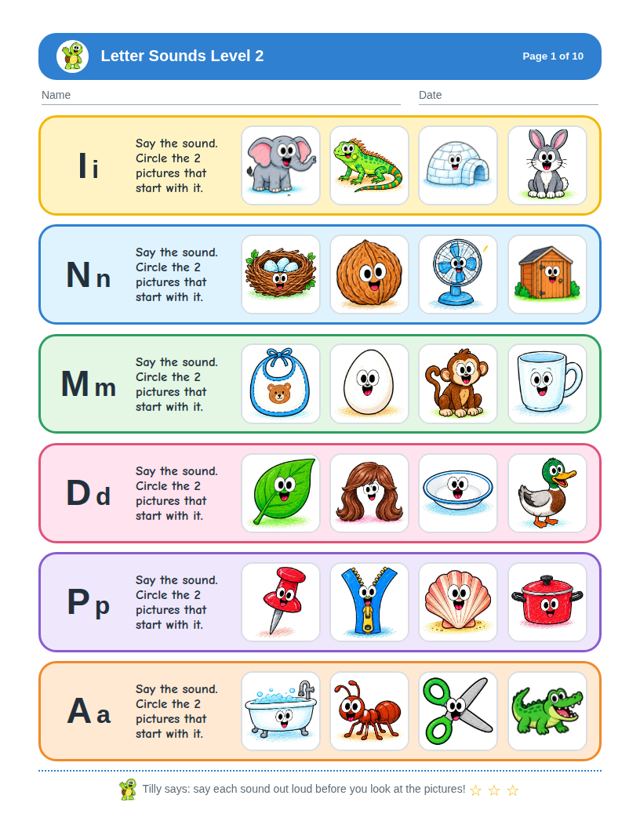
All 7 letter sounds level worksheet packs in one download.
See insideFind the reading step that is hard and practice it for a few minutes every day. Read aloud together for fun, and work with the school so home and class practice match.
Watch for trouble with letter sounds, blending, guessing at words, or very slow reading compared to classmates. A free check and a talk with the teacher can show where your child is.
Yes. With clear, step-by-step teaching and short daily practice, most children make real progress. Starting early helps, but it is never too late to begin.
Not necessarily. Many children struggle for other reasons, such as missed teaching. Only a qualified professional can diagnose dyslexia, so ask the school if you are worried.
Ten to fifteen minutes of focused practice on the hard step, plus reading aloud for fun, each day. Short and regular is the key.
Decodable books for your child to read alone, and books your child loves for you to read aloud. Easy books for independent reading help build confidence.
 Learn to ReadFree Phonics Games for KindergartenFree phonics games for kindergarten that build real reading: listening, blending, word building and sentence games, with tips to make each one count.Read the guide
 Learn to ReadHow to Find Your Child’s Reading LevelHow to find your child’s reading level at home: check each reading step in order, listen to your child read a short page, and choose books that fit.Read the guide
 Learn to ReadHow to Teach Digraphs: sh, ch and thHow to teach digraphs like sh, ch and th: show two letters making one sound, practice with pictures and word lists, and read and spell digraph words.Read the guide
“Behind in reading” can mean fourteen different things, and each one needs different help. Check off what is true for your child. You will see what to work on first, and what can wait.