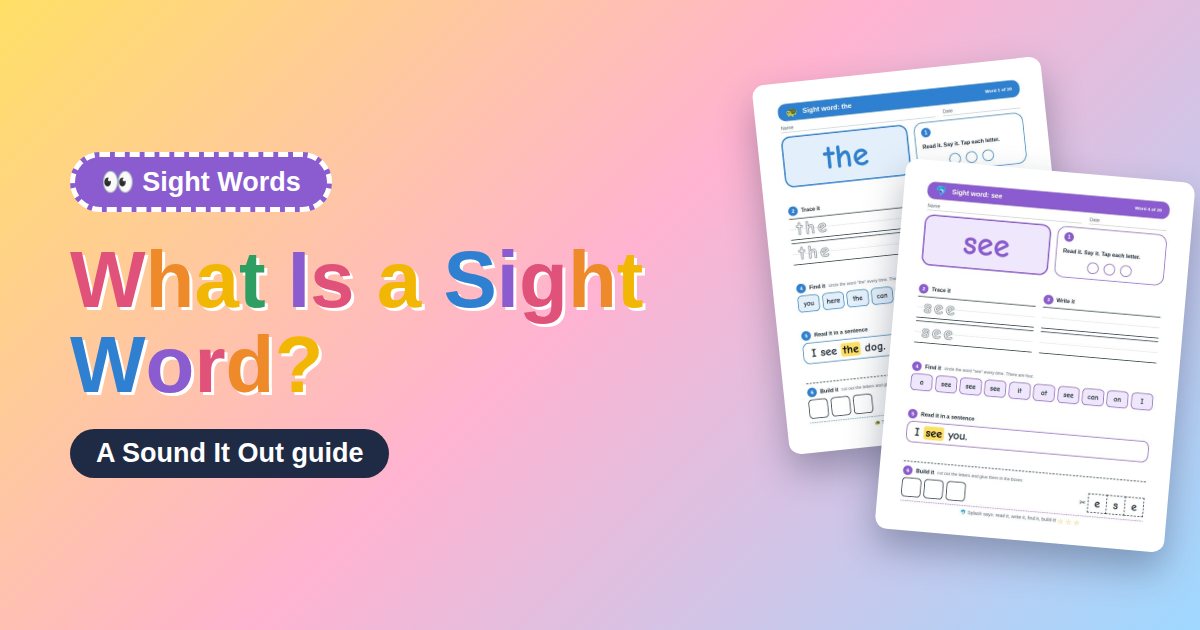
A sight word is a word a child learns to recognize by sight, without sounding out each letter. Many sight words, like 'the', 'said', and 'was', do not follow regular phonics rules, so children memorize how they look and sound. Learning sight words helps children read common words quickly, so reading sounds smooth instead of choppy.
1What Is a Sight Word, and Why Does It Matter?
Most English words can be sounded out letter by letter using phonics rules. The word 'cat' follows this pattern: c makes the /k/ sound, a makes the short a sound, and t makes the /t/ sound, so blending the three sounds gives the word. A sight word does not work this way. Words such as 'said', 'was', 'the', 'you', and 'they' break regular phonics rules, so sounding them out letter by letter gives the wrong word, or no word at all. A child has to learn these words by looking at the whole word, saying it out loud, and repeating this until the word is known right away.
Sight words matter because they make up a large share of the words in early books and sentences. Words like 'the', 'and', 'is', 'you', 'a', and 'was' appear on almost every page a child reads. When a child knows these words by sight, reading moves smoothly instead of stopping on every word. This frees up attention for sounding out new or harder words, like 'frog' or 'jump', in the same sentence.
2What Your Child Needs to Know First
Before starting sight words, a child should already know most uppercase and lowercase letters by name, and be able to say at least a few letter sounds, such as the sounds for m, s, a, t, and p. Sight words are easier to learn once a child understands that print carries meaning, that words are read from left to right, and that a word is made of separate letters, not one picture.
To check this in one minute, show your child five letters, such as m, a, t, s, and p, and ask them to name each one out loud. If they can name four or five of the five letters without help, they are ready to start learning sight words now. If they struggle to name more than one or two, spend a few more weeks on letter names and sounds before moving on.
3Step 1: Pick Five Words to Start With
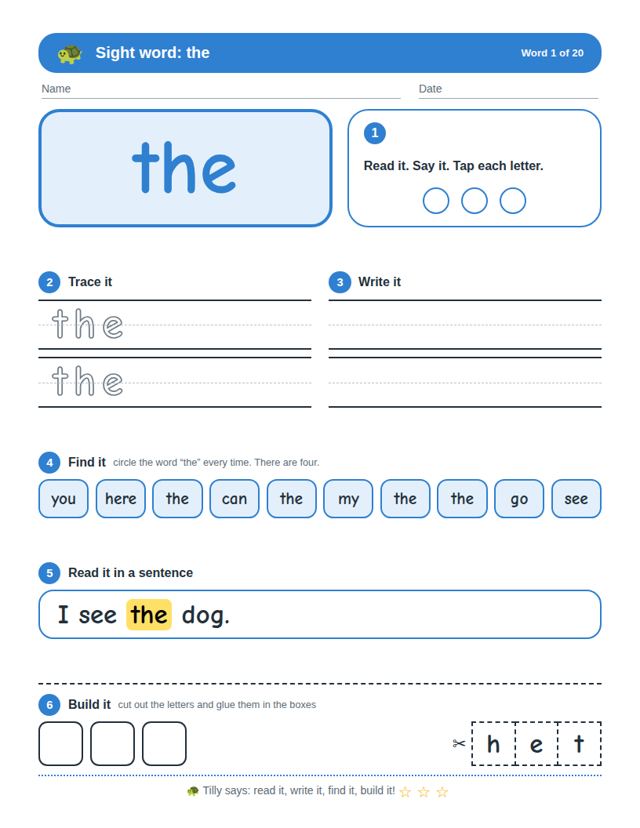
Start with five words at a time, not twenty. Good first words include 'the', 'and', 'is', 'you', and 'a'. These five words show up on nearly every page of an early reader book, so your child will see them again and again. Write each word on its own card in large, plain print, using the same lowercase letters your child sees in books.
Hold up the first card and say, 'This word is the. T-H-E spells the. Say it with me: the.' Point under the word as your child says it back to you. Do this for each of the five words, one at a time, before moving to the next word. Keep your voice calm and make it feel like a simple game, not a test.
4Step 2: Practice With Flash Cards Every Day
Each day, shuffle the five cards and show them one at a time. Say, 'What word is this?' and wait three seconds before helping. If your child says 'the' correctly, say, 'Yes, that word is the. Great job.' If they are not sure, say the word for them and have them repeat it: 'This word is and. Say and.'
Go through the stack two or three times in a row, no more than five minutes total. Mix the order of the cards each time so your child learns the word itself, not just its position in the pile. Praise quick, correct answers more than slow, correct ones, since speed is the real goal with sight words.
📖Practice this in the free reading appReading games your child can play on a phone, tablet or computer. Every word can be sounded out. No sign-up.Open the app5Step 3: Find the Words Inside Real Books
Once your child knows a word on a flash card, look for that same word inside a book you read together. Point to it and say, 'There is our word, the. Can you read it?' Seeing 'the', 'and', 'is', 'you', or 'a' inside a real sentence, not just on a card, helps your child understand why the word matters.
You can also point out sight words on signs, cereal boxes, or on paper around the house. Say, 'Look, there is the word is on this sign.' This kind of casual practice, spread through the day, often helps a word stick faster than flash cards alone.
6Step 4: Mix Old Words In With New Ones
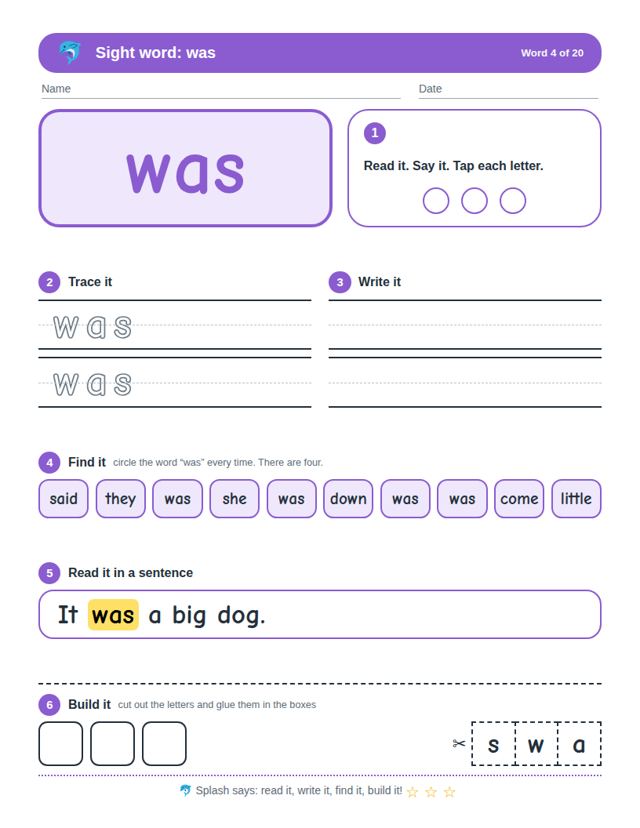
Once your child knows 'the', 'and', 'is', 'you', and 'a' without hesitating, add two or three new words, such as 'was', 'said', and 'they'. Keep the learned words in the stack too, so your child reviews them while learning new ones.
A simple way to say this to your child: 'You already know these five words. Today we are adding one more: was. W-A-S spells was.' Review the full set, old and new together, so the earlier words do not fade from memory while attention shifts to the newest word.
7What to Do When Sight Words Are Not Sticking
If your child knows a word one day and forgets it the next, this is common and does not mean something is wrong. It usually means the word has not been reviewed enough times yet. Go back to that single word for a few extra days, reviewing it at the start and end of practice, before adding a new word.
If your child mixes up similar-looking words, such as 'was' and 'saw', or 'said' and 'sad', slow down and compare the two words side by side. Say, 'This word is was, w-a-s. This word is saw, s-a-w. The letters are in a different order.' Practice the two words apart from each other for a few days before putting them back together.
If your child guesses a word from the first letter instead of looking at the whole word, cover less of the word with your finger, not more. Ask, 'Does that word look right from start to end?' and have them check the last letter too, not just the first one.
8How Much Sight Word Practice Is Enough
Five to ten minutes a day works better than one long session once a week. A normal week might look like this: Monday through Friday, spend five minutes on flash cards right after a snack or before bedtime, then read one short book together and point out the sight words inside it.
Keep review short so it stays fun. Many children lose interest after ten minutes of straight flash cards, so stop before boredom sets in, even if you planned more. Weekends can be lighter, such as just reading together and noticing sight words in a book, without any flash cards at all.
9How to Tell Your Child Is Ready for More Words
Your child is ready to add new words when they can read the current five words instantly, in any order, without sounding them out or pausing to think. They should also recognize the words inside sentences in a book, not only on flash cards.
Once a child reliably knows ten to fifteen sight words, you can start combining sight word practice with phonics, having your child read short sentences that mix a sight word like 'the' with a sounded-out word like 'cat', such as 'The cat sat.'
Quick tips
- ⭐Practice a small number of sight words at a time, such as five words a week.
- 🎈Say the word, spell it out loud, then say the word again each time you introduce a new card.
- 🌈Point out sight words in books, signs, and labels around the house.
- ✏️Review old sight words often so your child does not forget them.
- 🎯Keep each practice session under ten minutes so it stays fun.
- 💡Praise fast, correct answers to encourage automatic recognition, not just correct guessing.
- 🧩Write sight words in the same lowercase print your child sees in books.
 ➕ Addition and SubtractionMy Child Does Not Understand Subtraction: What to Do
 ✏️ Alphabet and HandwritingHow to Teach a Child to Hold a Pencil
 🔷 Shapes, Time and MoneyHow to Teach a Child to Tell Time