Home › Guides › Alphabet and Handwriting
When Should a Child Know All Their Letters?
 Detective CometSee every case →
Should my child know all the letters by now?What we found: the short answer
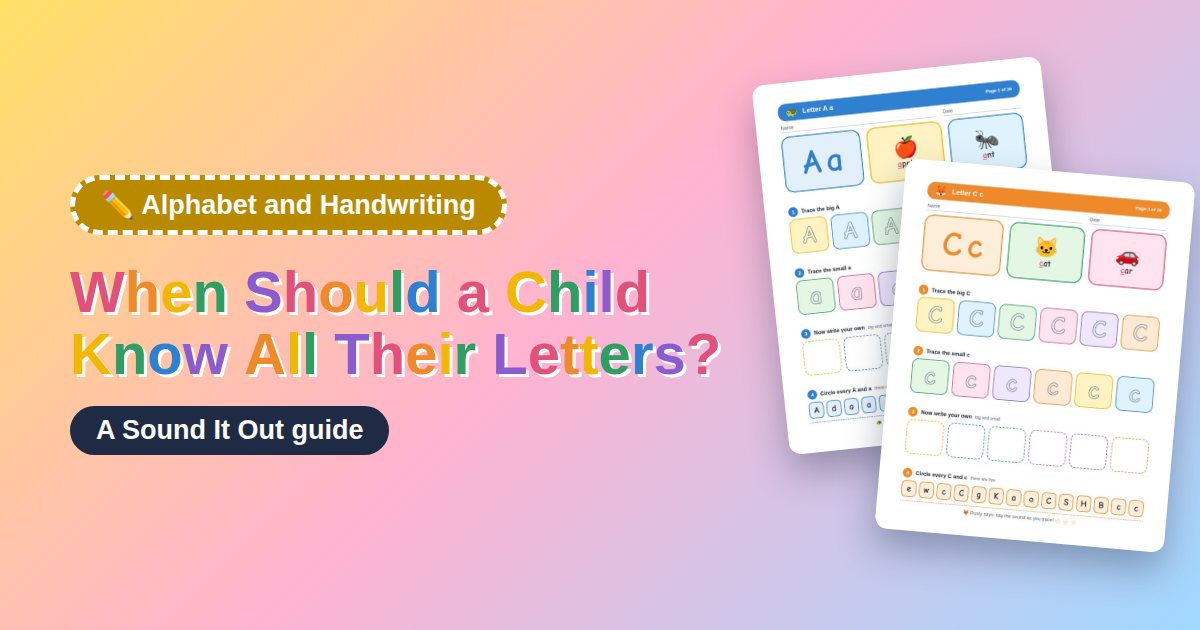
When should a child know all their letters? Many know all 26 uppercase letters by the end of kindergarten, around age 5 or 6. Lowercase often takes a little longer, because b, d, p and q look alike. A child does not need all 26 to start reading short words.
By Sound It Out. Updated 2026-10-15.
1When should a child know all their letters?
Many parents search for when a child should know all their letters, often after noticing another child the same age already names the whole alphabet. Letter learning is spread out over a few years. Many children learn a few letters, often the ones in their own name, around age 3. By age 4, many preschoolers can name several uppercase letters. By the end of kindergarten, around age 5 or 6, many children know all 26 uppercase letters and most lowercase letters too.
Lowercase letters almost always take longer than uppercase letters. Several lowercase letters look very different from their uppercase form, such as g, q and r. A few look like mirror images of each other, such as b and d. This is a normal part of learning letters, not a sign that something is wrong.
2What your child needs to know first
Before your child can learn all 26 letters, two smaller skills help a lot. First, your child needs to notice that print is made of separate shapes, not just decoration. Second, your child needs to be able to match two shapes that look the same, the same way they might sort socks by pattern.
Here is a quick check. Show your child two matching letter cards, such as two copies of M, and two cards that do not match, such as M and W. Ask your child to point to the two that look the same. If they can do this with several pairs, they are ready to start matching letters to sounds.
3Step 1: Start with the letters in your child’s name
Begin with the letters in your child’s name, since these matter most to them and come up every day. If your child is named Emma, start with E, M and A. If your child is named Carlos, start with C, A, R, L, O and S. Point to the first letter and say its sound, not its name: “This letter makes the sound eh, like at the start of Emma.”
Write the name in large, plain letters on a card. Point to each letter in order as you say the name slowly. Then mix up magnetic letters or letter cards and ask your child to put the name back in order. Repeat this for a few days until your child can do it without help.
4Step 2: Teach the letter sound, clean and short
Once your child knows a few letters, teach the sound each one makes, since the sound is what your child will use to read. Keep each sound clean and short: “mmm” for m and “sss” for s. For quick sounds, say a tiny “t”, “p” and “b” with no extra “uh” on the end. Teach the sound first. Letter names can come later, and they are not needed to start reading.
Teach two or three new sounds at a time instead of all 26 at once, and bring back every earlier sound each day. A good order is s, a, t, p, then i, n, m, d, then g, o, c, k, then ck, e, u, r. After those come h, b, f, l, then j, v, w, x, then y, z and qu. Point to a letter and ask, “What sound is this?” and wait for the answer before moving to the next letter.
 Practice this in the free reading appReading games your child can play on a phone, tablet or computer. Every word can be sounded out.Open the app
5Step 3: Match uppercase letters to lowercase letters
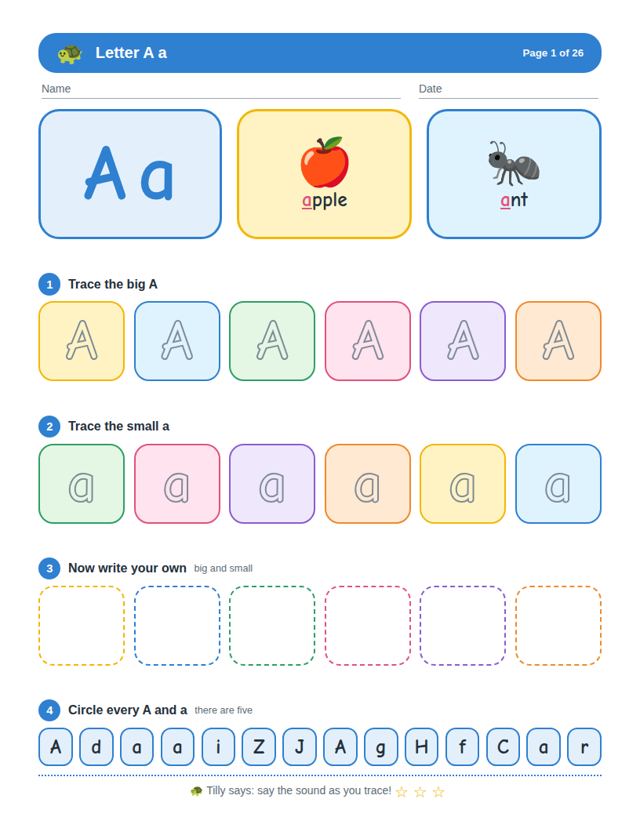
Books are printed mostly in lowercase, so match each uppercase letter your child knows to its lowercase form, one pair at a time. Begin with pairs that look alike, such as C and c, O and o, S and s, U and u, and V and v. Say, “This big C and this little c are the same letter.”
Move on to pairs that look different, such as A and a, G and g, Q and q, and R and r. Lay out uppercase cards in a row and ask your child to place the matching lowercase card under each one. This takes more practice than the easy pairs, so expect it to take longer.
6Step 4: Practice the letters that get mixed up
A handful of lowercase letters cause most of the confusion: b, d, p and q. These four letters use the same basic shape, a circle and a stick, just turned in different directions. Teach them one letter at a time instead of all four together. Start with b alone, and keep d away until b is steady.
Use a simple trick. Have your child make a fist with the left hand and stick up the thumb. The shape made by that hand looks like a lowercase b. When your child writes b, say the sound and the helper words: “bat first, then ball” (the line, then the round part). For d, say “c first, then d” (the round part, then up and down). When both are steady, bring them together with the word “bed”, which looks like a bed. Wait until b and d are steady before working on p and q.
7What to do when letter learning is not working
The most common problem is trying to teach too many letters at once. If your child seems to forget letters as fast as they learn them, stop adding new ones for now. Go back to the sounds your child knows, review them every day, and add one new sound only when those are steady.
Another common problem is mixing up letters that look alike, such as b and d, or m and n. When this happens, stop working on both letters in the same session. Teach one of the pair until your child is steady with it, then bring in the second one.
A third problem is losing interest after a few minutes. If your child gets restless, the session is too long or has too many letters in it. Shorten the session to five minutes and stop while your child still wants to keep going, even if that means stopping after just one letter.
8How much letter practice your child needs each week
Short, daily practice works better than one long session. Aim for five to ten minutes a day, most days of the week. A normal week might look like this: Monday, review three known letters and bring in one new letter. Tuesday through Thursday, practice the same four letters in a different way each day, such as tracing, matching cards and finding the letters in a book. Friday, review the whole week’s letters and point them out during a regular activity like reading a cereal box or a street sign.
Spread practice across the day in small moments instead of one sit-down lesson. Point out letters on signs, mail, grocery boxes or book covers. These short, natural moments add up.
9How to tell your child is ready for the next step
Your child does not need to know all 26 letters before starting to read words. The next step can begin as soon as your child knows the first few sounds. With s, a, t and p, a child can already read “at”, “sat” and “tap”. Your child does not need to be fast, just correct most of the time.
From there, keep adding two or three sounds at a time. Blend short words with the sounds your child knows, such as “pin”, “man” and “dog”. Common words like “the” come up on almost every page, so they can start here too. Match each sound to its letter or letters and mark only the part that has to be learned by heart. If your child knows the sounds but cannot yet join them into a word, the free blending check on this site takes about three minutes.
Quick tips
 Teach two or three new sounds at a time instead of all 26 at once, and review the earlier ones every day.
 Keep each sound clean and short: “mmm”, “sss”, and a tiny “b” with no extra “uh” on the end.
 Use your child’s name to teach the first few letters, since those matter most to them.
 Keep practice short and stop before your child gets tired or frustrated.
 Teach b, d, p and q one letter at a time, and add the next one only when the last is steady.
 Point out letters during everyday activities, like reading cereal boxes or street signs.
 Trace letters in sand or shaving cream before using a pencil on paper.
 Celebrate small wins, like spotting a letter in a new word.
Make these worksheets, free
Not sure where to start? Get a free plan for your child
Want the whole reading path, in order?The Reading Program gives you fifteen 10-day plans in the order reading is built, with a short video for you every day.See the Reading ProgramGood questions
What age should a child know the alphabet?
Many children can say the alphabet out loud by age 4 or 5. Knowing all 26 letters by sight, without singing the song, often comes by the end of kindergarten, around age 5 or 6. A child can start reading short words well before that, with only the first few letter sounds.
Is it normal for a first grader to still mix up letters?
Yes. Many first graders still mix up letters like b and d, or m and n. Mixing up b and d is common at five and six, and by seven it has usually settled. If your child is seven or older and still mixes them up often, tell your child’s teacher.
Should I teach uppercase or lowercase letters first?
Many preschools start with uppercase letters, since they are easier to tell apart and appear in names and book titles. Books are printed mostly in lowercase, so for reading your child needs the lowercase letters too. Teach each sound with its lowercase letter, and match it to the uppercase form.
Why does my child know a letter one day and forget it the next?
This is normal while a child is still learning. The letter has not been practiced enough times to stick in memory yet. Keep reviewing it in short sessions across several days instead of one long session, and it usually becomes more solid over time.
How many letters should a 4 year old know?
There is a wide range among 4 year olds. Many know several uppercase letters, often the ones in their name, while others know fewer. What matters more than the exact number is steady progress, so keep practicing a few letters at a time.
More guides
 Alphabet and HandwritingHandwriting Help for Kids With DysgraphiaHandwriting help for kids with dysgraphia: what it is, simple supports at home, letter practice that helps, and tools like typing and talk-to-text.Read the guide
 Alphabet and HandwritingHow to Help a Child Write SentencesHow to help a child write sentences: say it first, count the words, write with spaces, then check for a capital and a period. Steps, games and examples.Read the guide
 Alphabet and HandwritingHow to Teach a Child to Write Their NameHow to teach a child to write their name: start each letter at the top, trace, copy, then write alone, with a capital first letter and small letters after.Read the guide
Want the next sheet made for your child?
The packs on this site are free. The One Sheet goes further: one sheet a day, made for your child from what you tell us happened.
- No planning. Today’s sheet is ready every day.
- Made for your child. The next sheet is built from what you tell us.
- A few minutes of your time. Paper, not a screen.
See The One Sheet · $9.99 a month
Or try the 10-day plan: Know Every Letter, $19 one timeOr do the free 3-minute check first