
Home › Guides › Alphabet and Handwriting
Home › Guides › Alphabet and Handwriting
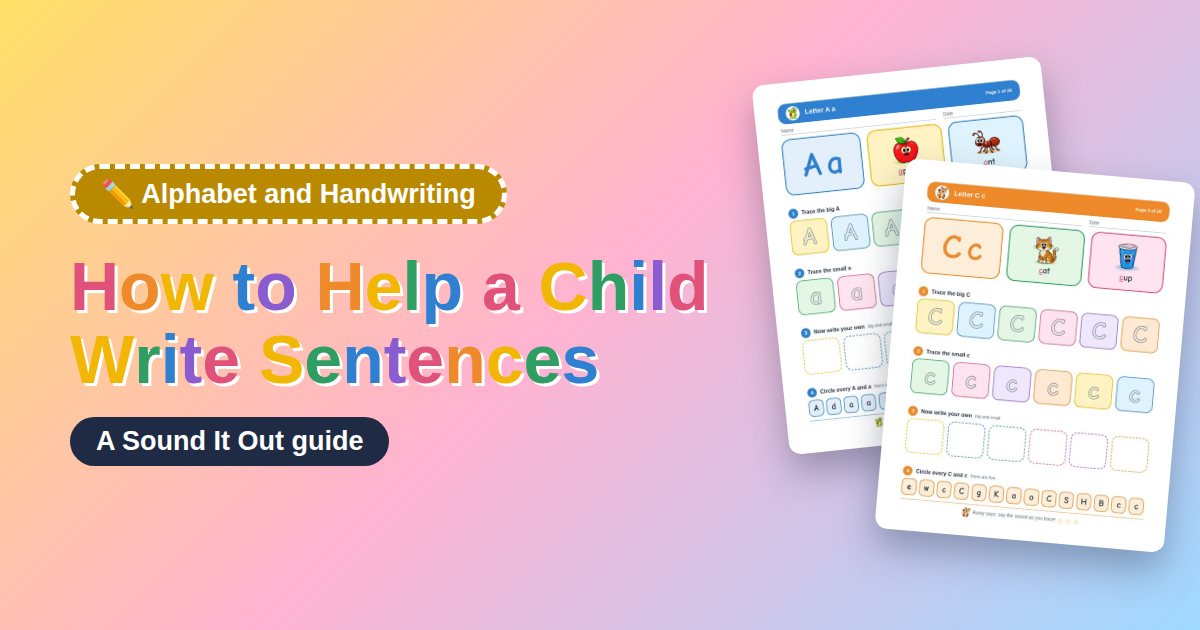
Writing a sentence asks a child to do many things at once: think of an idea, hold it in their head, spell each word and form each letter. Make it easier by splitting the job. Have your child say the sentence out loud first, count its words on fingers, write it one word at a time, then check for a capital letter, spaces and a period at the end.
A child writing a sentence has to remember what they want to say while they work out how to spell each word and how to form each letter. If spelling or handwriting is slow, the sentence gets lost halfway.
A U.S. Department of Education guide for schools says children should be taught to write sentences, along with handwriting and spelling, so these parts become easier.
Ask your child to tell you their sentence out loud before writing anything. Short is fine: I see a dog.
Then say it together and count the words on your fingers: I, see, a, dog. Four words. Now your child knows how much to write.
Have your child write the first word, then say the whole sentence again to find the next word. Saying it again keeps the sentence in their head.
Leave a finger space between words. If a word is hard to spell, let your child write the sounds they hear, then show the right spelling afterwards.
At the end, check three things together: a capital letter at the start, spaces between words, and a period at the end.
Praise the idea first, then the checks. One sentence a day, done well, builds the habit.
 Print free practice pagesFree pages from our packs, in color and in black and white.See the free pages
 Say the sentence out loud before writing.
 Count the words on fingers.
 Write one word, then say the sentence again.
 Leave a finger space between words.
 Check: capital, spaces, period.
Start with three to five words. Make them longer when short ones come easily.
No. Praise the idea and the checks first, then fix one or two words. Too many corrections at once makes writing feel hard.
Keep it to one sentence a day, about something your child cares about. Let them say it first, and you can write some words while they write the rest.
 Alphabet and HandwritingHandwriting Help for Kids With DysgraphiaHandwriting help for kids with dysgraphia at home: short practice, letter starts, wide lines, and other ways to write. When to ask for an evaluation.Read the guide
 Alphabet and HandwritingHow to Teach a Left-Handed Child to WriteSimple handwriting help for a left-handed child: how to tilt the paper, hold the pencil a little higher, and form letters without smudging.Read the guide
 Alphabet and HandwritingMy Child Struggles With Fine Motor SkillsYour child struggles with fine motor skills: holding a pencil, cutting, buttons. Simple daily play that builds hand strength, and when to ask for help.Read the guide
“Behind in reading” can mean fourteen different things, and each one needs different help. Check off what is true for your child. You will see what to work on first, and what can wait.