Home › Guides › Alphabet and Handwriting
Home › Guides › Alphabet and Handwriting
A left-handed child learns to write the same letters as everyone else, but a few small changes make it much easier. Let your child use the left hand. Tilt the paper the other way, to the right. Have your child hold the pencil a little higher, so they can see what they write. Sit on their left side when you show them, so your hand does not block the page.
Never push a left-handed child to switch hands. Many young children try both hands for a while before one becomes the clear favorite. Let your child choose.
Once your child mostly uses the left hand, set things up for that hand: the paper, the pencil and where you sit.
A right-handed child tilts the paper a little to the left. A left-handed child does the opposite: put the paper a little to the left of the middle and turn its top to the right.
This lets the arm move along the line without the hand curling over the top of the words. It also helps stop smudging.
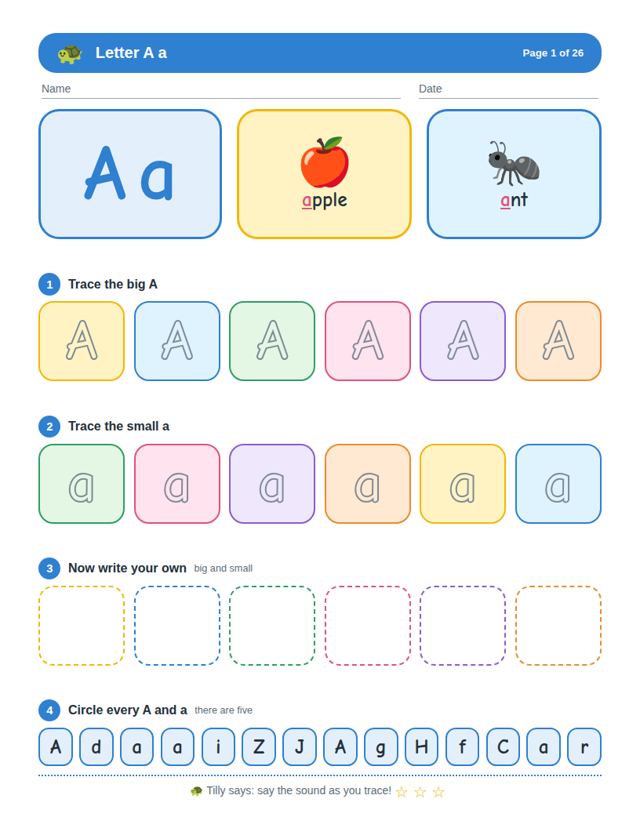
Have your child hold the pencil about a finger's width higher up than a right-handed child might. This lets them see the letters they just wrote.
The grip is the same: the pencil rests between thumb and first finger, held lightly, with the middle finger underneath. A pencil that does not smudge, or a soft pencil grip, can help.
Sit on your child's left when you show how to write a letter, so they can see your hand move. Better still, write the letter with your left hand, slowly, even if it looks wobbly.
Letters are formed the same way: start at the top, and go in the usual direction. Crossing a t from right to left is fine for many left-handed children.
 Print free practice pagesFree pages from our packs, in color and in black and white.See the free pages
 Tilt the paper so its top points to the right.
 Hold the pencil a little higher up.
 Sit on your child's left to show letters.
 Use a pencil or pen that does not smudge.
 Never make a left-handed child switch hands.
No. Let your child use the hand they prefer. Set up the paper and pencil for the left hand instead.
The hand moves over what was just written. Tilting the paper to the right and holding the pencil a little higher helps. A pen or pencil that dries fast helps too.
Many children use both hands at first, and a clear favorite often shows by about four to six. Let it happen on its own.
 Alphabet and HandwritingHandwriting Help for Kids With DysgraphiaHandwriting help for kids with dysgraphia at home: short practice, letter starts, wide lines, and other ways to write. When to ask for an evaluation.Read the guide
 Alphabet and HandwritingHow to Help a Child Write SentencesHow to help a child write sentences: say it first, count the words, write it, then check capital letter, spaces and period. Simple steps for home.Read the guide
 Alphabet and HandwritingMy Child Struggles With Fine Motor SkillsYour child struggles with fine motor skills: holding a pencil, cutting, buttons. Simple daily play that builds hand strength, and when to ask for help.Read the guide
“Letters are messy, start in the wrong place or face the wrong way”
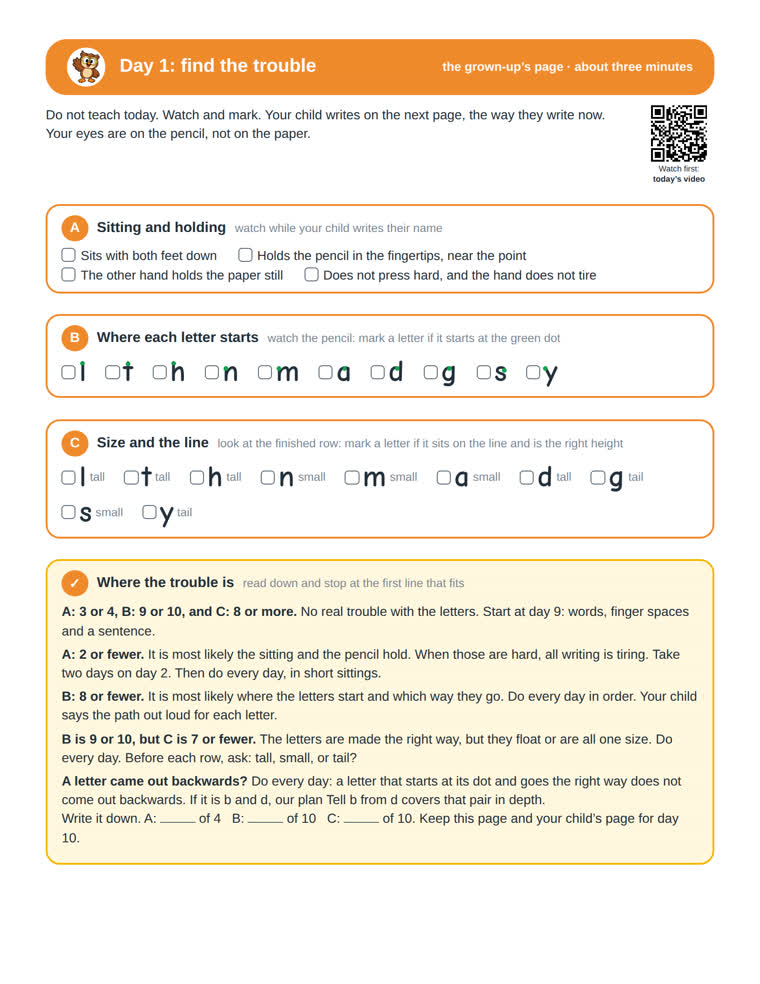
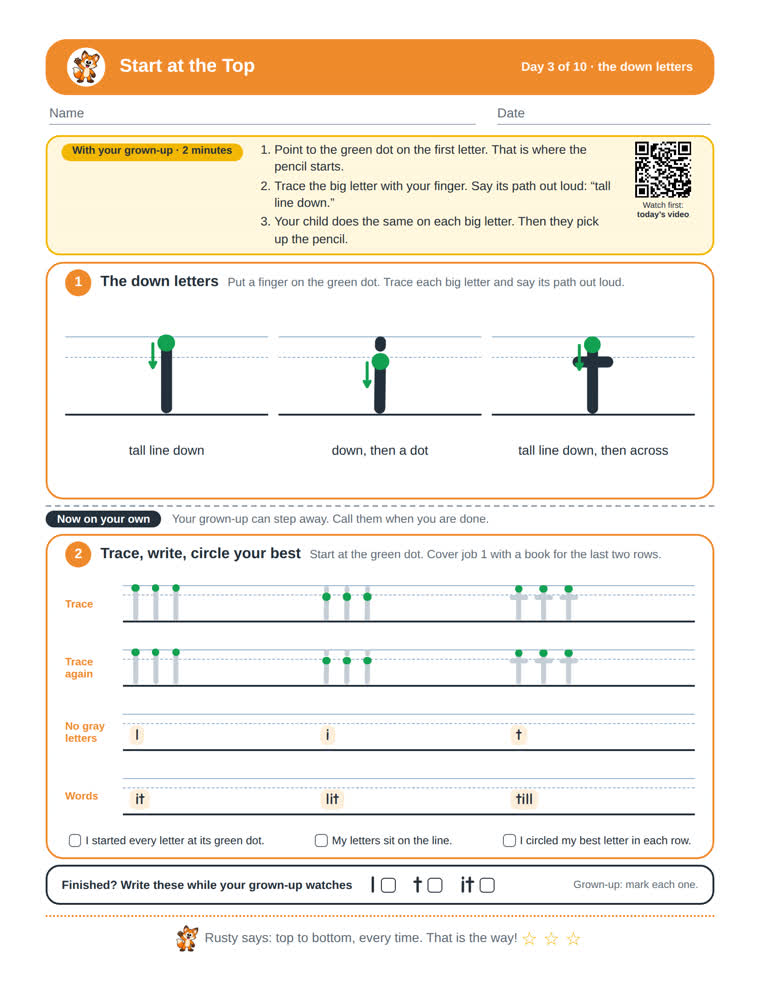
Start at the Top is a full 10-day plan, with a short video that shows you every step. The goal: on day 10 your child starts every small letter in the right place, sits it on the line, and writes new words that you can read. It is the goal, not a promise.