
Home › Guides › Learn to Read
Home › Guides › Learn to Read
 Detective PipSee every case →
The teacher said to read decodable books at home. What are they?What we found: the short answer
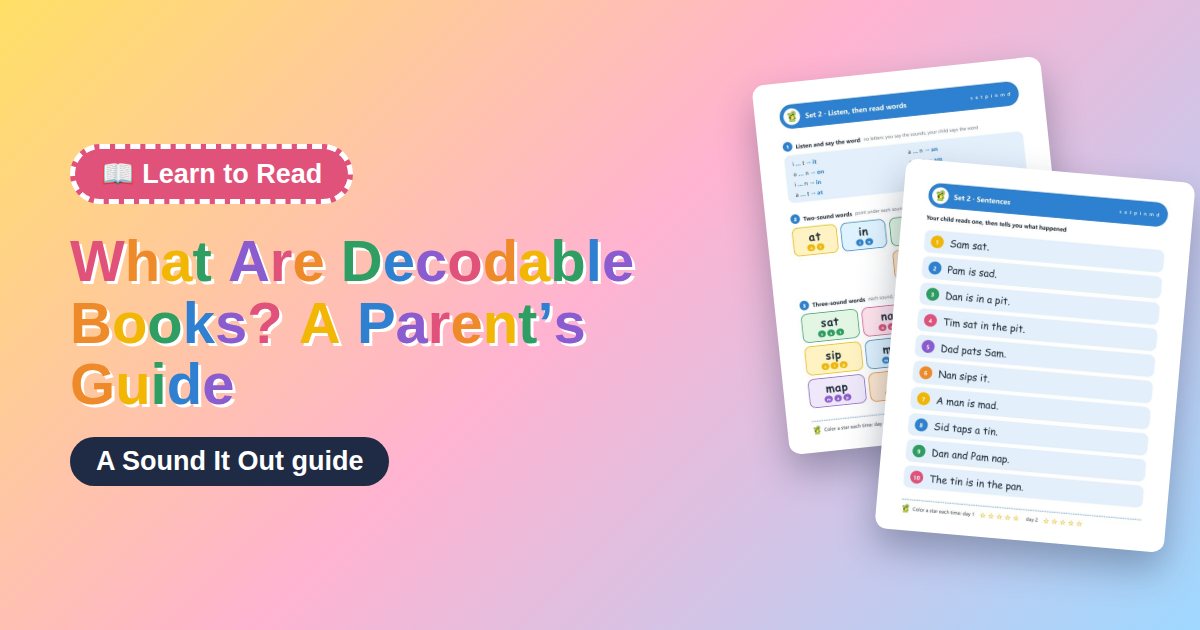
What are decodable books? They are simple books written almost only with letter sounds and patterns your child has already learned. A child who knows s, a, t and p can read Sam sat on a mat alone. That lets your child practice real sounding out, instead of guessing from pictures.
By Julz, founder of Sound It Out. Updated 2026-10-15.
A decodable book is a short book where nearly every word can be sounded out with the phonics your child knows. The words match the lessons, one step at a time.
An early decodable book might say: Tim has a cap. The cap is red. Every word follows the letter sounds, except a few very common words such as the and is.
Most decodable books come in sets or levels. Each level adds a few new sounds, such as sh, ck or silent e, so the books grow with your child.
They look plainer than picture books. The pictures are there to enjoy, not to give away the words.
Some schools call them phonics readers or decodable readers. The idea is the same in every case.
Think of a decodable book as practice that fits. It is like a swimming pool with a shallow end. Your child can practice the strokes safely before moving to deeper water.
When a child reads a regular picture book too early, many words cannot be sounded out yet. The child has to guess, often from the first letter or the picture.
Guessing can become a habit that is hard to break later. Decodable books remove the need to guess, because every word can be worked out.
A US Department of Education practice guide on early reading suggests having students read decodable text to prevent this kind of problem.
Each book also gives your child many chances to use the same sounds. That repeated practice is what turns slow sounding out into quick reading.
Finishing a whole book alone is a big confidence boost. Children who feel successful want to keep reading.
Reading research shows that teaching phonics step by step helps children learn to read. Decodable books are where that teaching turns into real reading, page after page.
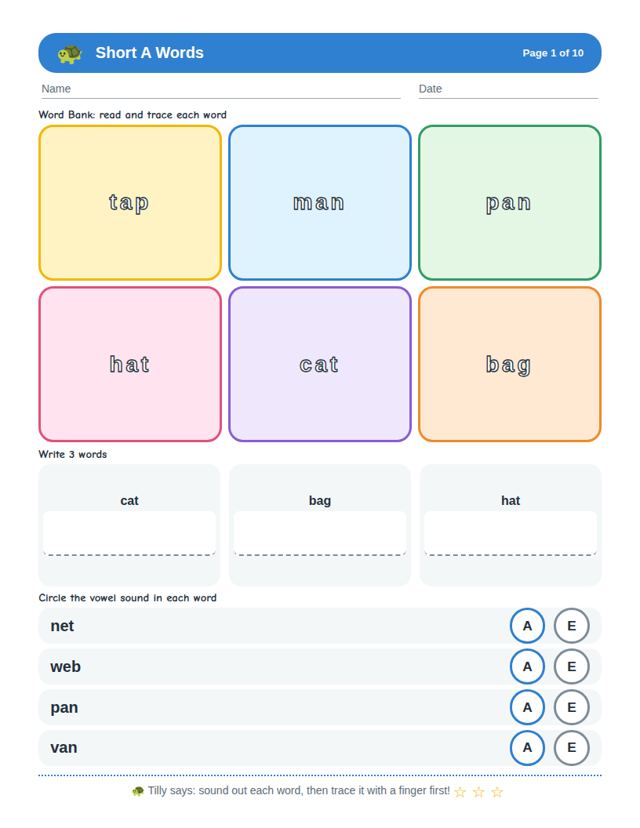
In kindergarten, decodable books usually use short words with three sounds, such as cat, pig, hop and sun. These are often called CVC words.
A few common words like the, a, is and to are included too. Children learn them as they go, one at a time.
Sentences are short, often four to six words. Each page may have just one or two lines.
Choose a level that matches the sounds your child knows today, not the level of the class. A book that is too hard turns reading back into guessing.
If your child reads every word but slowly, the level is right. Speed comes with rereading.
By the end of kindergarten, many classes also add words with sh, ch and th. Decodable sets usually include those in the later kindergarten levels.
Leveled readers are sorted by overall difficulty, such as level A or level B. They often use repeated patterns and picture clues, like I see a cat, I see a dog.
Children can read these by memory and pictures without looking closely at the letters. That can hide a gap in sounding out.
Decodable books are sorted by phonics skill instead. Each book uses the sounds taught so far.
For a beginning reader, decodable books give the most practice with the letters themselves. Picture books are still wonderful to read aloud together.
Many families use both: decodable books for your child to read, and rich picture books for you to read to your child.
You do not have to choose one or the other forever. Decodable books are a stage, and most children move past them once the common patterns are learned.
 Practice this in the free reading appReading games your child can play on a phone, tablet or computer. Every word can be sounded out. No sign-up.Open the app
Before reading, look at the cover and read the title together. Point out one or two words with a new sound, such as ship or chop.
Let your child read each word, pointing under it with a finger. If your child gets stuck, ask for each sound, then for the whole word.
Read the same book two or three days in a row. The first reading is slow, the second smoother, and the third often sounds like talking.
After reading, ask one or two questions about the story. Who was in it? What happened? Understanding matters from the start.
Keep sessions short, about ten minutes. Stop while your child still wants more.
If your child stops on a word, wait a few seconds before helping. Many children work it out alone when given a moment.
List the sounds your child knows. Then look for books that use only those sounds, plus a few common words.
Open the book and ask your child to read a page. If your child reads most words correctly by sounding out, it is a good fit.
If your child misses many words or guesses, pick an earlier level. If every word is easy and fast, move up a level.
Most sets list the sounds used in each book on the cover or inside. That makes choosing much easier.
You can also make your own short decodable stories with the sounds your child knows. A free maker can help.
If your child reads a level easily on the first try, try the next level. Reading the same easy level for too long can feel boring.
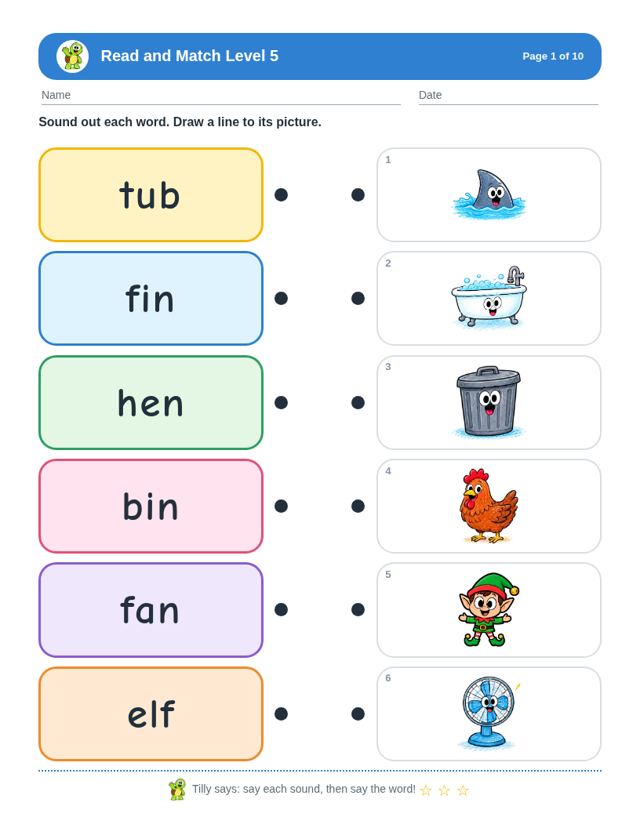
You do not need to buy a full set to start. Short decodable stories and passages are available free online and through many schools.
Ask your child’s teacher which phonics program the class uses. Many programs have matching books that can come home.
Libraries often have decodable series in the early reader section. Ask a librarian for phonics readers.
Printable decodable passages work well too. A single page with a short story and a picture is enough for daily practice.
Keep the books your child has mastered in a basket. Rereading old favorites builds speed and confidence.
Some free decodable stories also come with a few questions. These help you check understanding without turning reading into a test.
If your child cannot sound out the words, check the letter sounds first. A child who is unsure of the sounds will find every book hard.
If your child knows the sounds but cannot join them, work on blending by ear for a few days. You say the sounds, and your child says the word.
If your child reads words but loses the meaning, reread the same page and talk about it. Meaning often comes on the second or third reading.
If reading is a struggle every day, a free check can show which step is in the way.
Share what you see with the teacher, so practice at home and at school match.
Also check that your child is looking at the words, not the pictures. Covering the picture for one reading can show this quickly.
Your child reads new decodable books at the current level smoothly, with few mistakes, on the first or second try.
Your child sounds out unknown words instead of guessing, even in books that are not decodable.
Your child knows most common patterns, including letter teams, silent e and vowel teams.
Then mix in more regular children’s books. Your child now has the tools to work out new words.
Keep reading aloud together too. Hearing richer stories builds the words and ideas your child will need next.
Many children keep a favorite decodable book for a long time. Rereading it now and then is a happy reminder of how far they have come.
 Choose books that use only sounds your child knows.
 Point under each word while reading.
 Read the same book two or three days in a row.
 Ask one or two questions after reading.
 Keep sessions to about ten minutes.
 Keep reading picture books aloud for fun.
Not sure where to start? Get a free plan for your child
Want the whole reading path, in order?The Reading Program gives you ten 10-day plans in the order reading is built, with a short video for you every day.See the Reading Program Listen and Say the WordYou say the sounds slowly, your child says the whole word. No letters to look at, so it trains the ear first.Play free
 Build the WordYour child hears a word and taps the letter tiles in the right order to build it.Play free
 Read the WordOne short word at a time, such as sat, pin or dog. Every word uses only the sounds of the level you choose.Play free
Short a words worksheets, CVC word family practice.
Get the free pages FREE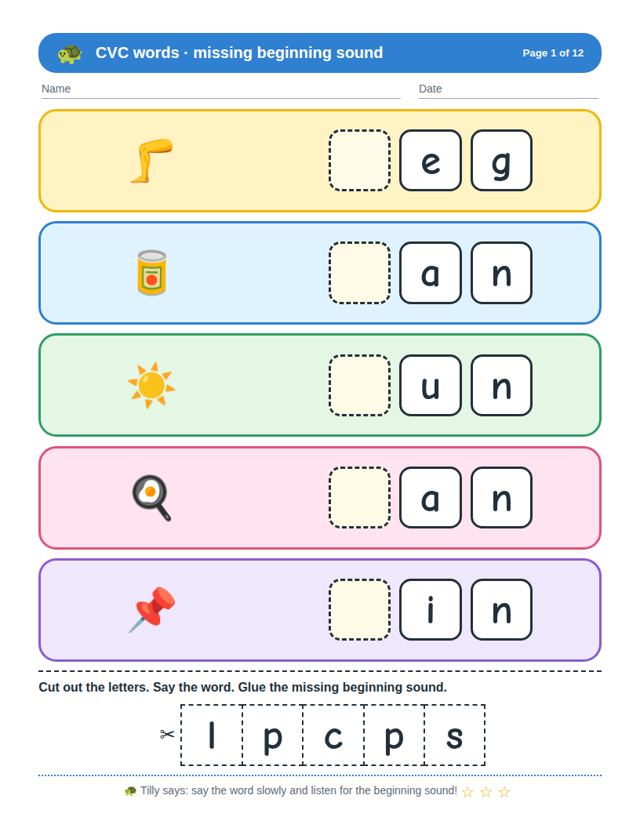
CVC cut and paste worksheets for beginning, middle and ending sounds.
Get the free pages $3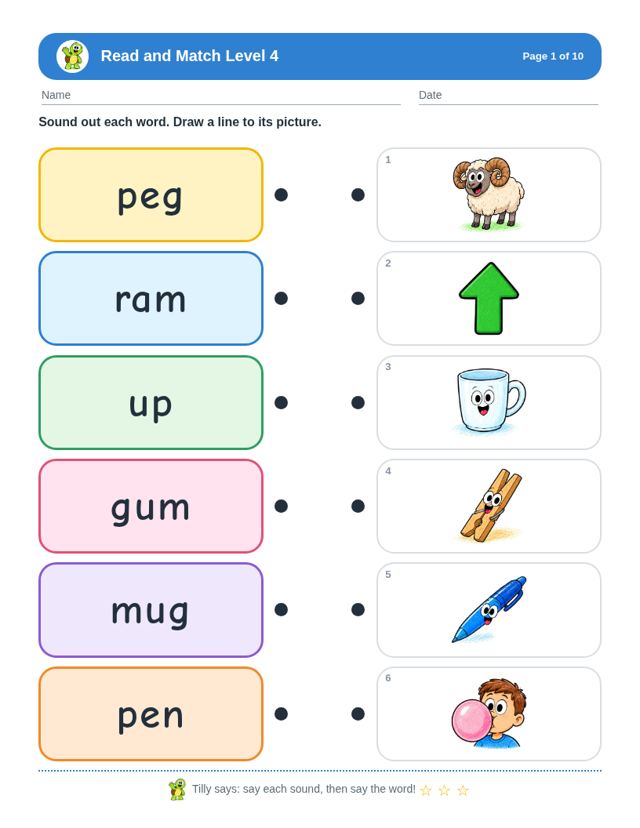
All 5 read and match level worksheet packs in one download.
See inside $3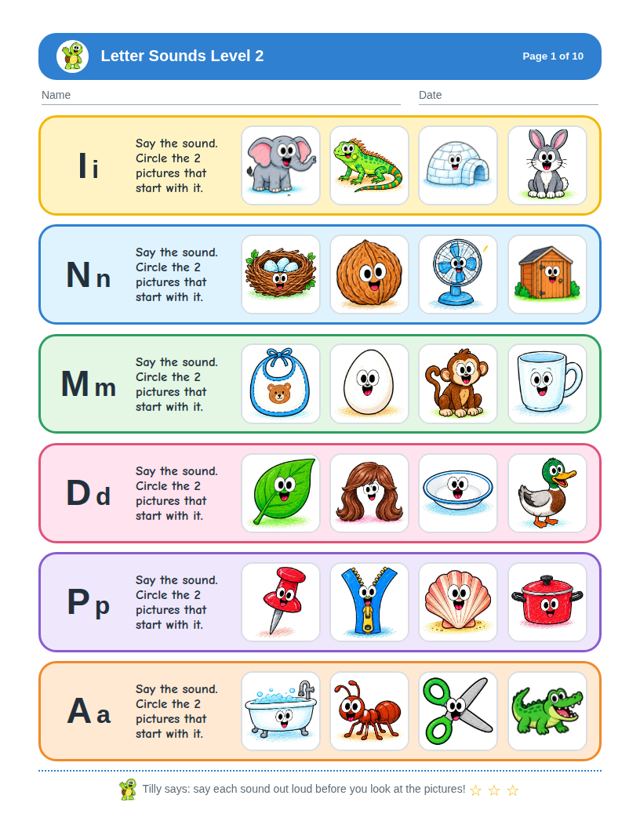
All 7 letter sounds level worksheet packs in one download.
See insideThey are used to practice reading with the letter sounds a child has learned. Every word can be sounded out, so children practice real reading instead of guessing.
No. Leveled readers are sorted by overall difficulty and often rely on patterns and pictures. Decodable books are sorted by phonics skill.
Usually until your child knows the common phonics patterns and can sound out new words easily. For many children, that is through first grade.
Yes. Write short sentences using only the sounds your child knows, plus a few common words. A free decodable story maker makes this easier.
Words that can be read by sounding them out with known letter sounds, such as cat, ship or cake once silent e has been learned.
A few minutes most days works well. Short, regular reading builds skill faster than long sessions once a week.
 Learn to ReadFree Phonics Games for KindergartenFree phonics games for kindergarten that build real reading: listening, blending, word building and sentence games, with tips to make each one count.Read the guide
 Learn to ReadHow to Find Your Child’s Reading LevelHow to find your child’s reading level at home: check each reading step in order, listen to your child read a short page, and choose books that fit.Read the guide
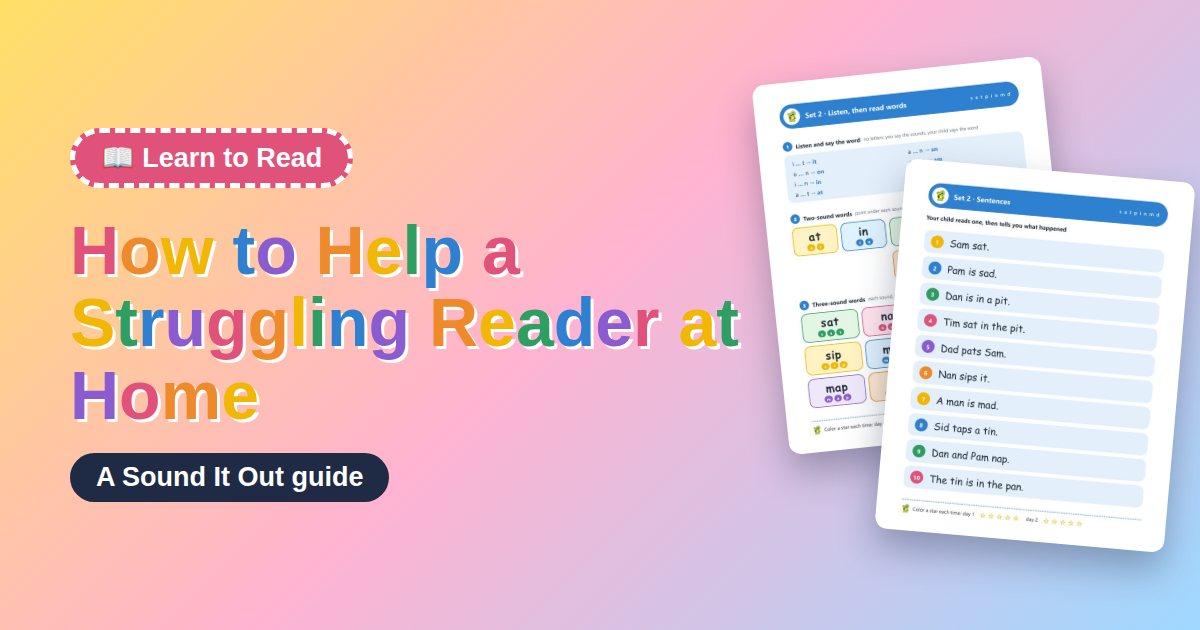 Learn to ReadHow to Help a Struggling Reader at HomeHow to help a struggling reader at home: find the step that is hard, teach it in a few minutes a day, read together, and work with the school on support.Read the guide
The packs on this site are free. The One Sheet goes further: one sheet a day, made for your child from what you tell us happened.
See The One Sheet · $9.99 a month
Or try the 10-day plan: From Sounds to Words, $19 one timeOr do the free 3-minute check first