
Home › Guides › Learn to Read
Home › Guides › Learn to Read
 Detective TillySee every case →
My child is learning about nouns at school. How can I help?What we found: the short answer
Here is how to teach nouns to kids: call them naming words. A noun names a person, a place, an animal or a thing, like mom, park, cat or ball. Find nouns around the house, sort them, and spot them in sentences. Then add plurals, like one cat and two cats.
By Julz, founder of Sound It Out. Updated 2026-10-15.
A noun is a naming word. It names a person, a place, an animal or a thing.
Mom, teacher, park, school, dog, cat, ball and cup are all nouns.
Calling them naming words makes the idea easy for young children.
US kindergarten standards include using common nouns and verbs, and making regular plurals by adding s or es.
In first grade, children learn common, proper and possessive nouns.
Nouns are often the first part of grammar children learn, because they are so concrete. Children already know hundreds of nouns from everyday talk.
Talk about nouns while reading picture books. Ask your child to point to a person, a place, an animal or a thing.
Knowing nouns also helps reading. When a child can find the naming word in a sentence, it is easier to say who or what the sentence is about.
Step 1: point to things in the room and name them. Say: these are naming words, or nouns.
Step 2: ask your child to name five things in the kitchen. Each one is a noun.
Step 3: sort pictures into people, places, animals and things.
Step 4: read a short sentence and find the nouns: The dog ran to the park.
Step 5: write a sentence and underline the nouns together.
Give your child a clear way to check: can I see it, touch it or go there? If yes, it is probably a noun.
Keep a small notebook of nouns your child finds each week.
For a child who is not reading yet, do all of these steps out loud, with pictures instead of written words.
Noun hunt: walk around the house and list every noun you see.
I spy a noun: give a clue, and your child guesses the noun.
Noun sort: sort picture cards into four piles, person, place, animal and thing.
Noun memory: match a picture with its word card.
Keep games short and switch them often.
A full example: in The cat sat on the mat, the nouns are cat and mat. Ask your child to point to each one and tell you if it is a person, place, animal or thing.
Draw pictures of nouns from each group and label them.
Change the room for each hunt: the kitchen one day, the bathroom the next, the yard after that.
A common noun names any person, place or thing: girl, city, dog.
A proper noun names a special one: Mia, Texas, Rex. Proper nouns start with a capital letter.
Start with your child’s own name, the names of family, pets and your town.
Sort words into common and proper. Proper nouns get capitals.
This links nouns to capital letters, which children practice in writing.
Use picture cards for these games at first. Pictures help children who do not yet read many words.
Make labels for things around the house: door, table, lamp.
 Practice this in the free reading appReading games your child can play on a phone, tablet or computer. Every word can be sounded out. No sign-up.Open the app
Singular means one. Plural means more than one.
Most plurals add s: one cat, two cats. Some add es: one box, two boxes.
Use real objects: one cup, then two cups. Say both words clearly.
Hear the ending: cats ends with s, boxes ends with es.
Irregular plurals, like mice or feet, can come later.
Your child’s name is the perfect first proper noun, because it is special and always starts with a capital.
Read the proper nouns on a map of your town together.
Possessive nouns, like Mia’s hat, come in first grade. Show them with real things that belong to someone.
Every sentence needs a naming part. The cat sleeps: cat is the noun.
Ask: who or what is this sentence about? That answer is usually a noun.
Build sentences with noun and action cards: dog plus runs makes the dog runs.
Swap nouns to make silly sentences: the cake runs.
This shows how nouns and verbs work together.
Plurals connect grammar to spelling and reading. Children see and hear the s or es at the end.
Count objects and say the plural: one shoe, two shoes.
You can also ask for a better noun: the thing becomes the truck, and the place becomes the zoo.
Once nouns are clear, teach verbs as doing words: run, jump, eat.
Sort words into naming words and doing words.
Act out verbs and point to nouns. Moving helps the difference stick.
Use simple sentences with one noun and one verb.
This is the start of understanding how sentences are built.
Building sentences this way helps writing too. Children who know the naming part and the doing part write clearer sentences.
Silly sentences make grammar fun and memorable.
Monday: a noun hunt around the house, writing or drawing each noun. Tuesday: sort picture cards into people, places, animals and things.
Wednesday: find the nouns in three short sentences from a favorite book. Thursday: common and proper nouns, starting with family names and your town.
Friday: one and more than one. Count objects and say the plurals, then write two of them with s or es.
Keep each day to about ten minutes. Short, playful practice builds grammar much better than long worksheets.
Next week, add verbs as doing words, and build short sentences with one noun and one verb.
People: mom, dad, teacher, baby, friend, doctor.
Places: park, school, home, store, beach, zoo.
Animals: cat, dog, fish, bird, frog, horse. Things: ball, cup, hat, book, bed, car.
Use these lists for sorting games, or ask your child to add one more word to each group every day.
Ask your child to find nouns in their own drawings. A picture of a park might show a slide, a tree, a dog and a friend, all nouns.
When your child writes, ask them to circle the naming words. This links the grammar lesson to their own writing, which is where it matters most.
Keep the lists on the fridge and add to them during the week. A growing list shows how much your child has learned.
If your child mixes nouns and verbs, go back to objects you can touch. You can touch a ball, so it is a noun.
Use pictures for every word at first.
Teach only the four groups: person, place, animal, thing.
Keep sentences very short.
If writing sentences is hard overall, the free sentence check can show where to start.
Act it out: your child can be the noun, and you say a verb for them to do. The noun is who, and the verb is what they do.
Use the same simple words each time: naming words and doing words.
If your child is stuck, give two choices: is ball a naming word or a doing word?
Your child names nouns around the house quickly.
Your child sorts nouns into people, places, animals and things.
Your child finds the noun in a short sentence.
Your child adds s or es to make plurals.
Then your child is ready for verbs, adjectives and longer sentences.
Some ideas, like happiness, are nouns too. Leave those for later, when the basic idea is firm.
If grammar sheets are used at school, ask for one to practice at home.
 Call nouns naming words.
 Start with things your child can touch.
 Sort into person, place, animal, thing.
 Use your child’s name for proper nouns.
 Show one and more than one with objects.
 Find nouns in short sentences.
Not sure where to start? Get a free plan for your child
Want grammar practice planned for you?The One Sheet Grammar gives your child one grammar sheet a day, made from what you tell us. From capital letters and periods to is and are.See The One Sheet Grammar Listen and Say the WordYou say the sounds slowly, your child says the whole word. No letters to look at, so it trains the ear first.Play free
 Build the WordYour child hears a word and taps the letter tiles in the right order to build it.Play free
 Read the WordOne short word at a time, such as sat, pin or dog. Every word uses only the sounds of the level you choose.Play free
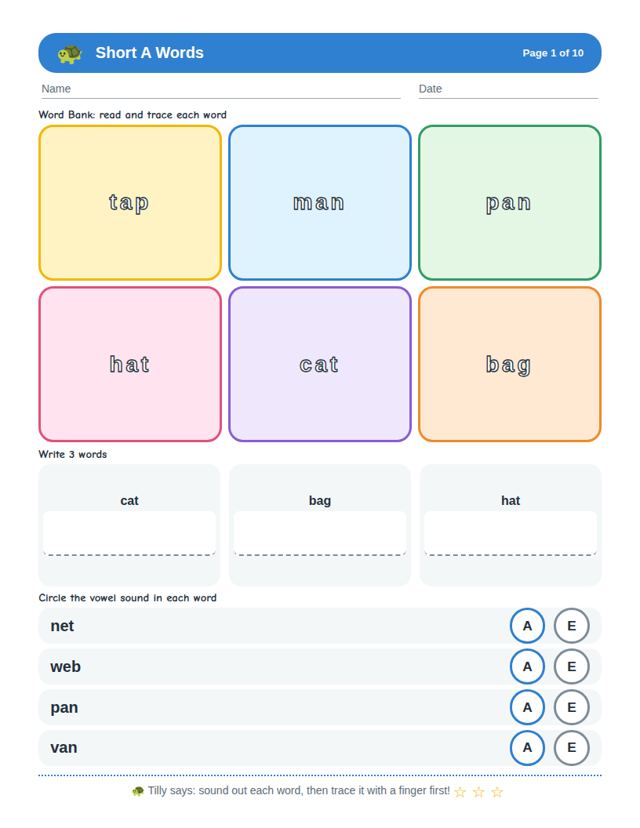
Short a words worksheets, CVC word family practice.
Get the free pages FREE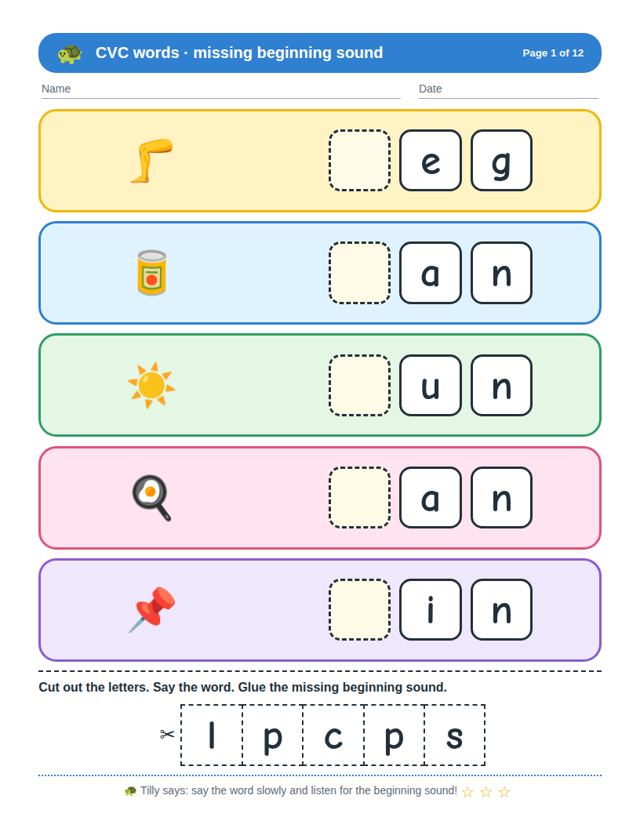
CVC cut and paste worksheets for beginning, middle and ending sounds.
Get the free pages $3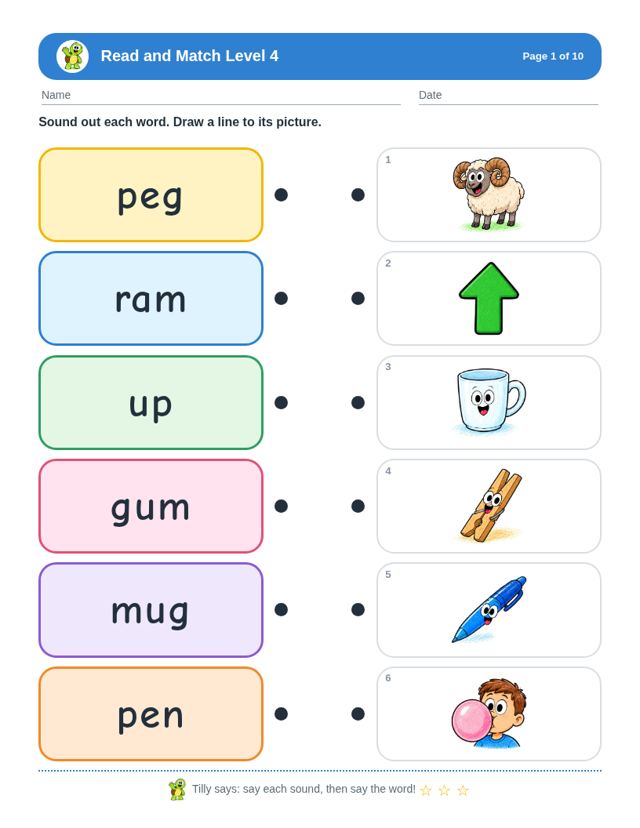
All 5 read and match level worksheet packs in one download.
See inside $3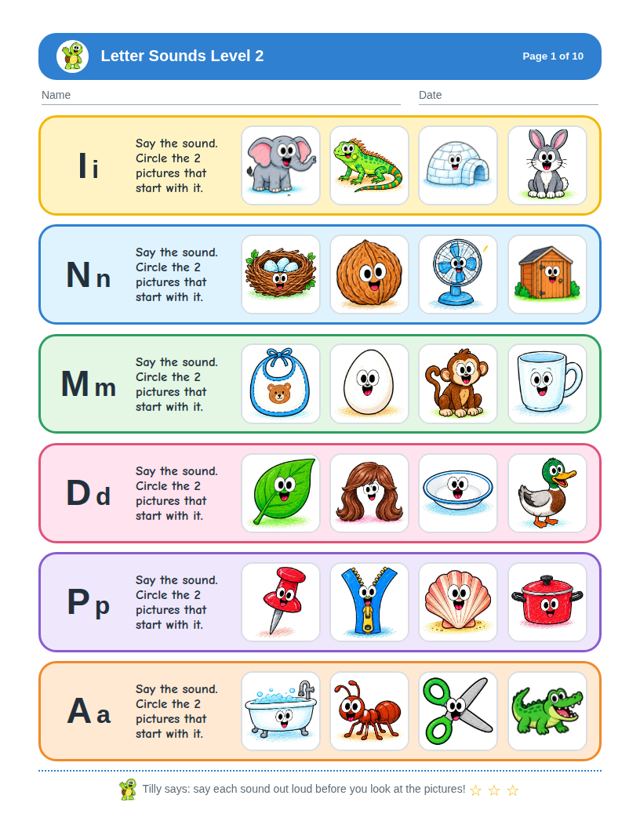
All 7 letter sounds level worksheet packs in one download.
See insideA noun is a naming word. It names a person, a place, an animal or a thing, such as mom, park, dog or cup.
Many start in kindergarten with naming words and plurals. In first grade, children learn common, proper and possessive nouns, and use them in sentences.
Start with names your child knows, like family, friends, pets and your town. Show that each one starts with a capital letter, and sort common and proper nouns.
A noun names someone or something. A verb tells what someone or something does. In the dog runs, dog is the noun and runs is the verb.
Use real objects: one cup, then two cups. Add s for most words and es for words like box and dish, and say both words clearly.
Yes, as practice after games and talk. Sorting nouns into groups and circling nouns in short sentences are good places to start.
 Learn to ReadFree Phonics Games for KindergartenFree phonics games for kindergarten that build real reading: listening, blending, word building and sentence games, with tips to make each one count.Read the guide
 Learn to ReadHow to Find Your Child’s Reading LevelHow to find your child’s reading level at home: check each reading step in order, listen to your child read a short page, and choose books that fit.Read the guide
 Learn to ReadHow to Help a Struggling Reader at HomeHow to help a struggling reader at home: find the step that is hard, teach it in a few minutes a day, read together, and work with the school on support.Read the guide
“Behind in reading” can mean fourteen different things, and each one needs different help. Check off what is true for your child. You will see what to work on first, and what can wait.