
Home › Guides › Learn to Read
Home › Guides › Learn to Read
 Detective RustySee every case →
My child reads cap but not cape. How do I teach silent e?What we found: the short answer
Here is how to teach silent e: show that an e at the end makes the vowel say its name. Cap becomes cape, and kit becomes kite. Practice pairs side by side, then read and spell silent e words. Start once short vowel words like cat and hop are easy.
By Julz, founder of Sound It Out. Updated 2026-10-15.
In words like cake, bike, hope and cute, the e at the end makes no sound. Instead, it changes the vowel before it.
The vowel now says its name: a as in acorn, i as in ice, o as in open, u as in unicorn. That is why some teachers call it magic e or bossy e.
The pattern is vowel, consonant, e. In cape, the a is the vowel, p is the consonant, and the e sits at the end.
US first grade standards include knowing final e for long vowel sounds. Many children start it at the end of kindergarten or in first grade.
It is one of the most useful patterns in early reading, because it unlocks hundreds of words.
Many children find it fun to learn that a letter can be silent and still do a job. It turns the rule into a small mystery they can solve.
Some programs teach a picture for each long vowel, such as an acorn for long a. Using the same picture every time helps.
Teach silent e once your child reads short vowel words easily, such as cap, kit, hop and cut. The silent e rule builds on those words.
Your child should also blend four-sound words, such as stop or hand, without much trouble.
If short vowels are still mixed up, practice them first. Silent e will be confusing if the short sounds are not firm.
A quick check: ask your child to read cap, pin, hop and tub. If all four come quickly, your child is ready.
There is no rush. A strong base makes this step much easier.
Some children are ready earlier, especially if they love reading. Others need more time with short vowels. Follow your child, not the calendar.
A short daily review of short vowel words keeps the base strong while silent e is new.
Step 1: write cap and read it. Then add an e to make cape. Read the new word together and talk about what changed.
Step 2: show that the e does not say anything. It jumps over the p and tells the a to say its name.
Step 3: practice word pairs: kit and kite, hop and hope, cut and cute, pin and pine.
Step 4: read lists of silent e words alone, then in short sentences: I can ride my bike.
Step 5: spell silent e words. Say the word, listen for the long vowel, and remember the e at the end.
Do this with a few pairs each day, not a long list. Three or four pairs read well are better than twenty read with guessing.
Say the long vowel as its letter name, clearly and slowly, so your child can hear it.
Pairs are the clearest way to teach this pattern. Write the short word, then add the e, and read both.
Good pairs include can and cane, tap and tape, rid and ride, not and note, tub and tube.
Make a card with an e on it. Your child slides the e onto the end of a word and reads the new word.
Ask your child to sort words into two piles: short vowel and silent e. Sorting makes the pattern stand out.
This simple game is often the moment the rule clicks.
Keep a list of the pairs your child has read. Add a new pair each day, and reread a few old ones at the start of each session.
Line the pairs up in two columns, short and long, so your child sees the pattern at a glance.
 Practice this in the free reading appReading games your child can play on a phone, tablet or computer. Every word can be sounded out. No sign-up.Open the app
If your kindergartener is ready, keep it playful. Use the e card game and a few pairs a day.
Focus on one vowel at first, such as a. Cap and cape, tap and tape, mad and made.
When a works well, add i, then o, then u. Teaching one vowel at a time keeps it simple.
Use pictures for the silent e words: a cake, a kite, a rope. Pictures help the new words stick.
If it is too hard, wait a few weeks and keep practicing short vowel words.
Long i and long a are often easiest to hear. Long u can be trickier, because cute and tube sound a little different.
Ask your child to choose which word matches a picture: cap or cape? This checks understanding.
Reading and spelling go together. After reading cape, ask your child to spell it.
Say the word slowly: c, ay, p. Your child writes c, a, p, then remembers the e at the end.
Many children forget the e when spelling at first. Remind them: if the vowel says its name, check for the e.
Practice a few words a day, not a long list. Use them in short sentences too.
Spelling these words helps your child read them faster as well.
Use the words in sentences your child can relate to, such as I like cake, or The kite is red. Real sentences make the pattern useful.
Spelling tests at school often include silent e words. Practicing them at home helps there too.
Magic e wand: make a wand with an e on the end. Your child taps it at the end of a short word to change it.
Silent e bingo: call out words, and your child finds them on the board.
Word pair memory: match each short word with its silent e partner.
Picture sort: sort pictures by the vowel sound, short or long.
Read a short silent e story together and hunt for all the words with the e.
Choose one game per day and keep the word list the same for the week. The game keeps it fresh, and the same words build speed.
Let your child invent silly sentences with silent e words. Funny sentences are easy to remember.
If your child reads cape as cap, point to the e and ask what it tells the a to do. Then read again.
If your child adds silent e to every word, go back to sorting short and long words side by side.
If the long vowel sounds are not known, practice the vowel names first with pictures.
If reading silent e words stays hard after weeks of practice, a free check can show where the trouble starts.
A step-by-step plan can also help, with a short lesson for you each day.
Watch out for words that break the rule, such as have and give. Treat these as tricky words and teach them separately, after the rule is firm.
Tell the teacher what you see, so school and home practice the same words.
Your child reads pairs like kit and kite correctly, without help.
Your child reads new silent e words in sentences and books.
Your child spells common silent e words with the e at the end.
Your child can explain the rule in their own words.
Then your child is ready for vowel teams such as ai, ee and oa, the next long vowel patterns.
Keep reading silent e words in books for a few weeks after the rule is learned. Regular practice keeps it strong.
Celebrate the first silent e book your child reads alone.
 Start only when short vowel words are easy.
 Teach with word pairs like cap and cape.
 Use an e card your child can slide on.
 Teach one vowel at a time at first.
 Practice spelling silent e words too.
 Keep sessions short and playful.
Not sure where to start? Get a free plan for your child
Want the whole reading path, in order?The Reading Program gives you ten 10-day plans in the order reading is built, with a short video for you every day.See the Reading Program Listen and Say the WordYou say the sounds slowly, your child says the whole word. No letters to look at, so it trains the ear first.Play free
 Build the WordYour child hears a word and taps the letter tiles in the right order to build it.Play free
 Read the WordOne short word at a time, such as sat, pin or dog. Every word uses only the sounds of the level you choose.Play free
Short a words worksheets, CVC word family practice.
Get the free pages FREE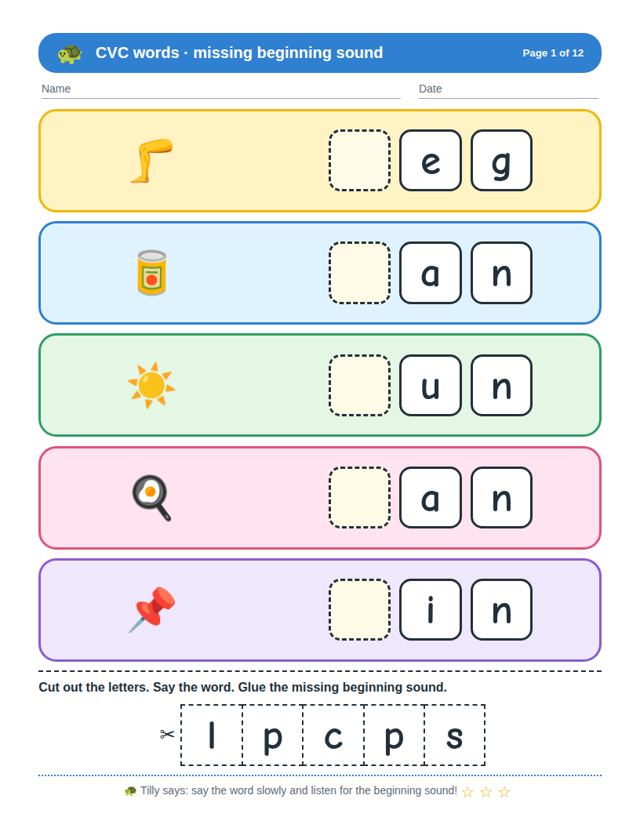
CVC cut and paste worksheets for beginning, middle and ending sounds.
Get the free pages $3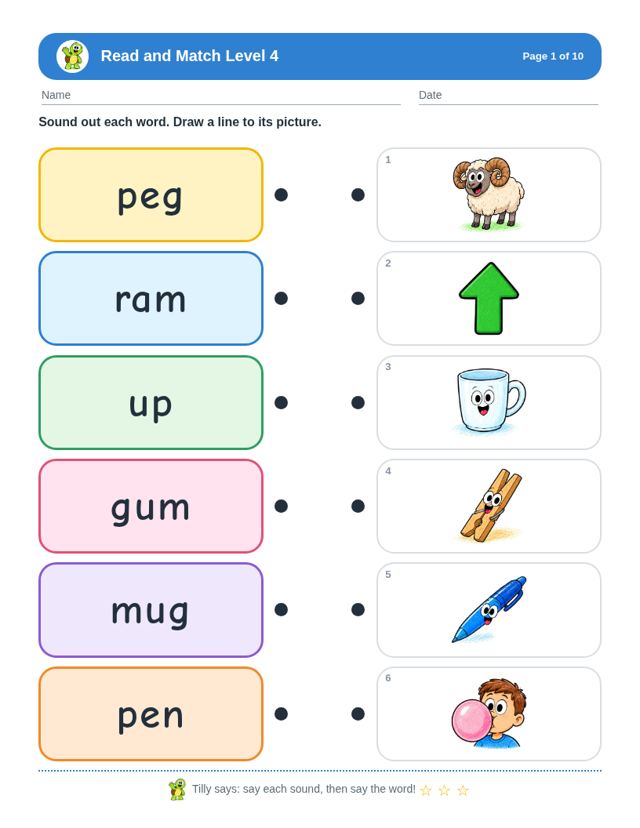
All 5 read and match level worksheet packs in one download.
See inside $3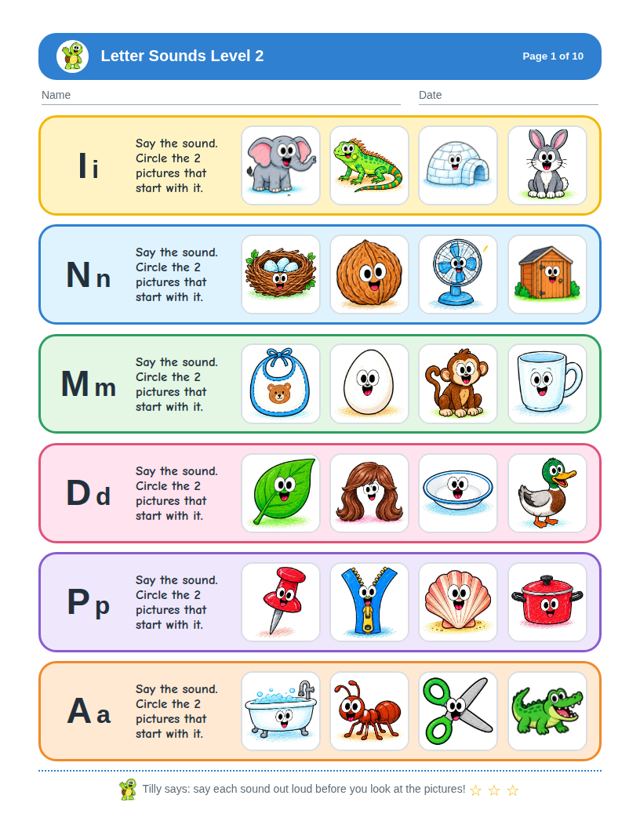
All 7 letter sounds level worksheet packs in one download.
See insideSay that the e at the end is quiet, but it tells the vowel to say its name. Show it with cap and cape.
Many children learn it in first grade, and some at the end of kindergarten, once short vowel words are easy.
Yes. Magic e, bossy e and silent e are different names for the same pattern.
This is common at first. Remind your child to check for the e when the vowel says its name.
Use word pairs, sorting games and short sentences, a few words a day, and practice spelling the words too.
Vowel teams, such as ai in rain, ee in tree and oa in boat.
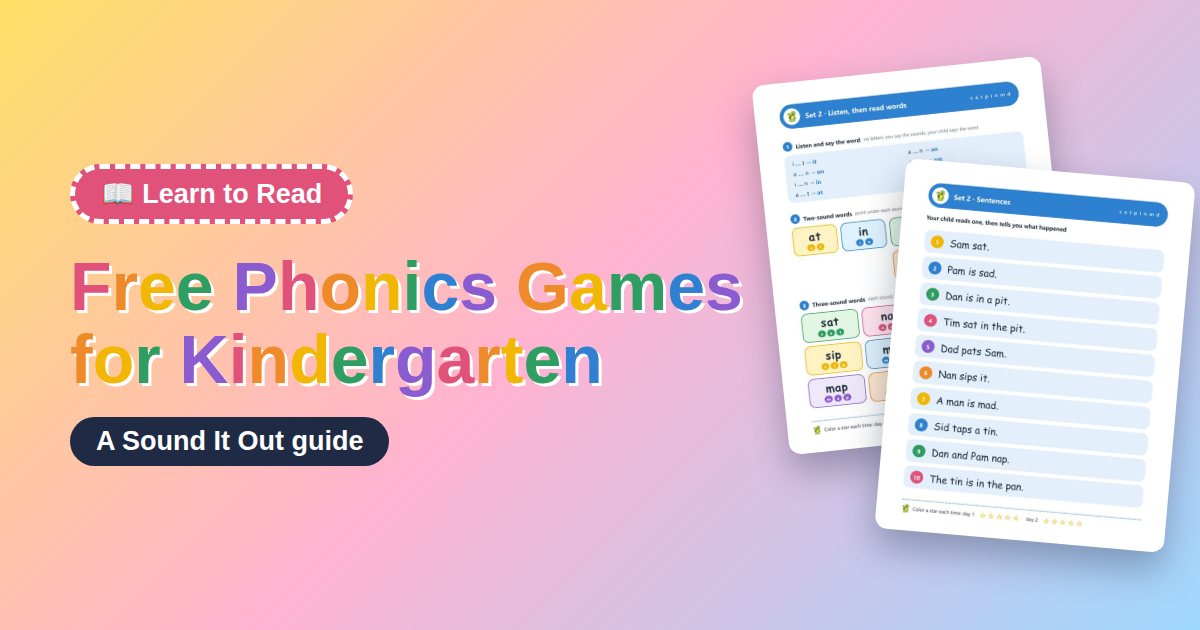 Learn to ReadFree Phonics Games for KindergartenFree phonics games for kindergarten that build real reading: listening, blending, word building and sentence games, with tips to make each one count.Read the guide
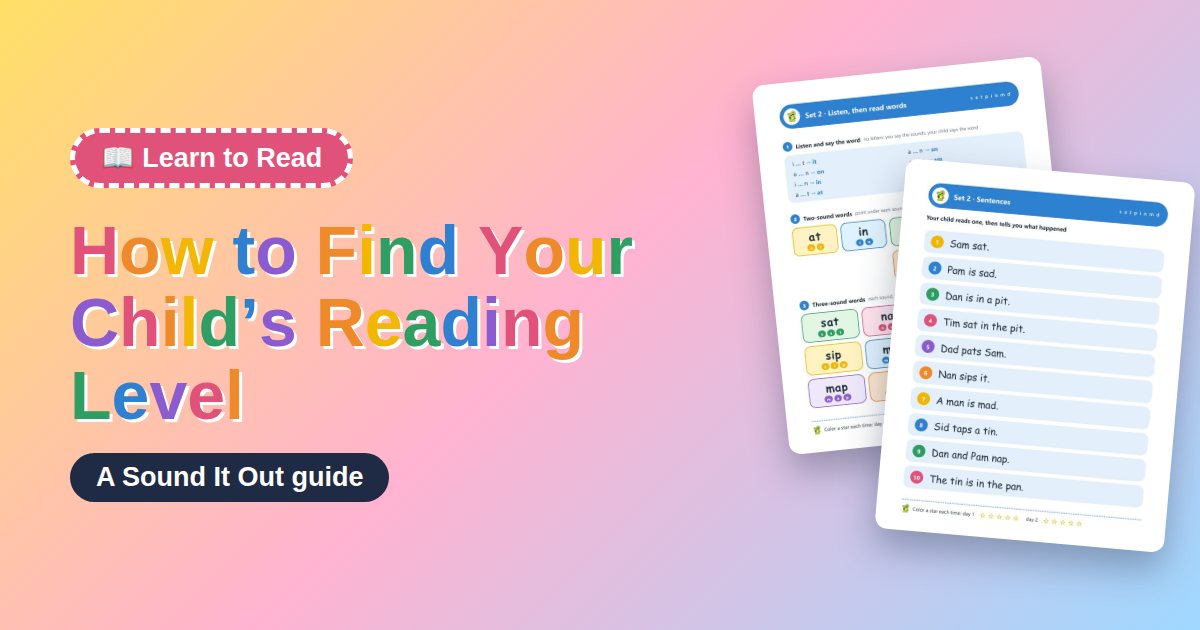 Learn to ReadHow to Find Your Child’s Reading LevelHow to find your child’s reading level at home: check each reading step in order, listen to your child read a short page, and choose books that fit.Read the guide
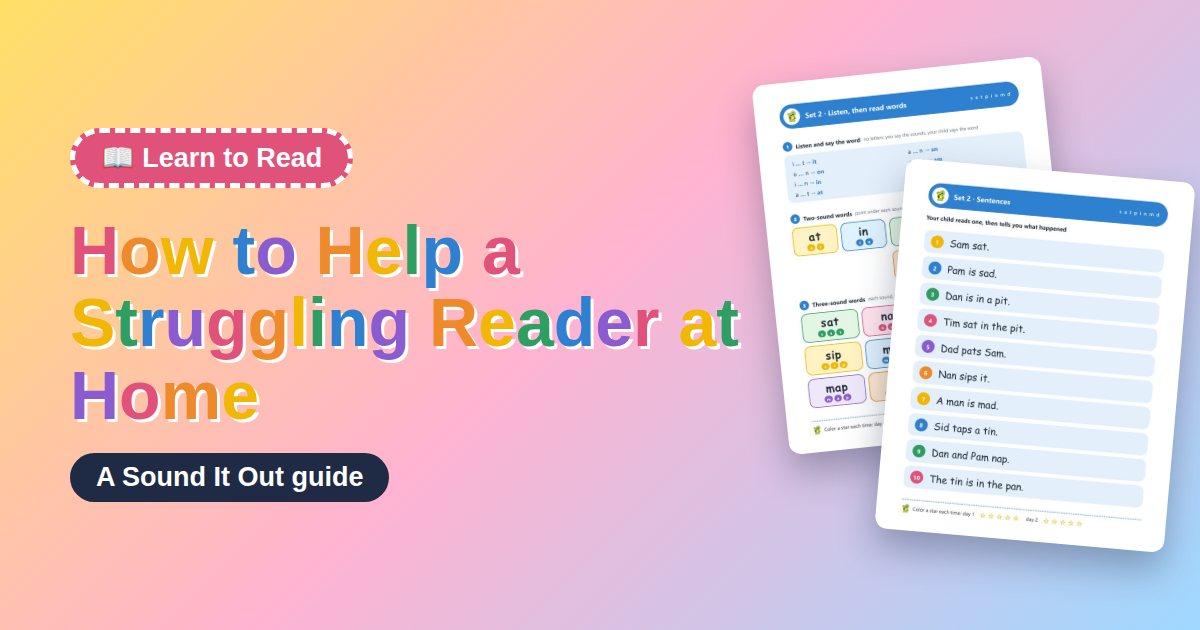 Learn to ReadHow to Help a Struggling Reader at HomeHow to help a struggling reader at home: find the step that is hard, teach it in a few minutes a day, read together, and work with the school on support.Read the guide
The packs on this site are free. The One Sheet goes further: one sheet a day, made for your child from what you tell us happened.
See The One Sheet · $9.99 a month
Or try the 10-day plan: Cap to Cape, $19 one timeOr do the free 3-minute check first