
Home › Guides › Numbers and Counting
Home › Guides › Numbers and Counting
 Detective CometSee every case →
My child reads 34 but does not know it is 3 tens and 4 ones.What we found: the short answer
Here is how to teach place value to kids: show that ten ones make one ten. Bundle ten sticks into a group, then build numbers with tens and ones. 34 is 3 tens and 4 ones. Use real objects first, then pictures, then place value charts and written numbers.
By Julz, founder of Sound It Out. Updated 2026-10-15.
Place value means a digit’s value depends on its place in the number. In 34, the 3 means 3 tens, or 30, and the 4 means 4 ones.
It is the key idea behind our number system. Every ten ones make a ten, and every ten tens make a hundred.
In kindergarten, US standards ask children to see the numbers 11 to 19 as ten ones and some more ones.
In first grade, children learn that the two digits of a two-digit number stand for tens and ones.
Strong place value makes adding, taking away and big numbers much easier later.
An easy way to explain it: numbers are like bags of ten. When we have ten loose ones, we put them in a bag and call it one ten.
Using money also helps: ten pennies make one dime.
Your child should count to at least 20 correctly, and ideally to 100.
Your child should count objects one by one and know the last number tells how many.
It helps to know bonds to 10, such as 7 and 3 make 10.
If counting is not yet firm, practice that first.
A quick check: ask your child to count 15 objects. If that is easy, start with teen numbers.
If your child struggles with counting past 20, spend time on counting first. Place value makes much more sense when the number names are familiar.
If your child is not ready, keep practicing counting objects to 20.
Step 1: count out ten craft sticks and bundle them with a rubber band. Say: this is one ten.
Step 2: make another bundle. Now there are two tens, or twenty.
Step 3: show 13 as one bundle and three loose sticks. Say: thirteen is one ten and three ones.
Step 4: build numbers like 24 and 37 with bundles and loose sticks.
Step 5: write each number and point to the tens digit and the ones digit.
Here is an example: build 27 with two bundles and seven sticks. Count the bundles first, ten, twenty, then the sticks, twenty-one up to twenty-seven.
Use the same bundles every day, so your child gets used to them.
Teen numbers are where place value begins. Each one is ten and some more.
Use a ten frame filled with ten counters, plus a few extra. 16 is a full ten frame and 6 more.
The teen names are tricky, because we say the ones part first in words like fourteen.
Say it the long way sometimes: ten and four make fourteen.
When teen numbers make sense, move to twenties and beyond.
Teen numbers are tricky in many languages, not just English. Children everywhere need extra practice with them.
Ask your child to show 15 in two ways: with sticks and with the ten frame.
 Print free practice pagesFree pages from our packs, in color and in black and white.See the free pages
A place value chart has two columns, tens and ones. Your child puts bundles in the tens column and loose sticks in the ones column.
Then write the digits under each column. The number appears right there.
Later, use base ten blocks or drawings: a long line for a ten and a dot for a one.
Ask your child to read the number and say it in tens and ones.
Practice going both ways: from objects to number, and from number to objects.
Drawing tens and ones is a great step between objects and numbers. Lines for tens and dots for ones are quick to draw.
Graph paper helps keep tens and ones lined up when writing.
First graders work with numbers up to 100 and beyond. They compare numbers using tens and ones.
Ask: which is bigger, 42 or 24? Your child looks at the tens first.
Add ten more or ten less: 35 and ten more is 45. Only the tens digit changes.
Use a hundreds chart to show the pattern down each column.
US first grade standards also include counting to 120, starting at any number.
Comparing numbers by tens is a big idea. A number with more tens is bigger, even if its ones digit is smaller.
Point out how the tens digit changes as you move down a hundreds chart.
Bundle race: count sticks into bundles of ten and see how many tens you make.
Build my number: call out a number, and your child builds it with tens and ones.
Roll a two-digit number with two dice: one for tens, one for ones. Build and read it.
Hundreds chart puzzles: cut a chart into pieces and put it back together.
Keep games short and use real objects often.
Mix games and real objects through the week. Variety keeps practice interesting while the idea stays the same.
Let your child be the banker and trade ten ones for a ten.
Monday: bundle sticks into tens and count the bundles. Tuesday: build teen numbers as one ten and some ones, and say each one the long way.
Wednesday: build numbers in the twenties and thirties on a tens and ones chart. Thursday: draw tens as lines and ones as dots, then write the numbers.
Friday: play build my number or roll a two-digit number, and compare two numbers by their tens.
Keep sessions short, and use real objects every day, even after drawings are easy.
Ones: single items, like one stick or one cube.
Tens: groups of ten ones, bundled together.
Digit: one of the symbols we write numbers with, 0 to 9.
Tens place and ones place: in 52, the 5 is in the tens place and the 2 is in the ones place. Use these words while building numbers.
Hundreds: ten tens make one hundred. Bundle ten bundles together to show it, once tens and ones are firm.
Expanded form: 52 is 50 and 2. Writing numbers this way shows the value of each digit clearly.
Go back to bundling real objects. Many children need to make tens with their hands many times.
If teen names are confusing, practice saying them as ten and some more.
If your child writes 31 for 13, build both numbers and compare them side by side.
If math stays hard, a free math check can show which step needs work.
Talk to the teacher about the materials used in class, so home matches.
Place value worksheets work best after building with objects. Your child counts the tens and ones in pictures, then writes the number.
Ask the teacher whether the class uses blocks, sticks or drawings.
Your child says a number like 46 is 4 tens and 6 ones.
Your child builds two-digit numbers with tens and ones.
Your child compares two numbers by looking at the tens first.
Your child adds or takes away ten and knows which digit changes.
Then your child is ready for adding and taking away with bigger numbers.
When place value is firm, adding numbers like 23 and 10 becomes easy and makes sense.
Celebrate the first time your child reads and builds a number alone.
 Bundle real objects into tens.
 Start with the teen numbers.
 Use a two-column tens and ones chart.
 Say teens as ten and some more.
 Use a hundreds chart for patterns.
 Practice both ways: objects to number and back.
Not sure where to start? Get a free plan for your child
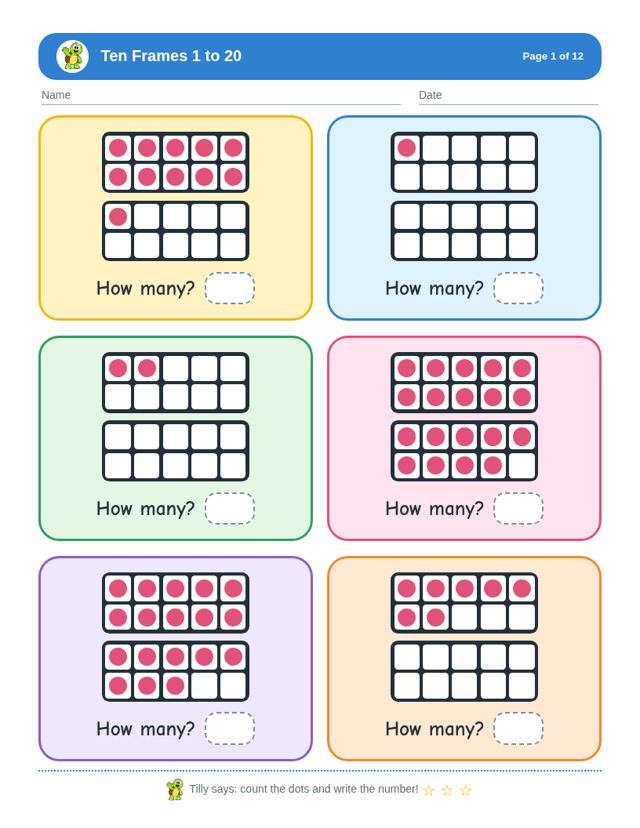
Want math practice planned for you?The One Sheet Math gives your child one math sheet a day, made from what you tell us about your child. From counting to adding and taking away.See The One Sheet MathNumber tracing and counting worksheets with ten frames.
Get the free pages FREE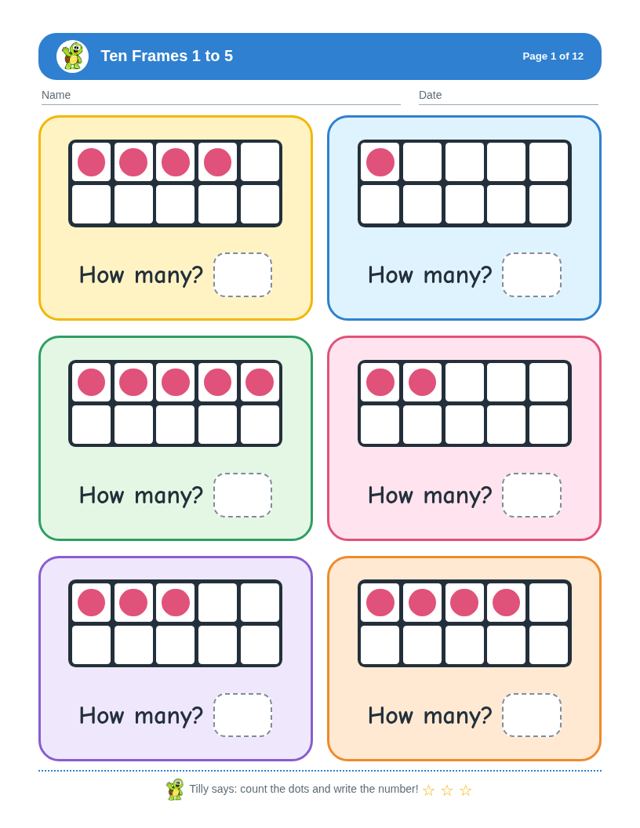
Ten frame worksheets, counting 1 to 5.
Get the free pages $3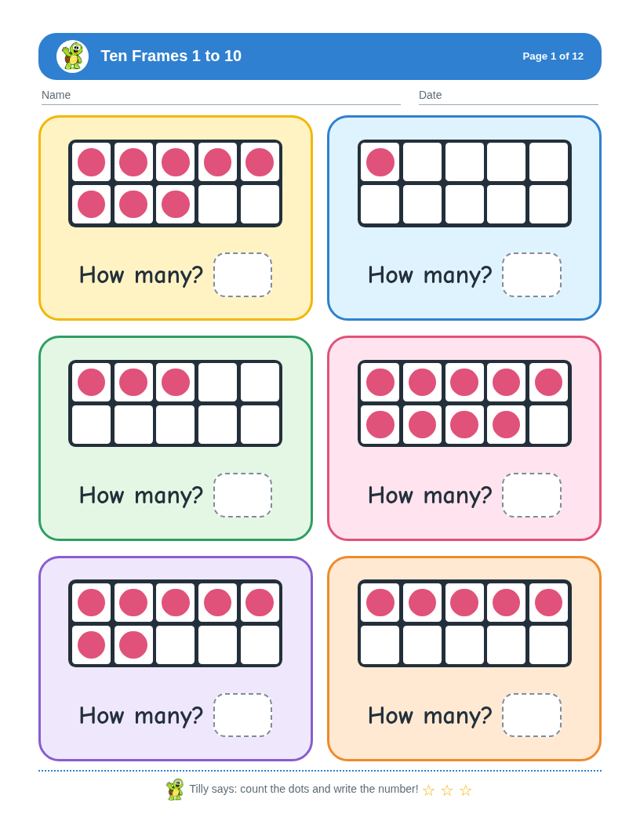
4 ten frames worksheet packs in one download.
See inside FREE Math Path · Level 1
Ten frame worksheets, counting 1 to 5.
See insideShow that ten ones make one ten, using bundled sticks or blocks. Then build numbers with tens and ones, count the tens first, and write the digits under each part.
It starts in kindergarten, when children see 11 to 19 as ten and some more. It grows in first grade with tens and ones up to 100 and beyond.
The teen names say the ones part first, as in thirteen. Build both numbers with objects and compare them, so your child sees one ten and three ones.
Blocks where a long rod shows a ten and a small cube shows a one. At home, bundled craft sticks or straws work just as well.
Bundle ten objects into a ten, keep the rest as ones, and count the tens first, then the ones. Write the number and point to each digit.
It helps. A simple paper with two columns, tens and ones, is enough to sort bundles and loose objects and write the number.
 Numbers and CountingHow to Teach Counting to PreschoolersHow to teach counting to preschoolers: say the numbers in order, touch one thing per number, and learn that the last number tells how many. With games.Read the guide
 Numbers and CountingMy Child Is Struggling With Math: What to DoMy child is struggling with math: how to find the missing step, teach with objects and pictures, practice a little every day, and when to ask for help.Read the guide
 Numbers and CountingWhen Can Kids Count to 100? What Age, and How to HelpWhen can kids count to 100? Most learn by the end of kindergarten, around age 5 or 6. What to practice first, and four steps to help at home.Read the guide
“Behind in reading” can mean fourteen different things, and each one needs different help. Check off what is true for your child. You will see what to work on first, and what can wait.