
Home › Guides › Addition and Subtraction
Home › Guides › Addition and Subtraction
 Detective SplashSee every case →
The teacher keeps talking about number bonds. How do I teach them?What we found: the short answer
Here is how to teach number bonds to kindergarten children: show that a number can be split into two parts. Five can be 4 and 1, or 3 and 2. Start with real objects, then ten frames, then the number bond picture. Practice bonds to 5 first, then bonds to 10.
By Julz, founder of Sound It Out. Updated 2026-10-15.
A number bond shows how a number splits into two parts. The whole is 5, and the parts are 3 and 2.
It is often drawn as three circles joined by lines: one circle for the whole and two for the parts. Some schools call it a part-whole model.
Number bonds are the same facts as adding and taking away. 3 and 2 make 5, so 5 take away 2 is 3.
US kindergarten standards ask children to split numbers up to 10 into pairs in more than one way. They also ask children to find the number that makes 10 with any number from 1 to 9.
Knowing bonds well makes adding and taking away much faster later.
Here is a simple way to explain it. The whole is the big number. The parts are the smaller numbers that make it. Point to each circle as you say whole and parts.
The same idea will come back for years, with bigger numbers and harder problems.
Children who only count by ones often get stuck as numbers grow. Bonds give them a smarter way to think.
A child who knows that 8 is 5 and 3 can add 8 and 2 by thinking about 10. That is real number sense.
Bonds to 10 are especially useful, because our number system is built on tens.
Research on early math says children learn number in a developmental order. Bonds fit naturally after counting and comparing.
They also help with subtraction, because the parts and the whole show both facts at once.
Number bonds also build confidence. Children who can think in parts feel clever, because they find answers without counting everything again.
Bonds to 10 are often called friends of ten in class.
Your child should count up to 10 objects correctly, touching each one.
Your child should know that the last number counted tells how many.
It helps if your child can see small groups, like 3 dots, without counting each one.
If counting is still shaky, practice that first. Bonds build on solid counting.
A quick check: put seven blocks on the table and ask how many. If the answer comes easily, your child is ready.
If your child is younger or less confident, start with bonds to 3 and 4 before 5. Small wins keep math happy.
If your child is not ready, spend another week on counting objects and seeing small groups.
Step 1: take five blocks. Split them into two piles, 4 and 1. Say: five is four and one.
Step 2: move one block across to make 3 and 2. Say: five is also three and two. Find every way together.
Step 3: put the blocks on a ten frame or two plates, so the two parts are easy to see.
Step 4: draw the number bond picture. Write 5 in the top circle, and the parts in the two lower circles.
Step 5: hide one part. Show five, with three visible, and ask how many are hiding.
Say the bond out loud every time, in the same words: five is three and two. Saying it helps your child remember the pattern.
Ask your child to explain each step back to you. Teaching it shows understanding.
 Print free practice pagesFree pages from our packs, in color and in black and white.See the free pages
A ten frame is a box of ten squares in two rows of five. It shows numbers in a way the eye can read quickly.
Fill the frame with two colors of counters, such as 6 red and 4 yellow. Your child sees that 10 is 6 and 4.
Change the colors to find all the bonds to 10: 9 and 1, 8 and 2, 7 and 3, and so on.
Dot cards and fingers work too. Show 7 fingers as 5 on one hand and 2 on the other.
Pictures come after objects. When your child understands with blocks, the pictures make sense.
Two-colored counters, beans painted on one side, or red and yellow blocks all make the two parts easy to see on the frame.
Keep the ten frame on the table during practice, so your child can check.
Start with bonds to 5. There are only a few: 5 and 0, 4 and 1, 3 and 2.
When those are quick, move to 6, 7, 8 and 9, one number at a time.
Bonds to 10 deserve extra practice. Many later strategies use them.
Teach that the parts can switch places: 3 and 2 is the same as 2 and 3. That halves the facts to learn.
Later, in first grade, children use bonds to 20 and to break teen numbers into ten and some more.
A quick daily warm-up helps a lot. Show a number and ask for one way to split it. Then ask for another way.
Practice the switch: if 3 and 2 make 5, ask about 2 and 3.
Hiding game: put some counters under a cup, show the rest, and ask how many are hiding.
Make ten: turn over number cards and find pairs that make 10.
Shake and spill: shake five two-colored counters in a cup, spill them, and say the bond you see.
Bond hunt: find things that come in parts, such as 3 red and 2 green apples in a bowl.
Keep games short and play them often.
Number bond worksheets work best after the games. Your child fills in the missing part, which is the same as the hiding game on paper.
Let your child choose the game for the day.
Bonds to 5: 5 and 0, 4 and 1, 3 and 2. Bonds to 6: 6 and 0, 5 and 1, 4 and 2, 3 and 3.
Bonds to 7: 7 and 0, 6 and 1, 5 and 2, 4 and 3. Bonds to 8: 8 and 0, 7 and 1, 6 and 2, 5 and 3, 4 and 4.
Bonds to 10: 10 and 0, 9 and 1, 8 and 2, 7 and 3, 6 and 4, 5 and 5. Each pair can switch places too.
If your child counts every object each time, use smaller numbers and ten frames to build quick seeing.
If the bond picture is confusing, go back to real objects on two plates.
If hiding games are hard, show the whole first, then hide only one counter.
If math stays hard, a free math check can show which step needs work.
Talk to the teacher about the words used in class, so home and school match.
Some children need to touch and move objects for weeks before the picture makes sense. That time is well spent.
Ask the teacher whether the class draws bonds as circles or as a bar.
Your child tells you several ways to split a number up to 10.
Your child says how many are hiding without counting all the objects.
Your child knows which number makes 10 with any number from 1 to 9.
Your child uses bonds to solve small adding and taking away problems.
Then your child is ready for bonds to 20 and adding with bigger numbers.
Keep a small chart of the bonds your child knows. Coloring each new bond makes progress easy to see.
Celebrate the first time your child names all the bonds to 10.
 Start with real objects on two plates.
 Use ten frames with two colors.
 Learn bonds to 5 before bonds to 10.
 Play the hiding game often.
 Show that parts can switch places.
 Keep practice short and daily.
Not sure where to start? Get a free plan for your child
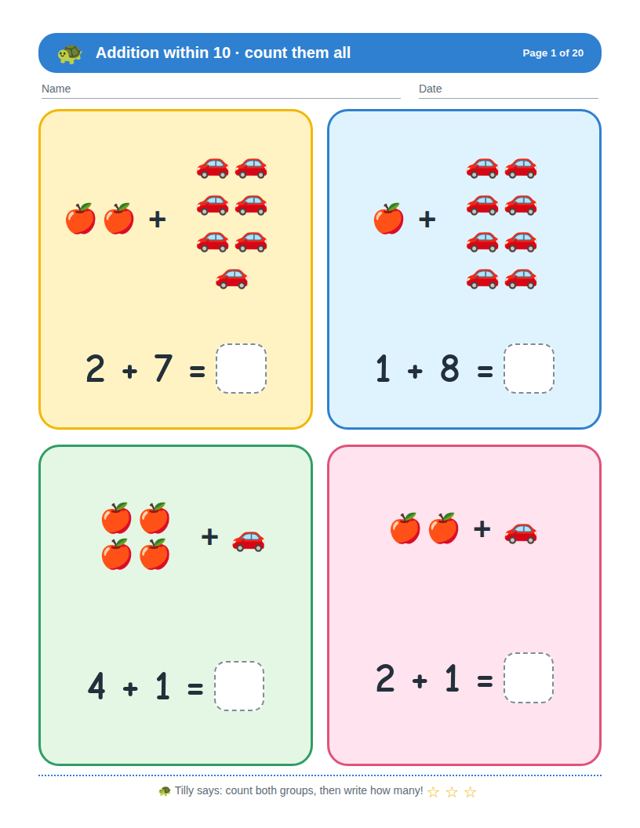
Want math practice planned for you?The One Sheet Math gives your child one math sheet a day, made from what you tell us about your child. From counting to adding and taking away.See The One Sheet MathAddition within 10 worksheets with pictures and a number line.
Get the free pages FREE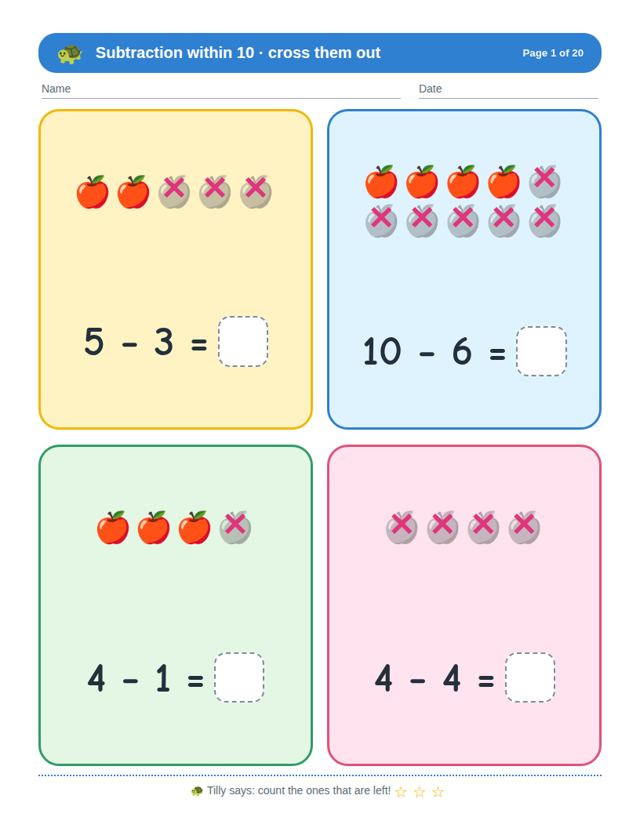
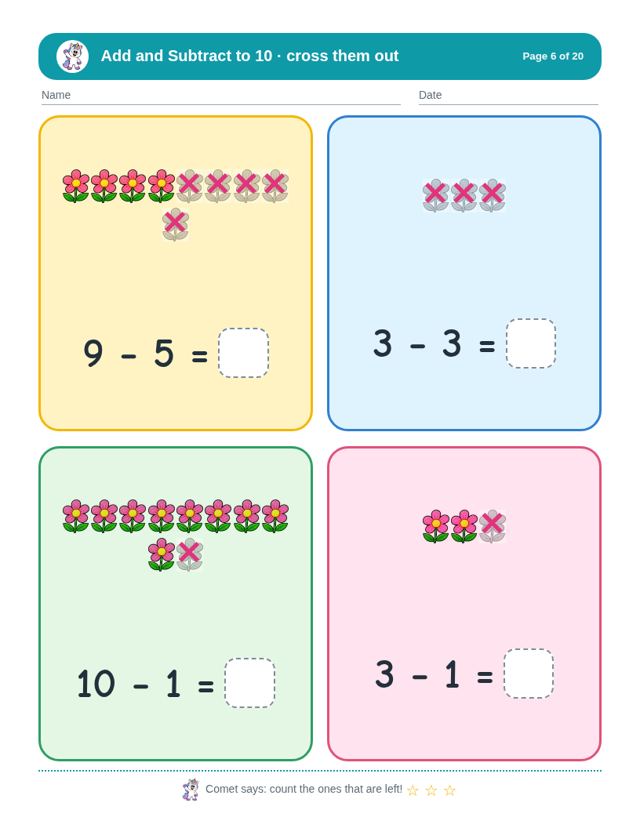
Subtraction within 10 worksheets with cross-out pictures and a number line.
Get the free pages FREE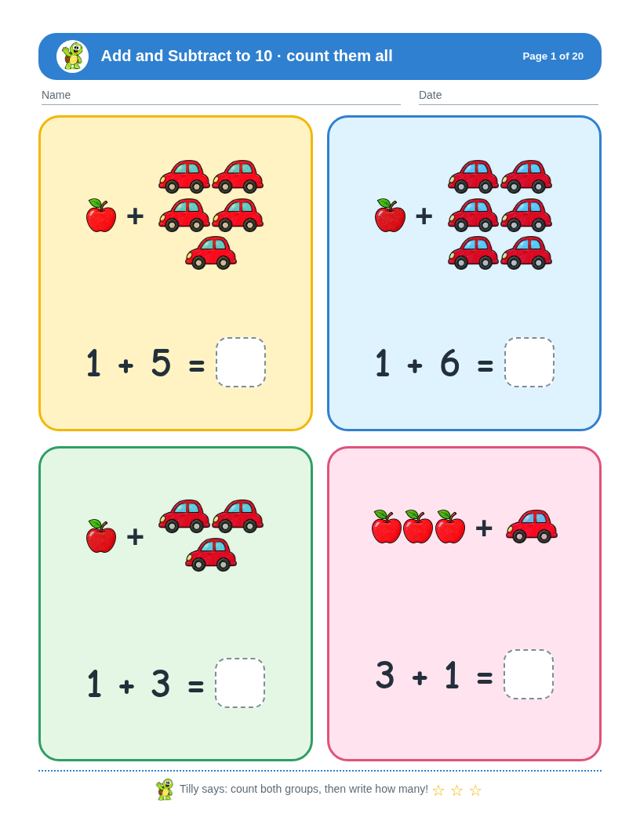
 Math Path · Levels 6 to 7
Addition and subtraction within 10 worksheets with pictures and a number line.
See inside $3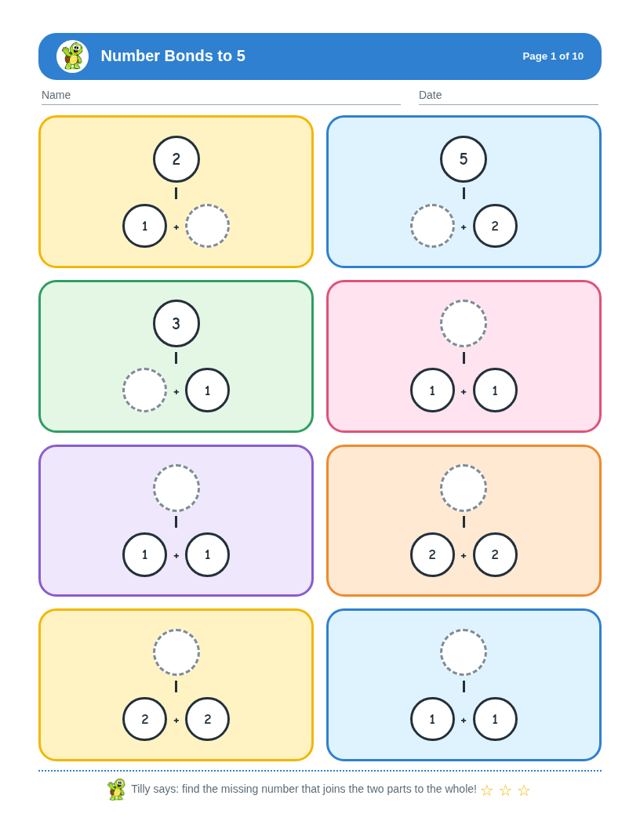
All 4 number bonds worksheet packs in one download.
See insideA picture that shows how a number splits into two parts, such as 5 is 3 and 2. It links adding and taking away.
Most learn them in kindergarten and first grade, starting with bonds to 5 and then to 10.
They show the parts that make a whole, so a child can add by thinking instead of counting every object.
9 and 1, 8 and 2, 7 and 3, 6 and 4, and 5 and 5, plus the same pairs switched.
They are closely linked. A number bond shows the parts and whole, and a fact family writes the matching adding and taking away facts.
No. Blocks, coins, buttons or snacks work well. A printed ten frame helps too.
 Addition and SubtractionHow to Teach Subtraction to KindergartenHow to teach subtraction to kindergarten children: take away with real objects, act out short stories, count back on a number line, and link it to adding.Read the guide
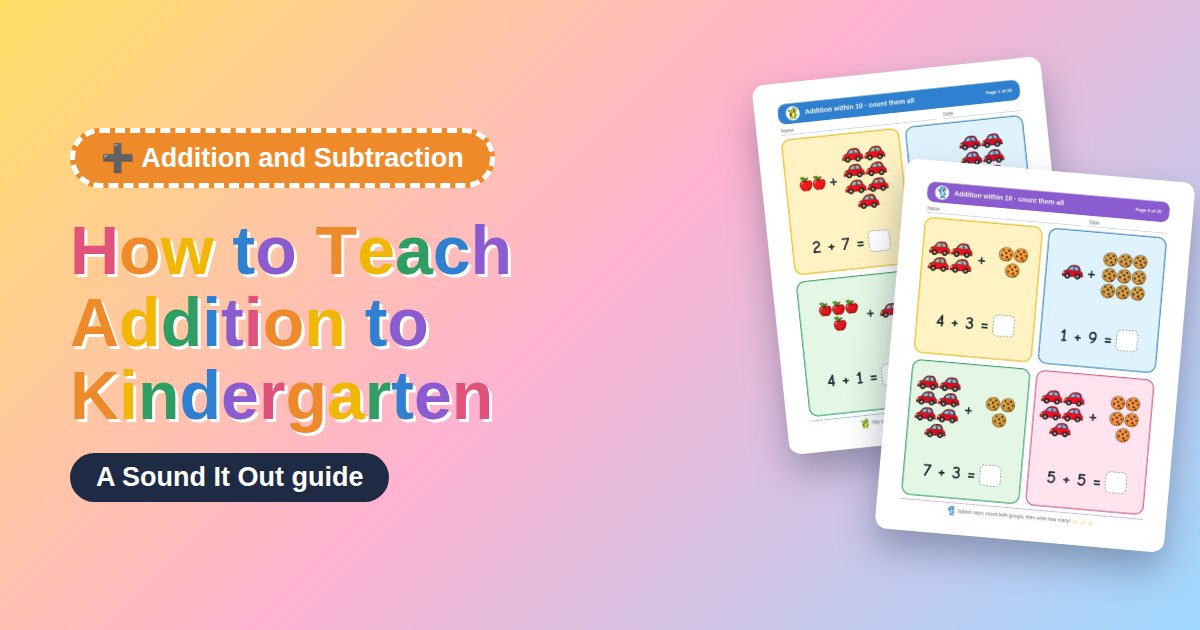 Addition and SubtractionHow to Teach Addition to KindergartenHow to teach addition to kindergarten children at home: start with real objects, count all, then count on, and learn the facts within 5 and 10.Read the guide
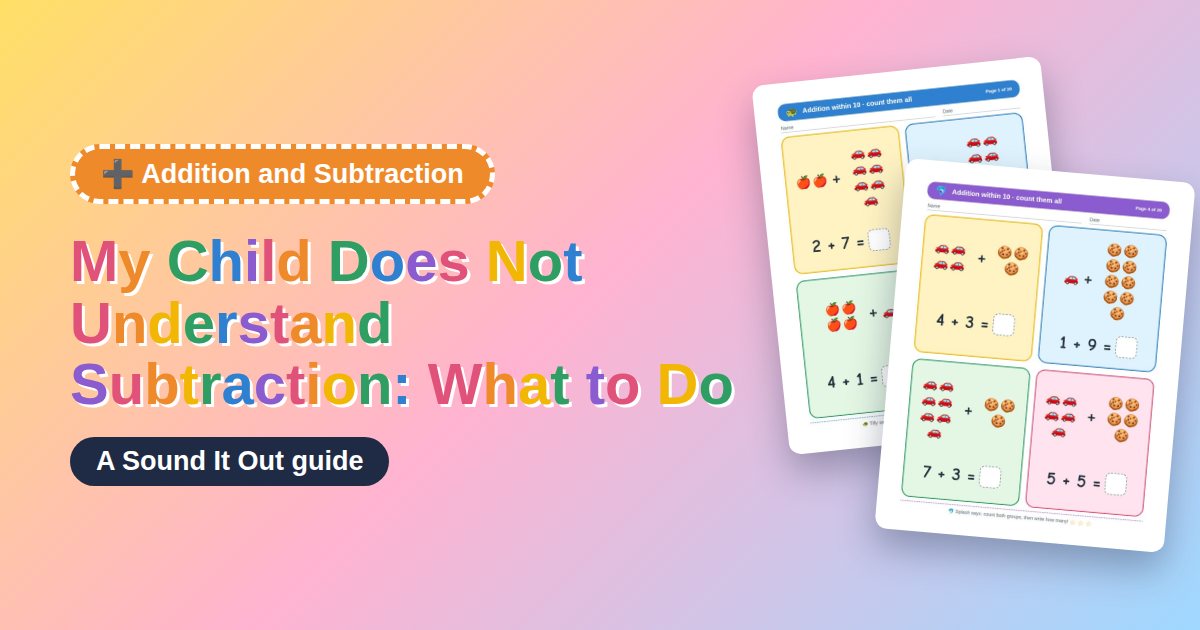 Addition and SubtractionMy Child Does Not Understand Subtraction: What to DoWhat to do when your child does not understand subtraction: why it confuses young children, and hands-on steps with objects and a number line.Read the guide
The packs on this site are free. The One Sheet goes further: one sheet a day, made for your child from what you tell us happened.
See The One Sheet · $9.99 a month
Or try the 10-day plan: Count It Up, $19 one timeOr do the free 3-minute check first