
Home › Guides › Addition and Subtraction
Home › Guides › Addition and Subtraction
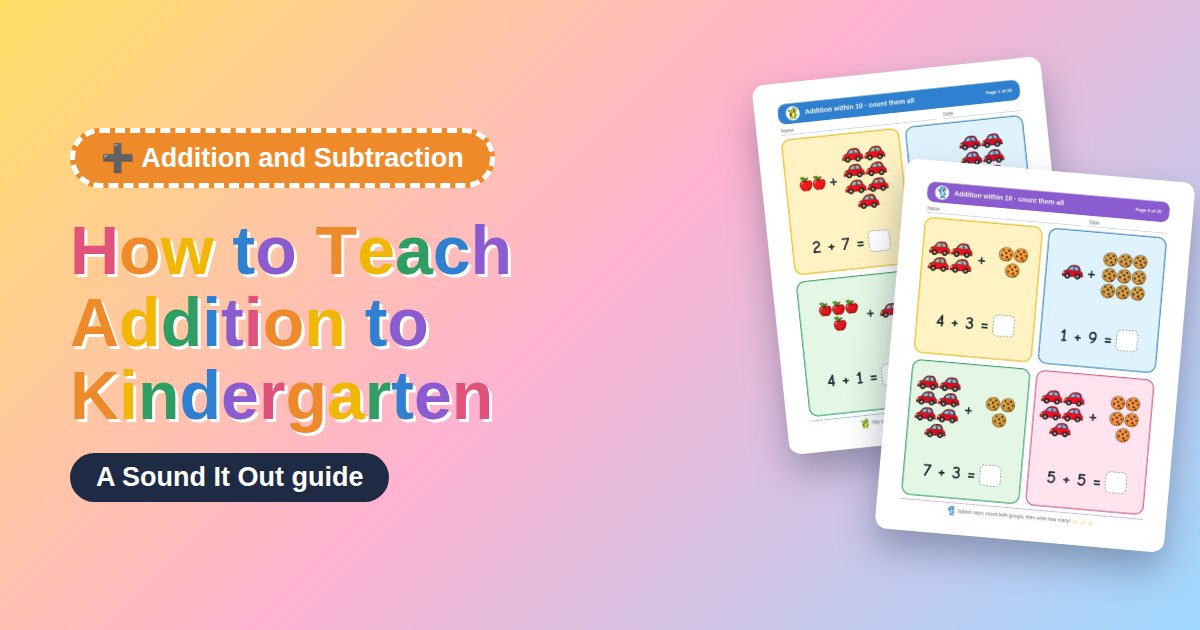
Teach addition by acting it out. Put three toys down, add two more, and count how many there are now. Then write it as 3 + 2 = 5. Start with sums up to 5, then 10. Move from counting all the toys to counting on from the bigger number, and only then to sums with numbers alone.
Addition means putting groups together. Show it with things: three apples and two more apples. How many apples now?
Children understand the plus sign much better after they have seen it happen with real things.
At first your child counts every toy: one, two, three, four, five. Later, show counting on: start at three and count two more, four, five.
Counting on is faster and leads to knowing sums by heart.
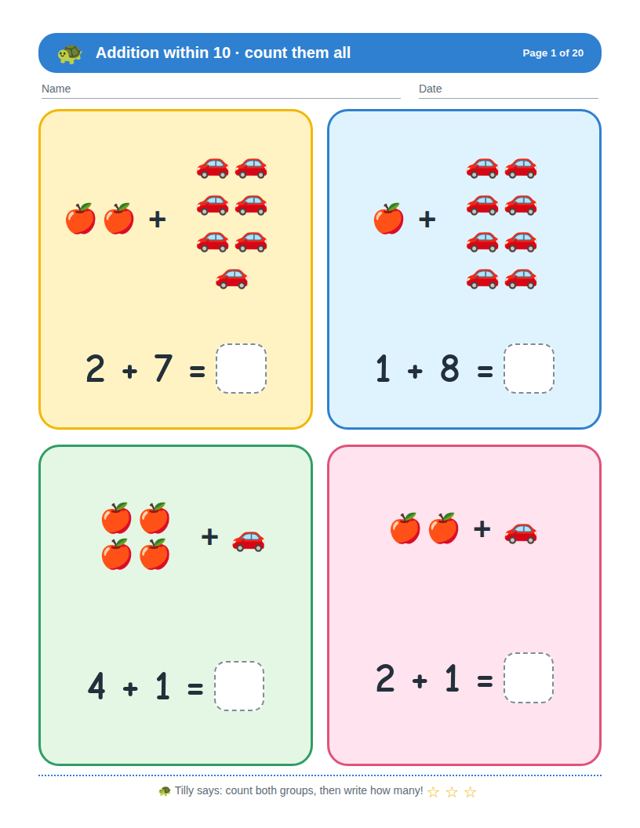
Worksheets with pictures to count are the step between toys and numbers. Your child counts the pictures, then writes the answer.
Sums with numbers only come when counting pictures is easy.
Over time, sums such as 2 + 2 and 5 + 5, and the pairs that make 10, become known by heart. Short daily practice helps more than long sessions.
Many US schools expect kindergarteners to add and take away within 10 by the end of the year.
 Print free practice pagesFree pages from our packs, in color and in black and white.See the free pages
 Act sums out with real things.
 Start with sums up to 5.
 Teach counting on from the bigger number.
 Use picture worksheets before number-only ones.
 Practice a few sums a day.
Addition within 10 worksheets with pictures and a number line.
Get the free pages FREE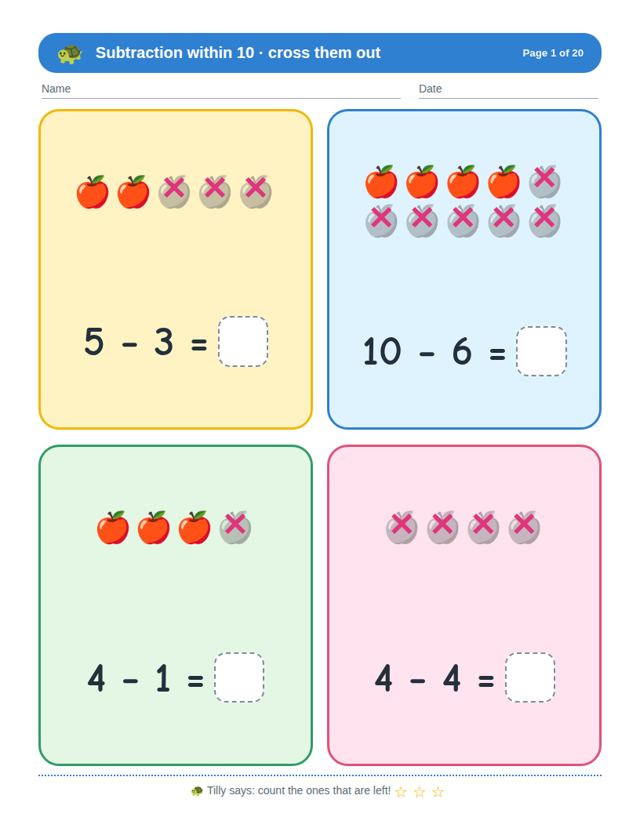
Subtraction within 10 worksheets with cross-out pictures and a number line.
Get the free pages FREE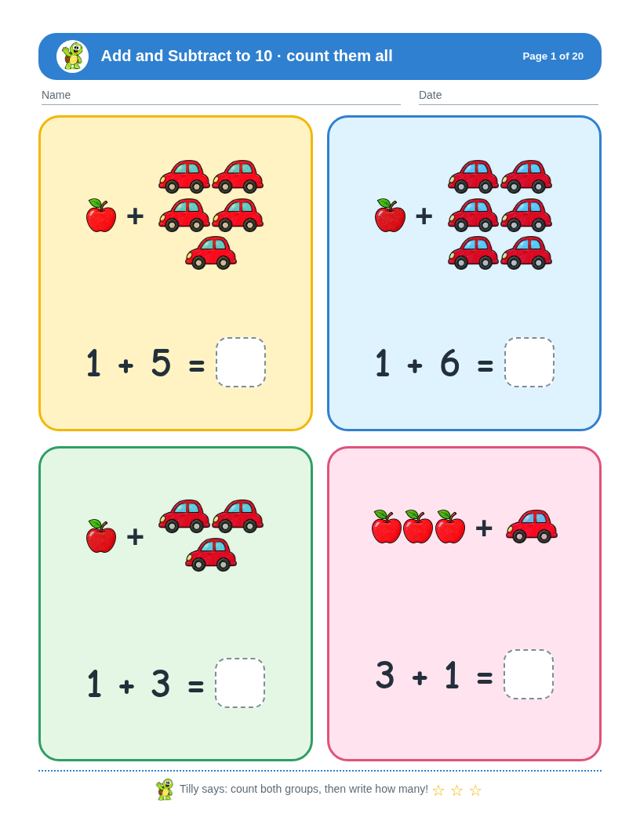
 Math Path · Levels 6 to 7
Addition and subtraction within 10 worksheets with pictures and a number line.
See inside $3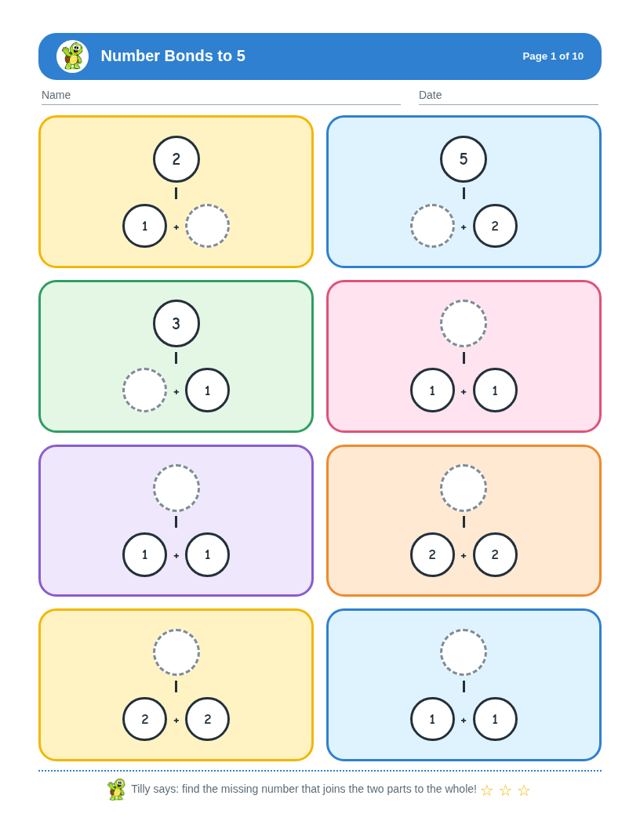
All 4 number bonds worksheet packs in one download.
See insideMany US schools expect adding and taking away within 10, and sums within 5 quickly, by the end of kindergarten.
Yes, at first. Fingers are a tool. Knowing facts by heart comes later with practice.
Soon after adding, also with real things: five apples, eat two, how many left?
Adding needs counting to be easy first. Practice one touch, one number, then act sums out.
 Addition and SubtractionMy Child Does Not Understand Subtraction: What to DoFind out why subtraction confuses many young children, and try hands-on steps this week using objects, a number line, and addition facts.Read the guide
 Learn to ReadDoes Phonics Help With Speech Delay?Does phonics help with speech delay? What reading practice can and cannot do for a child who talks late, and why to see a speech-language pathologist.Read the guide
 Alphabet and HandwritingHandwriting Help for Kids With DysgraphiaHandwriting help for kids with dysgraphia at home: short practice, letter starts, wide lines, and other ways to write. When to ask for an evaluation.Read the guide
The packs on this site are free. The One Sheet goes further: one sheet a day, made for your child from what you tell us happened.
See The One Sheet · $9.99 a month
Or try the 10-day plan: Count It Up, $19 one timeOr do the free 3-minute check first