
Home › Guides › Addition and Subtraction
Home › Guides › Addition and Subtraction
 Detective HootSee every case →
How do I teach my kindergartener to take away?What we found: the short answer
Here is how to teach subtraction to kindergarten children: start with real objects and take some away. Five apples, eat two, how many are left? Act out short stories, then count back on a number line. Link each fact to an adding fact your child already knows.
By Julz, founder of Sound It Out. Updated 2026-10-15.
US kindergarten standards ask children to solve take away problems within 10, using objects, drawings or acting out.
They also ask children to add and subtract within 5 fluently by the end of the year.
At this age, subtraction means taking away, finding how many are left, and comparing which group has more.
The minus sign and number sentences come after the idea is clear with objects.
Many children find subtraction harder than adding at first. That is normal.
At home, you do not need worksheets to start. Snacks, toys and everyday moments give plenty of subtraction practice.
Comparing groups is another kind of subtraction. Ask: how many more red blocks than blue blocks?
Adding moves forward, like counting on. Subtraction moves backward, which feels less natural.
There are many words for it: take away, minus, how many are left, how many more. That can be confusing.
Children also need to hold the starting number in mind while things change.
Real objects make the change visible, so your child does not have to imagine it.
With practice, subtraction becomes just as easy as adding.
Use one clear word at first, take away, and add the others slowly. Mixing many words too early can make a simple idea feel hard.
Some children find taking away easier with a story than with numbers alone.
Step 1: put five blocks on the table. Take two away. Count how many are left together.
Step 2: say the story: five take away two leaves three.
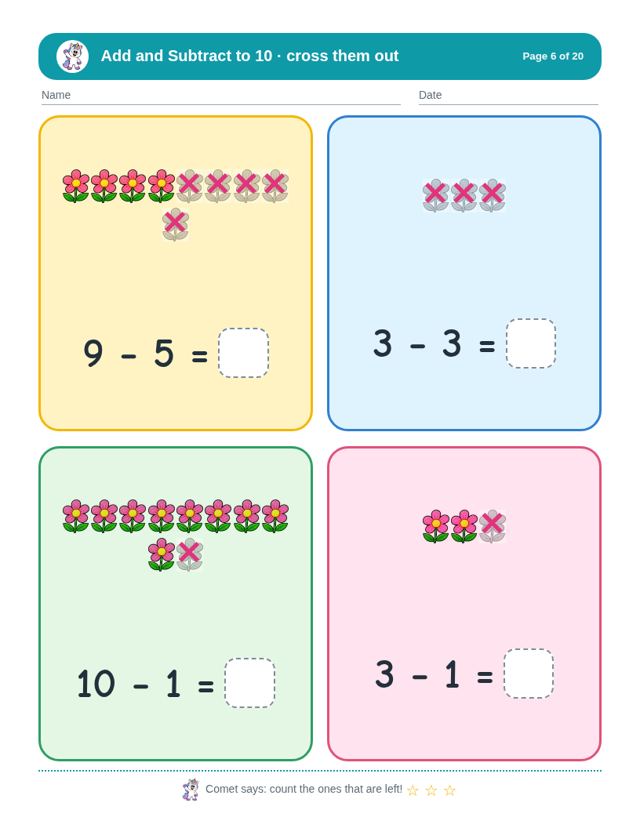
Step 3: draw it. Draw five circles and cross out two.
Step 4: write it: 5 minus 2 equals 3. Read the sentence together.
Step 5: practice small facts within 5 until they come quickly.
Here is an example of a full lesson. Show six cars. Drive two away. Count the cars left together, then draw six circles, cross out two, and write 6 minus 2 equals 4.
Let your child cross out pictures with a crayon. It shows clearly what was taken away.
Use stories about your child’s world. Four birds sit on a fence. One flies away. How many are left?
Let your child act it out with toys. Moving the toys makes the story clear.
Ask your child to make up a story too. Telling a story shows real understanding.
Use snack time: you have six crackers, you eat two. How many now?
Keep numbers small, so the story is the focus.
Good stories use familiar things: toys, snacks, pets and family. A story about the family dog eating two treats is more fun than a list of numbers.
Stories can also be about money: you have five pennies and spend two.
 Print free practice pagesFree pages from our packs, in color and in black and white.See the free pages
A number line shows numbers in order. Your child starts on 7 and jumps back 2 to land on 5.
Make a big number line on the floor with tape. Your child jumps backward along it.
Counting back works best with small numbers being taken away, like 1, 2 or 3.
Say the numbers out loud while jumping: seven, six, five.
This prepares your child for faster mental subtraction later.
Count back slowly at first. Many children skip a number when counting backward, so say each number clearly and point to it.
Mark the number line with big dots so jumps are easy to see.
Some children like to make their own number line with stickers from 0 to 10.
Every subtraction fact has a matching adding fact. If 3 and 2 make 5, then 5 take away 2 is 3.
Use number bonds to show both facts in one picture.
Ask: what do we add to 2 to make 5? That is the same as 5 take away 2.
Children who see this link need to learn fewer separate facts.
Practice adding and taking away side by side with the same numbers.
Here is a quick example: 2 and 3 make 5, so 5 take away 3 leaves 2. Show both with the same blocks.
Fact families show adding and taking away together with three numbers.
Bowling: set up ten cups, roll a ball, and count how many are still standing.
Snack math: start with a few crackers and eat some, saying the subtraction story.
Hide and count: hide some counters under a cup and ask how many were taken away.
Roll and take away: roll a die and take that many blocks from a tower.
Keep games short and celebrate careful thinking.
Games like these turn practice into play. Children often ask to play again, which means more practice without arguments.
Board games where pieces move backward are good practice too.
Monday: take away with blocks, numbers within 5, saying each story out loud. Tuesday: act out two or three stories with toys, then draw one of them and cross out the part taken away.
Wednesday: count back on a floor number line, taking away 1, 2 or 3. Thursday: link facts to adding with number bonds, using the same blocks for both.
Friday: play a game, such as bowling or roll and take away, and finish with a few facts written as number sentences.
Keep each day to about ten minutes. Repeat the week with numbers up to 10 once facts within 5 feel easy.
Take away: five blocks, take away two. This is the clearest phrase for young children.
Left: three birds flew away. How many are left?
Fewer: there are two fewer cookies now.
Minus: show it last, with the sign. Five minus two equals three.
Comparing is a different kind of subtraction. Line up five red blocks and three blue blocks, and ask how many more red blocks there are. Your child matches them one to one and counts the extra ones.
Use the same words in stories at home that the teacher uses in class. Ask the teacher which words come first, so your child hears them the same way in both places.
Go back to real objects. Many children need more time with things they can touch.
Use only numbers within 5 until the idea is clear.
Use one word, take away, until your child is comfortable, then add other words.
If counting back is hard, practice saying numbers backward from 10 first.
If math stays hard, a free math check can show which step needs work.
Watch how your child solves problems. If every problem is counted from the start, show counting back with small numbers.
If a game ends in frustration, switch to a story with objects.
Praise careful thinking more than right answers, so your child keeps trying.
Your child solves take away stories with objects or drawings.
Your child knows small facts within 5 quickly.
Your child explains what happened: I had five, I took two, now I have three.
Your child sees the link between adding and taking away.
Then your child is ready for subtraction within 10 and 20.
Keep practicing a little each day, even after your child understands. Facts within 5 become fast with regular short practice.
Write the facts your child knows on cards and review them.
 Start with real objects.
 Use short take away stories.
 Draw and cross out.
 Count back on a number line.
 Link each fact to adding.
 Keep numbers small at first.
Not sure where to start? Get a free plan for your child
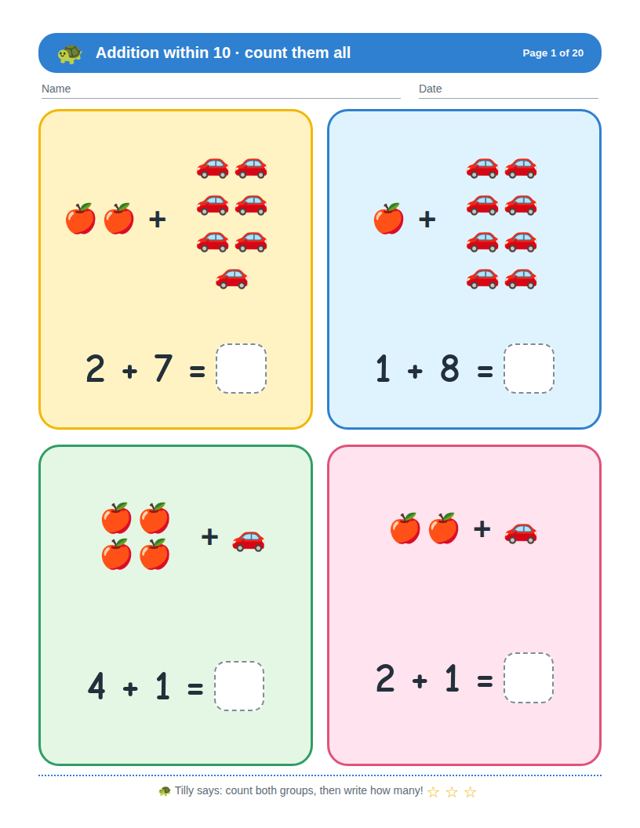
Want math practice planned for you?The One Sheet Math gives your child one math sheet a day, made from what you tell us about your child. From counting to adding and taking away.See The One Sheet MathAddition within 10 worksheets with pictures and a number line.
Get the free pages FREE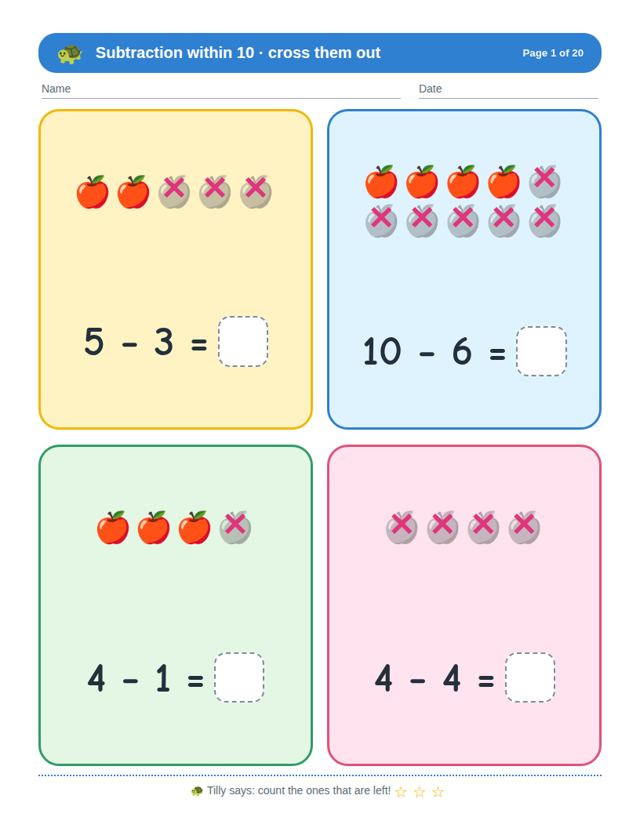
Subtraction within 10 worksheets with cross-out pictures and a number line.
Get the free pages FREE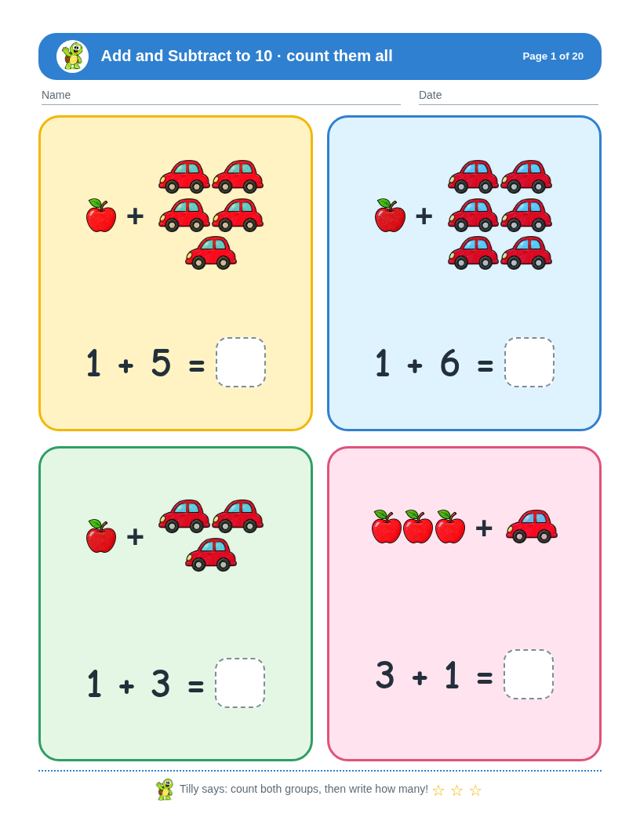
 Math Path · Levels 6 to 7
Addition and subtraction within 10 worksheets with pictures and a number line.
See inside $3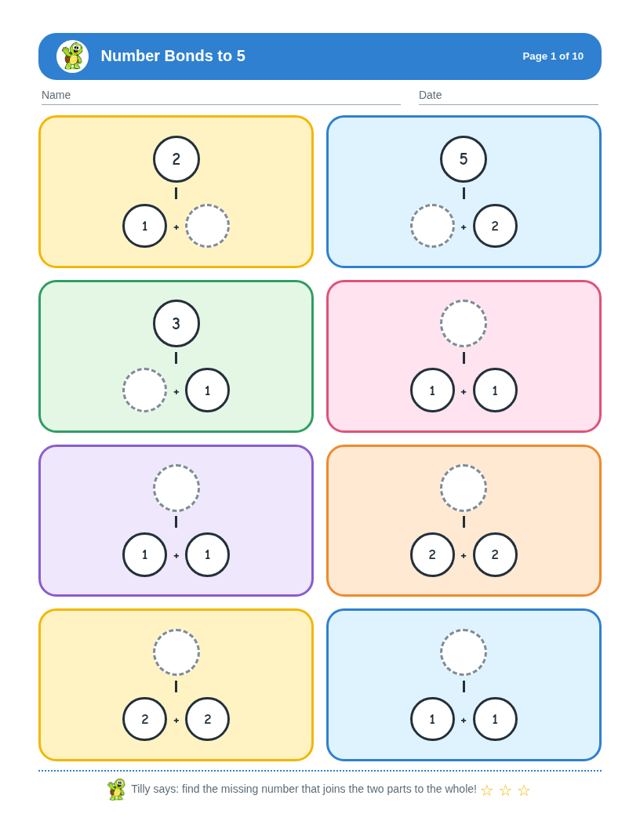
All 4 number bonds worksheet packs in one download.
See insideUse objects and stories. Say you have five apples and eat two, then ask how many are left. Let your child move the apples and count what remains.
Most start in kindergarten with take away problems within 10. By the end of the year, many know the facts within 5 quickly, and first grade builds on that.
Yes. Fingers are a natural tool at this age. Your child can hold up five fingers and fold down two to see what is left.
Short daily games with small numbers, linked to adding facts your child already knows. A few minutes a day works better than a long worksheet.
Say that minus means take away. Show 5 minus 2 with blocks first, then write the number sentence under the blocks and read it together.
For many children, yes, at first. Real objects, short stories and the link to adding facts make it much easier over time.
 Addition and SubtractionHow to Teach Number Bonds to KindergartenHow to teach number bonds to kindergarten children: split numbers into parts with real objects, use ten frames and bond pictures, and learn bonds to 10.Read the guide
 Addition and SubtractionHow to Teach Addition to KindergartenHow to teach addition to kindergarten children at home: start with real objects, count all, then count on, and learn the facts within 5 and 10.Read the guide
 Addition and SubtractionMy Child Does Not Understand Subtraction: What to DoWhat to do when your child does not understand subtraction: why it confuses young children, and hands-on steps with objects and a number line.Read the guide
The packs on this site are free. The One Sheet goes further: one sheet a day, made for your child from what you tell us happened.
See The One Sheet · $9.99 a month
Or get the Complete Kindergarten Bundle: 26 packs in one download for $3Is reading hard for your child? Find where to start