Home › The Reading Lab

Does phonics work?

What the studies found about sounding out words

The short answer

Does teaching a child to sound out words really help them read?

Yes, according to two large reviews. An expert panel found strong evidence for teaching children to blend letter sounds into words, to learn common spelling patterns and to recognize common words. The earlier National Reading Panel reached the same conclusion about systematic phonics.

What the research found

  • 6 × Strong evidence
  1. Eighteen studies of teaching children to decode words, analyze word parts and write words met the review's standards. Thirteen of them found positive effects on reading words, on spelling them, or on both.

  2. Eleven of those studies found positive effects on reading words, and four found positive effects on spelling.

  3. The children in the studies were in kindergarten through third grade. Eight studies looked at children at risk for reading difficulties, and others included children of all ability levels.

  4. The panel says this teaching can begin once a child knows a few consonants and vowels. Its first step is to teach children to blend letter sounds from left to right within a word.

  5. The panel's other steps are: teach common spelling patterns, teach common word parts, have children read decodable words alone and in text, teach common words so they are recognized quickly, and introduce the few words a text needs that cannot yet be sounded out.

  6. The National Reading Panel reported that its analysis showed systematic phonics instruction helps children succeed in learning to read.

What this means at home

  • Teach a few letter sounds, then start blending them into short words right away. Do not wait for the whole alphabet.
  • Blend from left to right, the same way every time.
  • Give your child words and short sentences made only of sounds they have been taught.
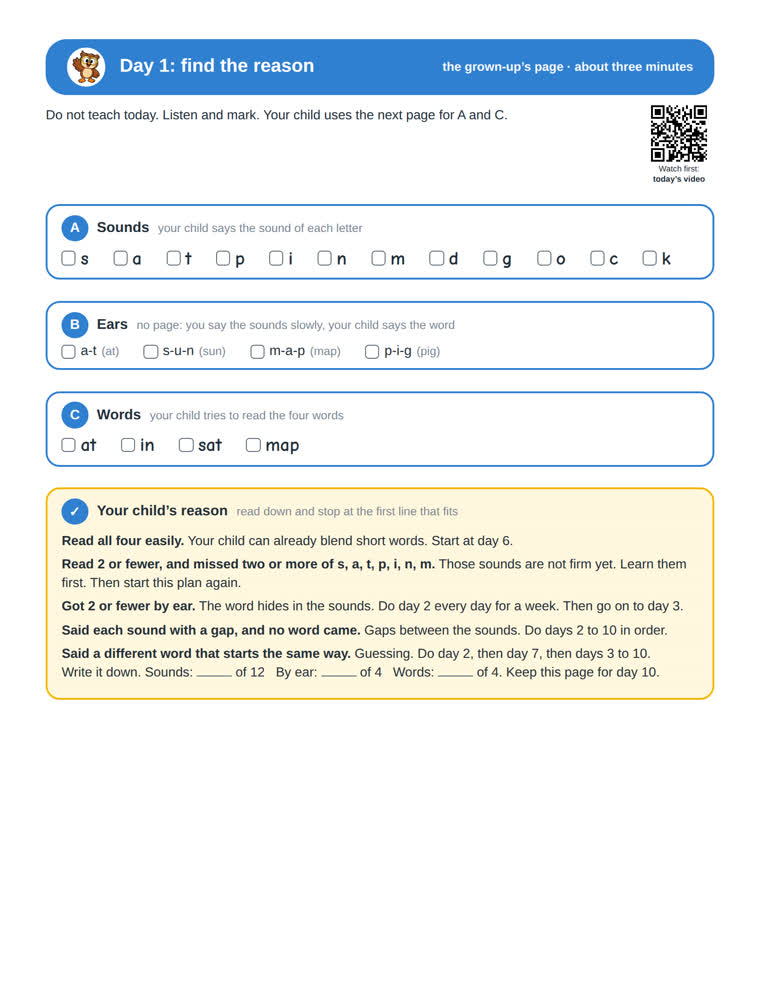
  • If your child knows the sounds but cannot put them together, the free blending check points to the likely reason.

What the research does not tell us

  • Thirteen of the eighteen studies found positive effects. This page does not report what the other five found, because the summary we read does not say.
  • All of the studies took place in schools. None tested parents teaching at home.
  • No study that met the standards measured what children learned about word parts and their meanings.
  • A review of many children cannot say how quickly any one child will learn.

Sources

We read each of these ourselves on October 9, 2026. Follow the links to read them too.

  1. Foundational Skills to Support Reading for Understanding in Kindergarten Through 3rd Grade. Barbara Foorman (panel chair) and others, for the What Works Clearinghouse, Institute of Education Sciences, U.S. Department of Education. 2016.A practice guide. An expert panel reviewed studies published since 2000 that met the Clearinghouse's standards, made four recommendations and rated the evidence behind each one.ies.ed.gov/ncee/wwc/PracticeGuide/21
  2. Report of the National Reading Panel: Teaching Children to Read. National Reading Panel, Eunice Kennedy Shriver National Institute of Child Health and Human Development. 2000.A review of the research on teaching reading, asked for by the U.S. Congress. The findings are summarized on the institute's own page, which is what we read.www.nichd.nih.gov/publications/pubs/nrp/findings

How we write these pages

  1. We read the source itself, not a news story about it.
  2. Every finding on a page names its source and where in the source it is found, so you can check it.
  3. We say how strong the evidence is, in the words of the people who reviewed it.
  4. We say what the research does not tell us. Most studies are done in schools, and no study can say what one child needs.
  5. If we get something wrong, tell us at hello@sounditoutreading.com and we will correct the page.

More from The Reading Lab

See all the research pages

More than worksheets

Does this sound like your child?

“Knows the sounds, but cannot put them together into a word”

From Sounds to Words is a full 10-day plan, with a short video that shows you every step. The goal: on day 10 your child reads words they have never seen before. It is the goal, not a promise.
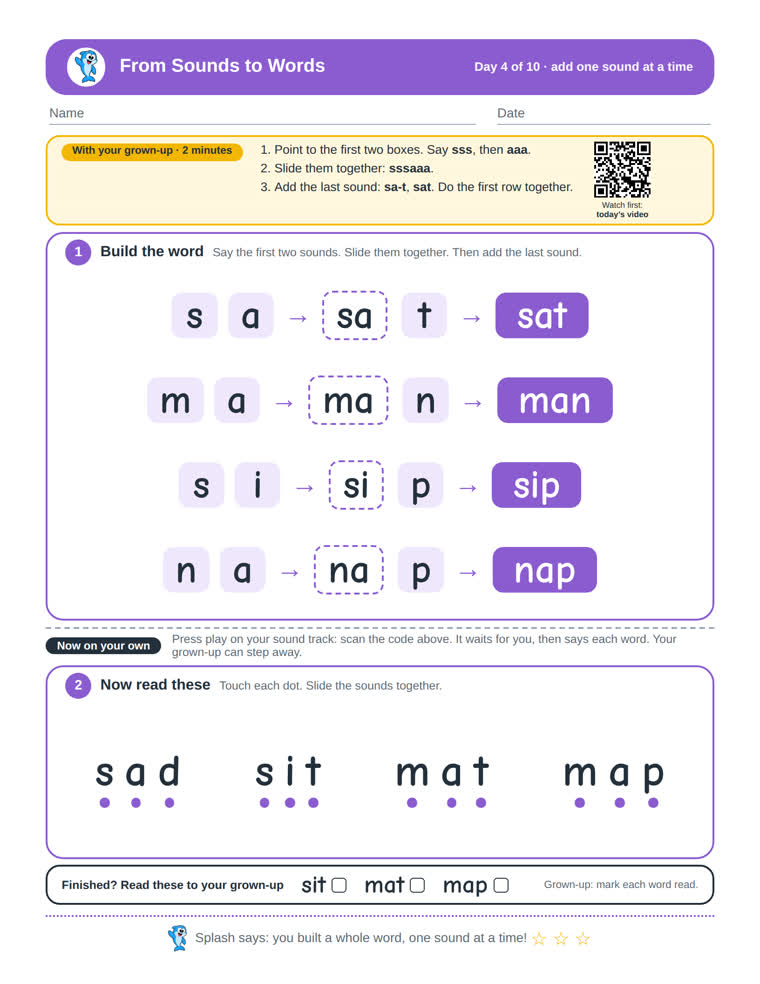
  • 21 printable pages, one short day at a time
  • 11 short videos that show you each day before you do it
  • 6 sound tracks your child works with alone, while you step away
  • A check on day 1 and day 10, and a report
  • About five minutes a day from you
  • $19, one payment. 30-day money back.

See the 10-day plan →Or do the free 3-minute check first