Home › The Reading Lab

Mixing up b and d

What an expert panel advises, and when to look closer

The short answer

Is it normal for a child to mix up b and d, and what helps?

An expert panel of reading researchers says mixing up letters such as b and d is common among children in the early grades. Its advice is to teach one of the two letters until the child knows it instantly, before bringing in the other. This is the panel's advice. It was not tested in a trial of its own.

What the research found

  • 5 × Expert advice, not a trial
  1. The panel says letter reversals, such as confusing d for b, are common among children in the early grades.

    Expert advice, not a trialSource 1, Obstacle 2.1, page 21
  2. Its advice is to focus on one letter at a time: teach the first letter shape in a variety of ways until the child can identify it instantly.

    Expert advice, not a trialSource 1, Obstacle 2.1, page 21
  3. Then teach another letter or two while still reviewing the first. After that, focus on the second of the confused letters on its own. Last, bring both letters into different words to make sure the child knows each one.

    Expert advice, not a trialSource 1, Obstacle 2.1, page 21
  4. If a child keeps struggling with reversals, the panel recommends a handwriting program, because writing a letter focuses the child's attention and hand-eye coordination on its shape.

    Expert advice, not a trialSource 1, Obstacle 2.1, page 21
  5. For some children, particularly older ones, continued problems with letter reversals can point to a disability or another reading difficulty that needs additional attention.

    Expert advice, not a trialSource 1, Obstacle 2.1, page 21

What this means at home

  • Do not teach b and d side by side. Pick one and stay with it until your child knows it at once.
  • Have your child write the letter, not only look at it.
  • If your child is older and still mixing letters up after steady practice, talk to the school.
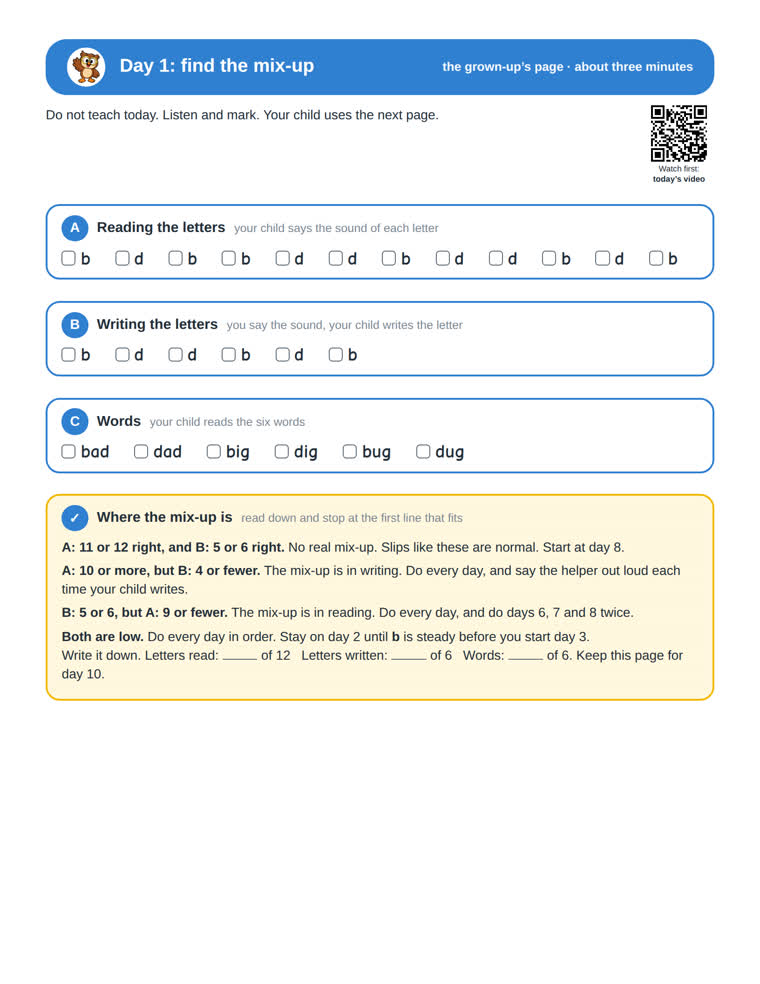
  • The free check for b and d shows whether the mix-up is in reading, in writing, or in both.

What the research does not tell us

  • This is expert advice from the panel. The guide does not report a study that tested this exact method against another one.
  • The panel's advice on reversals does not give an age at which they should have stopped.
  • A page like this cannot tell you whether your child has a reading disability. Only an assessment can.

Sources

We read each of these ourselves on October 9, 2026. Follow the links to read them too.

  1. Foundational Skills to Support Reading for Understanding in Kindergarten Through 3rd Grade. Barbara Foorman (panel chair) and others, for the What Works Clearinghouse, Institute of Education Sciences, U.S. Department of Education. 2016.A practice guide. An expert panel reviewed studies published since 2000 that met the Clearinghouse's standards, made four recommendations and rated the evidence behind each one.ies.ed.gov/ncee/wwc/PracticeGuide/21

How we write these pages

  1. We read the source itself, not a news story about it.
  2. Every finding on a page names its source and where in the source it is found, so you can check it.
  3. We say how strong the evidence is, in the words of the people who reviewed it.
  4. We say what the research does not tell us. Most studies are done in schools, and no study can say what one child needs.
  5. If we get something wrong, tell us at hello@sounditoutreading.com and we will correct the page.

More from The Reading Lab

See all the research pages

More than worksheets

Does this sound like your child?

“Mixes up b and d”

Tell b from d is a full 10-day plan, with a short video that shows you every step. The goal: on day 10 your child tells b from d, in letters, in words never seen before, and in their own writing. It is the goal, not a promise.
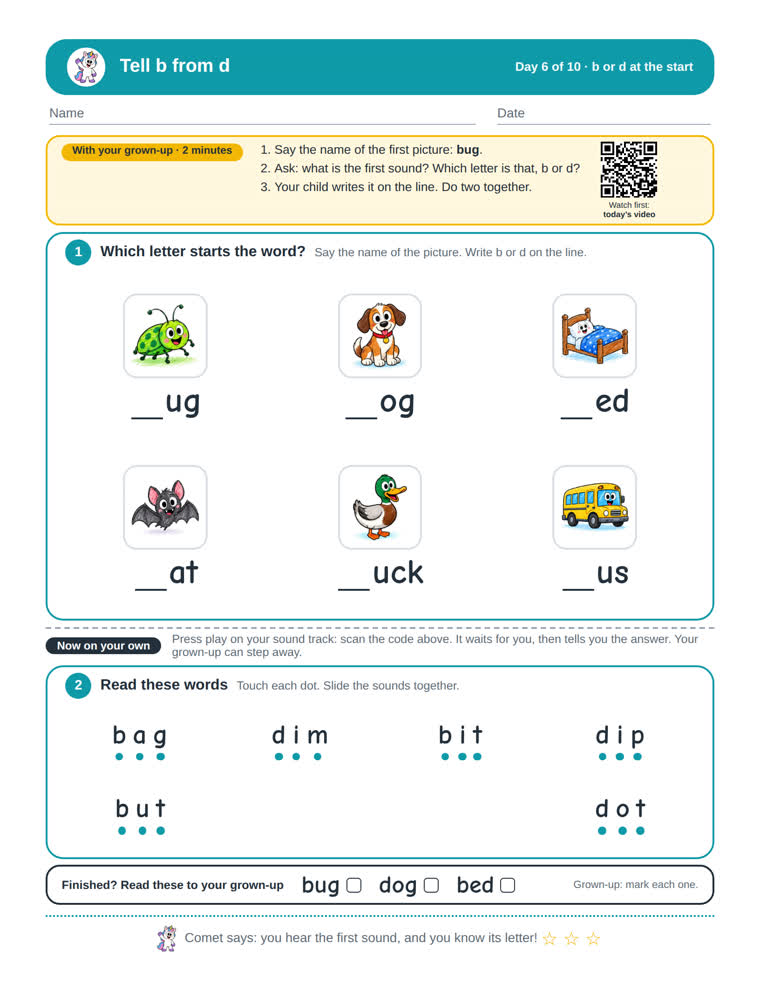
  • 21 printable pages, one short day at a time
  • 11 short videos that show you each day before you do it
  • 3 sound tracks your child works with alone, while you step away
  • A check on day 1 and day 10, and a report
  • About five minutes a day from you
  • $19, one payment. 30-day money back.

See the 10-day plan →Or do the free 3-minute check first