



Home › The Reading Lab

Hearing the sounds in words

Why the ears come into reading, and what the studies found

The short answer

Does it help to teach a child to hear the separate sounds in words?

Yes. An expert panel found strong evidence for teaching children to notice the separate sounds in spoken words and to link those sounds to letters. Seventeen studies met the review's standards, and all seventeen found positive effects.

What the research found

  • 6 × Strong evidence
  • 1 × Expert advice, not a trial
  1. Seventeen studies of teaching children to notice the segments of sound in words and to link sounds to letters met the review's standards. All seventeen found positive effects on knowing letter names and sounds, on awareness of sounds, or on both.

  2. The children in those studies were in kindergarten and first grade. Six studies included children at risk for reading difficulties, and eleven included readers at all levels.

  3. To read and spell words, the guide says a child must be able to pick out the separate sounds in a spoken word, name the letters, and know the sound or sounds of each letter.

  4. The guide says this teaching should begin as soon as possible. Once a child knows a few consonant and vowel sounds and their letters, they can start to sound out and blend those letters into simple words.

  5. The guide reports that being able to pick out sounds and link them to letters helps children read about 70 percent of regular one-syllable words, such as fish, sun and eat.

  6. Children who keep struggling to hear the sounds in words often benefit from one-to-one or small-group help, and the panel says early help can often put this right.

    Expert advice, not a trialSource 1, Obstacle 2.2, page 21
  7. The National Reading Panel reported that teaching children to work with the sounds in words was highly effective under a variety of teaching conditions.

What this means at home

  • Play sound games with no letters at all: say the sounds of a short word slowly and let your child say the word.
  • Ask for the first sound of a word, then the last sound, then all the sounds.
  • As soon as your child can hear the sounds, show the letters that go with them.
  • If your child cannot hear the sounds in words yet, the free listening check points to where to begin.

What the research does not tell us

  • The studies were done with children in kindergarten and first grade. They do not tell us about older children.
  • Twelve of the studies taught children in groups of two to eight, in addition to their normal lessons. That is not the same as a parent and one child at home.
  • These studies tell us what helped groups of children. They cannot say how long any one child will need.

Sources

We read each of these ourselves on October 9, 2026. Follow the links to read them too.

  1. Foundational Skills to Support Reading for Understanding in Kindergarten Through 3rd Grade. Barbara Foorman (panel chair) and others, for the What Works Clearinghouse, Institute of Education Sciences, U.S. Department of Education. 2016.A practice guide. An expert panel reviewed studies published since 2000 that met the Clearinghouse's standards, made four recommendations and rated the evidence behind each one.ies.ed.gov/ncee/wwc/PracticeGuide/21
  2. Report of the National Reading Panel: Teaching Children to Read. National Reading Panel, Eunice Kennedy Shriver National Institute of Child Health and Human Development. 2000.A review of the research on teaching reading, asked for by the U.S. Congress. The findings are summarized on the institute's own page, which is what we read.www.nichd.nih.gov/publications/pubs/nrp/findings

How we write these pages

  1. We read the source itself, not a news story about it.
  2. Every finding on a page names its source and where in the source it is found, so you can check it.
  3. We say how strong the evidence is, in the words of the people who reviewed it.
  4. We say what the research does not tell us. Most studies are done in schools, and no study can say what one child needs.
  5. If we get something wrong, tell us at hello@sounditoutreading.com and we will correct the page.

More from The Reading Lab

See all the research pages

More than worksheets

Does this sound like your child?

“Cannot tell me the first sound of a word, or cannot rhyme”

Ears First is a full 10-day plan, with a short video that shows you every step. The goal: on day 10 your child hears the sounds in a short word. They say how it starts, push three sounds together into a word, and pull a word apart into its sounds. It is the goal, not a promise.
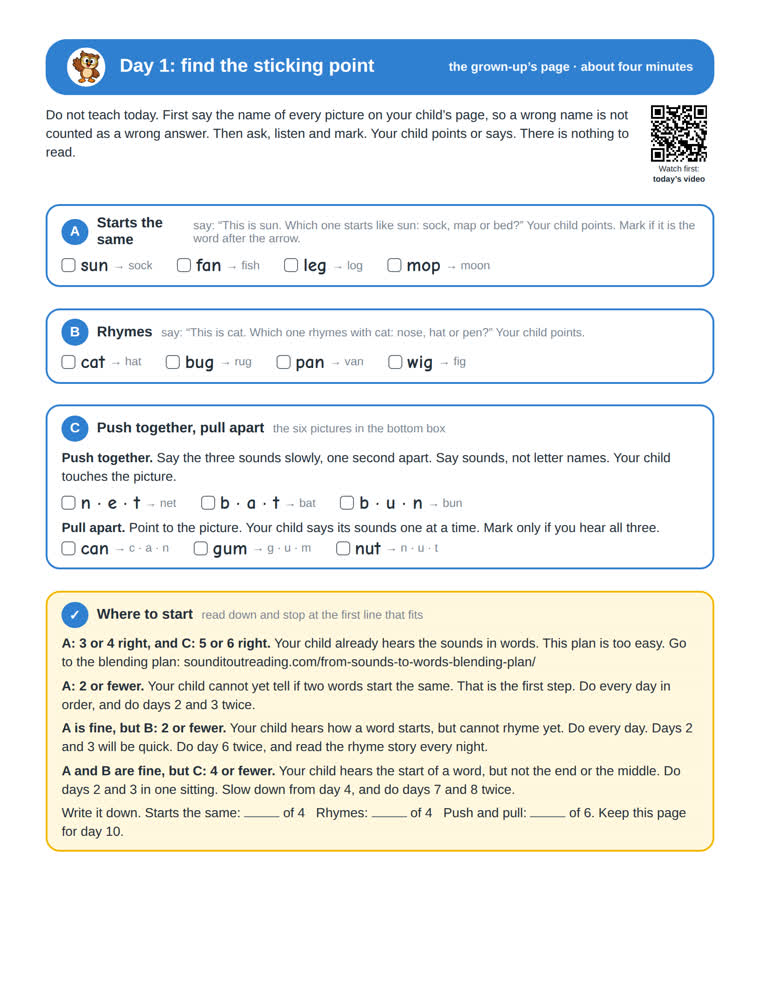
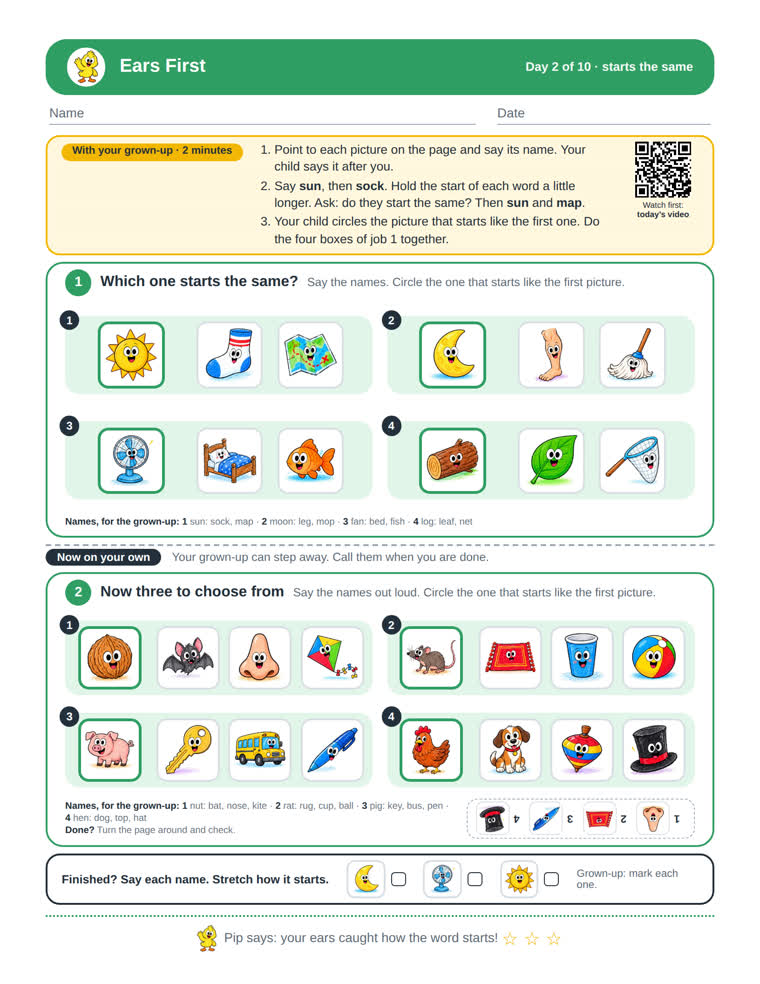
  • 22 printable pages, one short day at a time
  • 11 short videos that show you each day before you do it
  • 2 sound tracks your child works with alone, while you step away
  • A check on day 1 and day 10, and a report
  • About five minutes a day from you
  • $19, one payment. 30-day money back.

See the 10-day plan →Or do the free 3-minute check first