Home › Guides › Learn to Read
Home › Guides › Learn to Read
This is common. Many children can say letter sounds but have not yet learned to hear sounds separately inside a spoken word, which is a listening skill, not a reading skill. Start without letters: say a word out loud, like ‘sun’, and ask what sound you hear first. Practice this daily with simple words before adding letters back in.
This is common, and it does not mean your child is behind. Hearing the first sound in a word is a listening skill called phonemic awareness. It is different from knowing letter sounds, which is a reading skill. A child can know that the letter s makes the sound ‘sss’ and still not be able to pick that sound out of a spoken word like ‘sun’ without seeing the letter.
This skill usually comes before letters are even needed. Children hear whole words first, the way they always have, and have to learn to slow a word down and notice the separate sounds inside it. Without this skill, blending sounds into words and spelling by sound both stay hard, because both depend on hearing sounds as separate pieces, not as one solid chunk.
Before working on first sounds, your child should be able to say a short word clearly and repeat it back to you, such as ‘cat’ or ‘dog’. They do not need to know any letters yet. This skill works with spoken words alone, with eyes closed or the word never written down.
Try this check, it takes a few minutes. Say five words out loud, one at a time: sun, map, top, dog, fish. After each word, ask, ‘What sound do you hear first in sun?’ Listen for ‘sss’, not the word ‘sun’ repeated, not a guess, and not the letter name ‘s’. If your child answers two or more correctly, they are ready to practice. If not, start at step one below.
Say a single sound by itself, held for a second, like ‘mmm’, ‘sss’, or a short ‘t’. Ask your child to copy the sound back to you. Do this with sounds they already know from letters, such as s, a, t, p, m, and n, but say them as sounds only, never as letter names.
Then say a word slowly, stretching the first sound: ‘mmm-op’ for mop, ‘sss-un’ for sun, ‘ttt-op’ for top. Ask, ‘What is the first sound you hear?’ Praise the sound itself, not the guess: say ‘Yes, mmm, like mop.’ Example words to use this week: mop, sun, top, pin, dog, fan, bus, hat.
Pick five objects around the house or on a table: a cup, a sock, a ball, a pen, a bag. Say each word slowly and ask your child to tell you the first sound, not the letter. For cup, the answer is ‘k’, for sock, ‘sss’, for ball, ‘b’, for pen, ‘p’, for bag, ‘b’.
Make it a game: hide one object and say, ‘I am thinking of something that starts with mmm.’ Let your child guess mop, map, or milk. Switch roles so your child picks the sound and you guess. This keeps the sound in spoken language only, away from letters, which is exactly the skill being built.
 Practice this in the free reading appReading games your child can play on a phone, tablet or computer. Every word can be sounded out. No sign-up.Open the app
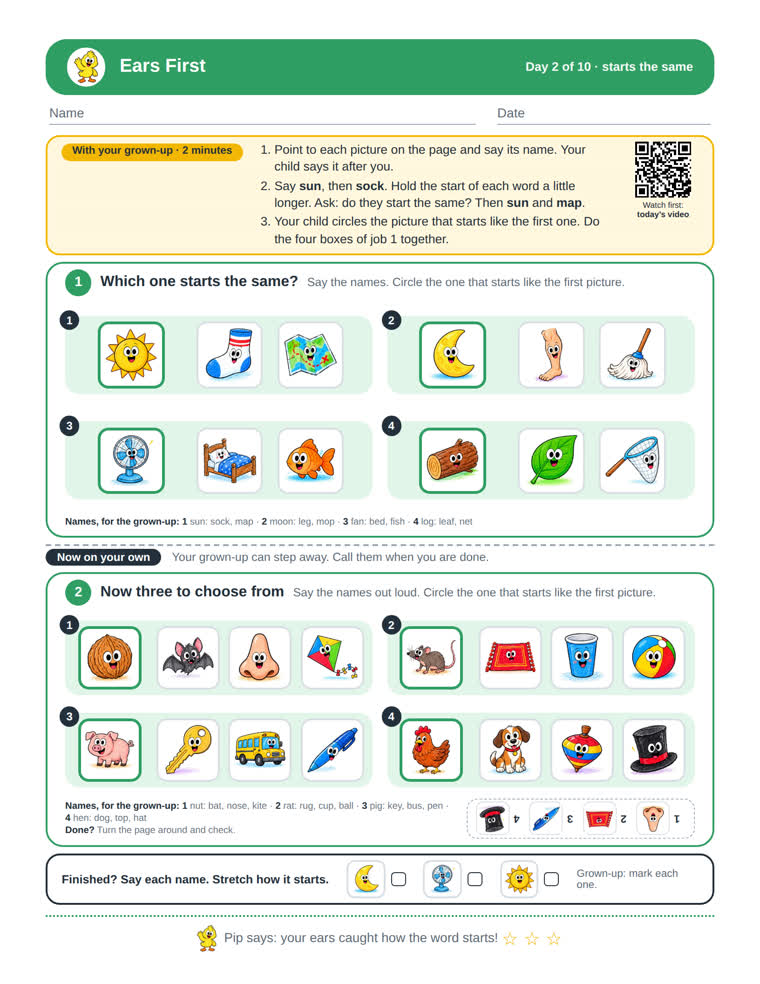
Say two words and ask if they start with the same sound: ‘sun’ and ‘sock’ (yes), ‘sun’ and ‘dog’ (no). Use pairs like man and mop (yes), top and bus (no), fan and fish (yes), pin and cup (no), dog and dig (yes).
If your child says no when the answer is yes, say both words again slowly, stretching the first sound: ‘sss-un, sss-ock, same sound, sss.’ Do not move to a new pair until the current one is clear. Five pairs a day is enough, more than that becomes tiring and stops helping.
Once your child can hear first sounds reliably in spoken words, bring back the letter. Show the letter s and say, ‘This letter makes the sound sss. Sun starts with sss, so sun starts with this letter.’ Do this with letters already being taught: s, a, t, p, i, n, m, d.
Keep the order the same every time: say the word, find the first sound, then show the matching letter. Never reverse it by starting with the letter name and asking for the sound, since that skips the listening step this guide is building and goes back to guessing.
The most common problem is that a child says the letter name instead of the sound, such as saying ‘ess’ instead of ‘sss’ for sun. Fix this by modeling only the sound every time, and gently say, ‘Just the sound, like this: sss,’ then try again.
Another common problem is that a child repeats the whole word back instead of pulling out the first sound, saying ‘sun’ when asked what sound sun starts with. Slow the word down yourself first, stretching it out loud, before asking the question again.
A third problem is rushing to letters before the sound is solid. If your child mixes up first sounds once letters are added back in, go back to spoken words only for a few more days before trying letters again.
A few minutes a day is enough, done once or twice daily. A normal week might look like this: Monday and Tuesday for sounds alone, step one. Wednesday for the object game, step two. Thursday for matching pairs, step three. Friday for bringing back letters, step four. Repeat earlier days if a day was hard.
Keep sessions short and end while your child is still enjoying it, even after just a few words. Mix in sounds your child already knows well with the newer ones, so the practice feels doable and not only hard. Children differ in how many days this takes, and that is normal.
Your child is ready to move on when they can hear the first sound in a new word they have not practiced before, not just the ones used in practice. Try a word you have not used yet, like ‘leg’ or ‘wet’, and check if they can pick out the first sound without help.
Once that is solid, move to blending those first sounds with the rest of the word, such as turning ‘sss’ plus ‘un’ into ‘sun’. If your child is seven or older and still cannot hear first sounds after steady practice, tell the teacher so they can check further.
 Always say the sound, never the letter name, until letters are brought back in step four.
 Keep each practice session to a few minutes so your child stays interested.
 Use words your child already knows how to say correctly, since mispronounced words make the sound harder to hear.
 Stretch the first sound out loud yourself before asking your child to find it.
 Praise the sound your child gives, not just a correct guess.
 Mix in easy, already mastered sounds with new ones so practice does not feel discouraging.
 Do this skill with spoken words only before tying it to any letter.
 Word ChainsOne sound changes each time: map, mad, mud. Your child spots what changed and reads the new word.Play free
 Listen and Say the WordYou say the sounds slowly, your child says the whole word. No letters to look at, so it trains the ear first.Play freeBuild the WordYour child hears a word and taps the letter tiles in the right order to build it.Play free
Short a words worksheets, CVC word family practice.
Get the free pages FREE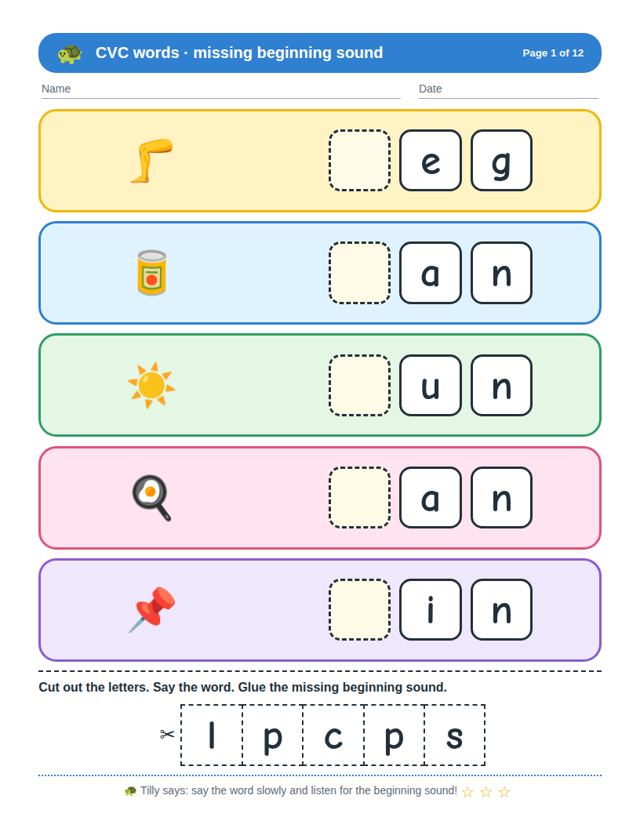
CVC cut and paste worksheets for beginning, middle and ending sounds.
Get the free pages $3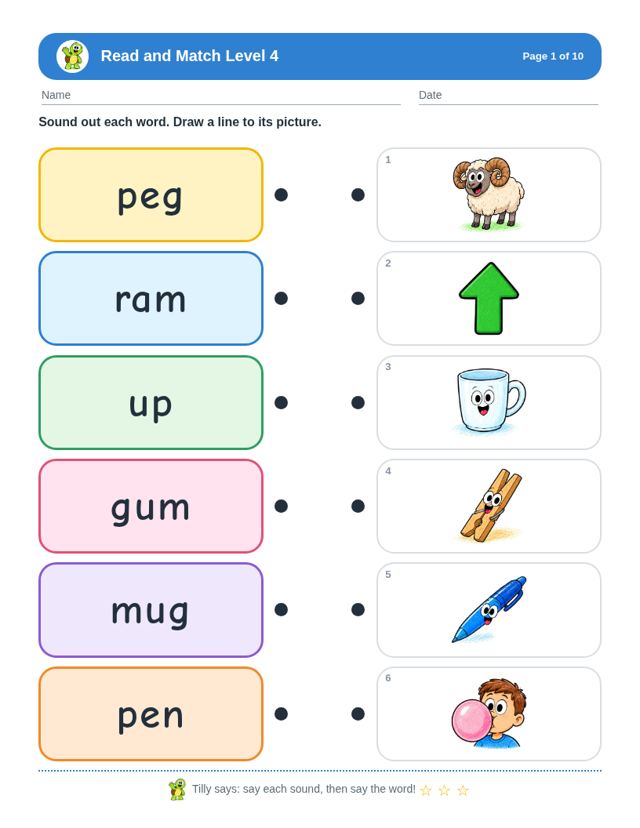
All 5 read and match level worksheet packs in one download.
See inside $3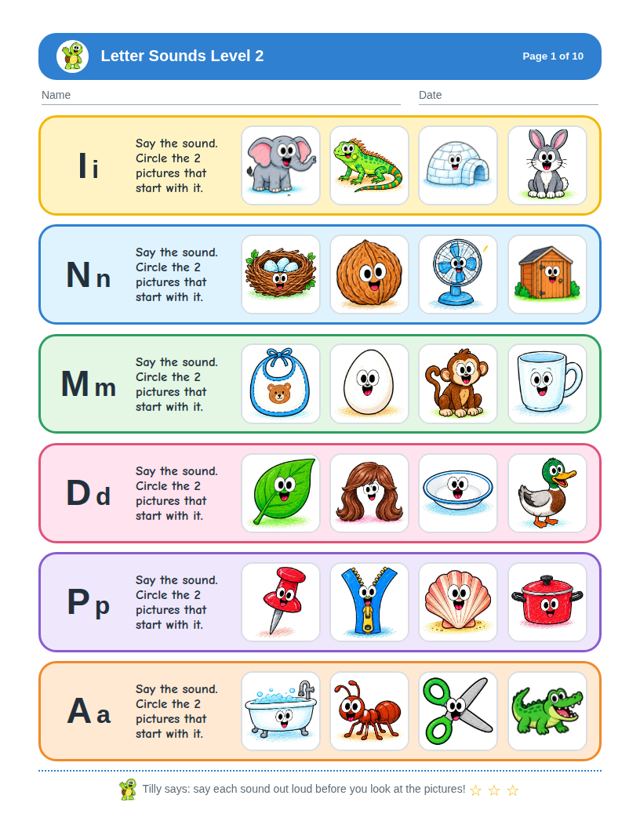
All 7 letter sounds level worksheet packs in one download.
See insideNo. Knowing a letter sound, like s makes ‘sss’, is different from hearing that sound inside a spoken word. A child can know both and still need practice connecting them, which is exactly what this skill builds.
Many children can hear first sounds in simple words during kindergarten, but children differ, and some need more practice than others. There is no single age this must happen by, so keep practicing steadily rather than worrying about timing.
No. Use only the sound, such as ‘sss’, not the letter name ‘ess’, until your child can hear first sounds reliably in spoken words. Letter names can be taught separately and do not help this particular skill.
Finish the first sound skill fully before adding last sounds. Last sounds are harder to hear and should be practiced the same way, word by word, once the first sound is solid and easy.
Yes. All of this practice can be done out loud, with spoken words and everyday objects, no paper or letters needed. Letters are only added in the last step, once the listening skill itself is solid.
 Learn to ReadMy Child Knows Sounds but Cannot Blend: What to DoYour child knows the letter sounds but cannot blend them into words. Here is why this happens and exactly what to do this week.Read the guide
 Learn to ReadMy Child Guesses Words Instead of Sounding OutLearn why kids guess at words instead of sounding them out, and get four simple steps, with example words, to build real sounding-out skills.Read the guide
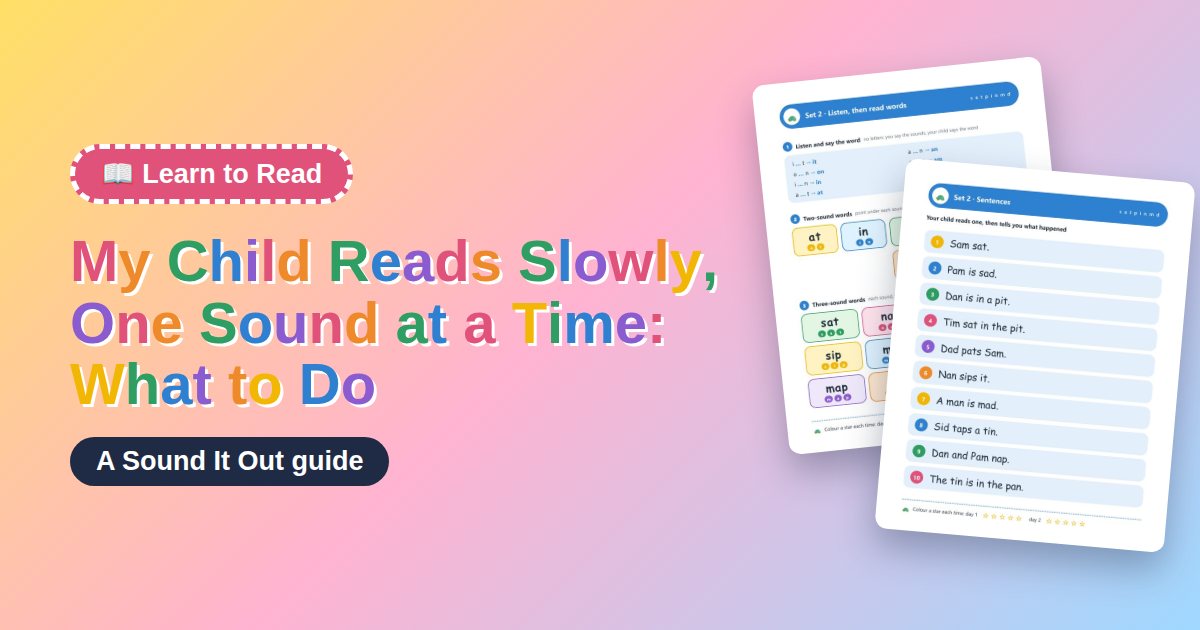 Learn to ReadMy Child Reads Slowly, One Sound at a Time: What to DoLearn why your child reads one sound at a time instead of smoothly, and simple steps to make reading smoother, with no timing.Read the guide
“Cannot tell me the first sound of a word, or cannot rhyme”
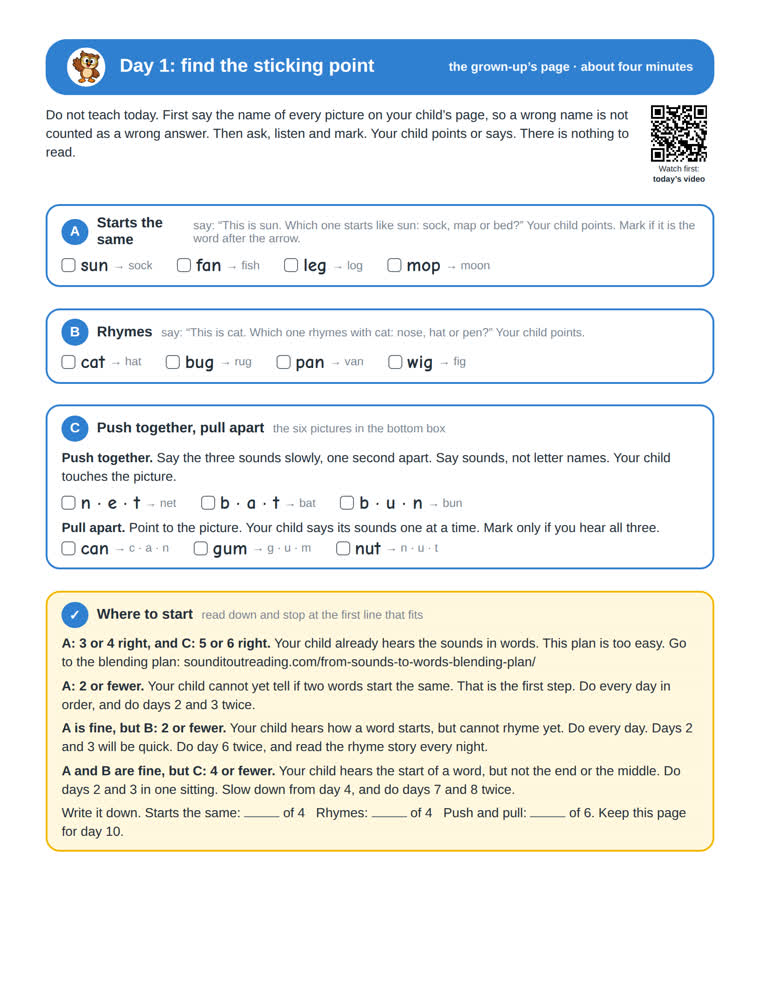
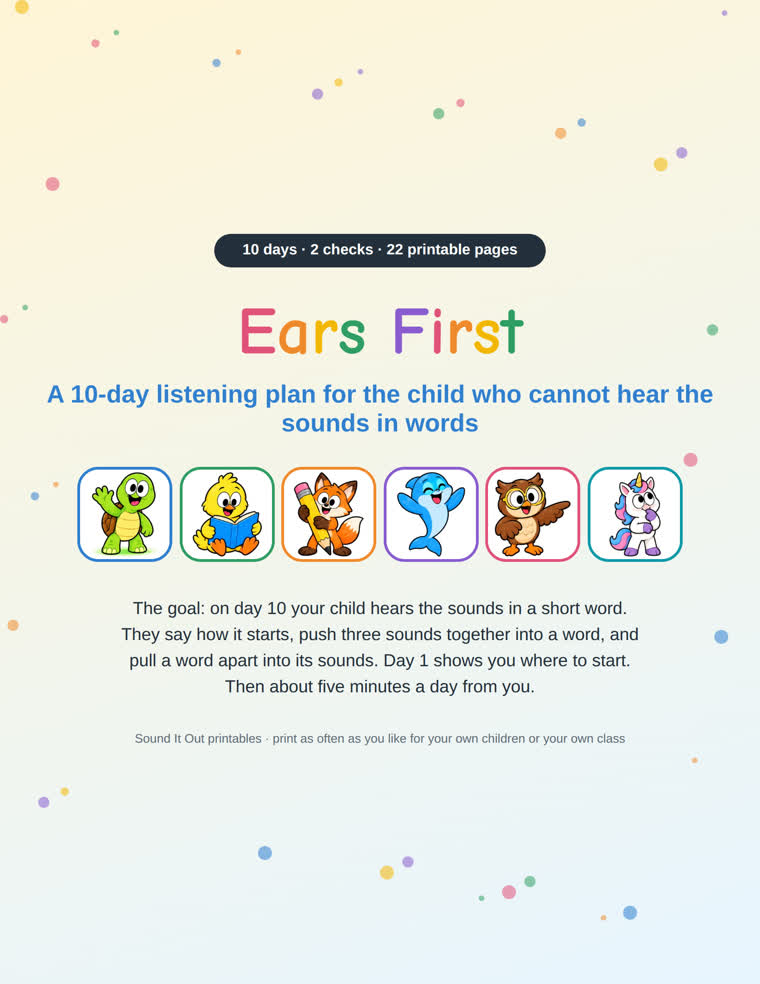
Ears First is a full 10-day plan, with a short video that shows you every step. The goal: on day 10 your child hears the sounds in a short word. They say how it starts, push three sounds together into a word, and pull a word apart into its sounds. It is the goal, not a promise.